Sri Lanka Thermal Paper Market Size, Share & Growth Rate
The Sri Lanka Thermal Paper Market was estimated at USD 271 Million in 2025 and is projected to reach USD 360 Million by 2032, growing at a CAGR of 4.1% from 2026 to 2032. This growth trajectory is propelled by the expanding applications of thermal paper across diverse industries such as retail, healthcare, and transportation. The increasing emphasis on operational efficiency and sustainability is further driving adoption, as businesses pivot towards cost-effective and eco-friendly printing solutions.
Sri Lanka Thermal Paper Market Year-wise Growth Rate and Key Drivers
This graph highlights how the Sri Lanka Thermal Paper Market has steadily grown over the years, supported by major growth factors.
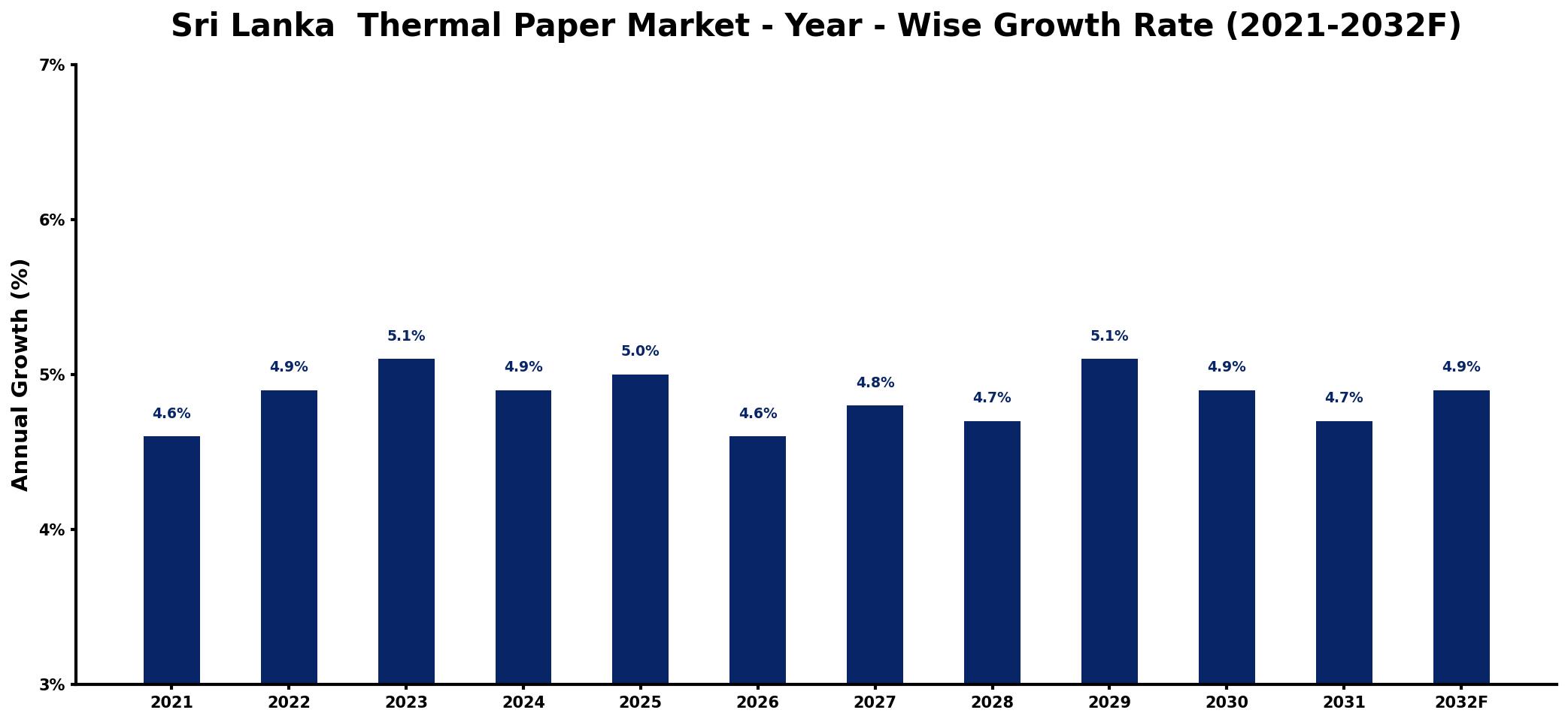
The table below presents the year‑wise growth rates along with the key drivers influencing the market
| Year | Growth Rate | Major Drivers |
| 2021 | 4.6% | Rising retail sector demand |
| 2022 | 4.9% | Expansion in hospitality industry |
| 2023 | 5.1% | Growth of e-commerce platforms |
| 2024 | 4.9% | Increased investment in technology |
| 2025 | 5.0% | Surge in food service industry |
| 2026 | 4.6% | Advancements in printing solutions |
| 2027 | 4.8% | Higher consumer spending patterns |
| 2028 | 4.7% | Boom in logistics operations |
| 2029 | 5.1% | Development of smart devices |
| 2030 | 4.9% | Increase in event management |
| 2031 | 4.7% | Growth in healthcare services |
| 2032 | 4.9% | Rising trends in automation |
Note: Market size estimations and growth projections presented in this report are based on 6Wresearch's proprietary forecasting methodology, utilizing the latest available industry data, government publications, and primary research inputs.
Sri Lanka Thermal Paper Market Synopsis
The Sri Lanka Thermal Paper Market is currently witnessing a robust period of growth, characterized by heightened demand driven by the essential needs of various sectors. However, as the market matures, it is expected to adapt to new technological advancements and consumer preferences that prioritize sustainability and innovation.
Future prospects suggest that while traditional applications continue to thrive, emerging trends towards digitalization and eco-friendly alternatives will shape the trajectory of the market. Companies are urged to innovate continually to stay relevant in this evolving landscape, ensuring they meet the diverse requirements of a growing customer base.
Sri Lanka Thermal Paper Market Key Takeaways
- The market is poised for steady growth as industries increasingly adopt thermal paper solutions.
- Environmental sustainability and the demand for eco-friendly products are gaining significant traction.
- Investment in research and development for innovative products is essential to meet market demands.
- Digitalization trends are influencing the overall dynamics of thermal paper consumption.
- The governments supportive policies bolster market stability and encourage sustainability initiatives.
Evaluation of Restraints in Sri Lanka Thermal Paper Market
The Sri Lanka Thermal Paper Market is grappling with several restraints that could limit its growth potential. One of the prominent constraints is the increasing reliance on digital documentation, which diminishes the necessity for physical receipts and labels. Additionally, fluctuating raw material prices, particularly for the chemicals used in paper production, contribute to cost volatility, affecting manufacturers' pricing strategies. Environmental concerns surrounding traditional thermal papers also pose a challenge, as stakeholders seek alternatives that are less harmful to both health and the environment, urging the industry to pivot towards more sustainable solutions.
Sri Lanka Thermal Paper Market Trends
Currently, there is a noticeable shift towards eco-friendly thermal paper products. Both consumers and businesses are expressing a growing preference for alternatives that are free from harmful chemicals such as BPA and are recyclable. Additionally, the trend towards digitalization is reshaping the demand landscape, with more businesses exploring electronic receipts and other digital solutions. As this evolution occurs, manufacturers are prioritizing the development of high-quality, durable thermal paper that meets both the eco-friendly and functional needs of their clients.
Sri Lanka Thermal Paper Market Opportunities
The market presents numerous investment opportunities, particularly in the production of high-quality thermal paper rolls, receipts, and labels tailored to various industries. There is also a significant potential for developing innovative, eco-friendly thermal paper solutions that cater to the growing consumer demand for sustainability. Collaborations with technology partners to enhance product offerings and improve distribution channels can lead to competitive advantages and capture greater market share.
Government Initiatives in the Sri Lanka Thermal Paper Market
The Sri Lankan government is actively promoting environmental sustainability through policies aimed at reducing the ecological impact of thermal paper production and usage. Regulations encourage manufacturers to adopt eco-friendly materials and comply with established quality standards. These initiatives not only protect consumer health but also spur research and innovation within the thermal paper sector. Such a regulatory environment fosters a balance between economic growth in the thermal paper industry and adherence to environmental preservation principles.
Future Insights of the Sri Lanka Thermal Paper Market
Looking ahead to the 2026-2032 period, the Sri Lanka Thermal Paper Market is expected to experience continuous growth fueled by expanding applications across numerous sectors. The ongoing digital transformation and government-supported modernization initiatives will likely create additional demand for thermal paper products. Despite potential setbacks from the shift towards digital receipts and heightened environmental scrutiny, the overall outlook remains optimistic. The market is poised for advancements in technology and sustainability, indicating a robust future.
Sri Lanka Thermal Paper Market Latest Developments (2025 - 2026)
Recent industry movements indicate a strong focus on sustainability and innovation. Manufacturers are increasingly investing in eco-friendly alternatives to traditional thermal paper. Furthermore, collaborations within the sector are becoming more common as companies seek to enhance product performance and distribution efficiency. Additionally, there is a noticeable rise in public and private sector initiatives aimed at encouraging digitalization, which is reshaping the overall demand landscape for thermal paper products.
Sri Lanka Thermal Paper Market - Key Attractiveness of the Report
- 10 Years of Market Numbers
- Historical Data Starting from 2022 to 2025
- Base Year: 2025
- Forecast Data until 2032
- Key Performance Indicators Impacting the Market
- Major Upcoming Developments and Projects
Key Highlights of the Report:
- Sri Lanka Thermal Paper Market Outlook
- Market Size of Sri Lanka Thermal Paper Market, 2025
- Forecast of Sri Lanka Thermal Paper Market, 2032
- Historical Data and Forecast of Sri Lanka Thermal Paper Revenues & Volume for the Period 2022-2032F
- Sri Lanka Thermal Paper Market Trend Evolution
- Sri Lanka Thermal Paper Market Drivers and Challenges
- Sri Lanka Thermal Paper Price Trends
- Sri Lanka Thermal Paper Porter's Five Forces
- Sri Lanka Thermal Paper Industry Life Cycle
- Historical Data and Forecast of Sri Lanka Thermal Paper Market Revenues & Volume By Application for the Period 2022-2032F
- Historical Data and Forecast of Sri Lanka Thermal Paper Market Revenues & Volume By Point of Sale (PoS) for the Period 2022-2032F
- Historical Data and Forecast of Sri Lanka Thermal Paper Market Revenues & Volume By Tags & Labels for the Period 2022-2032F
- Historical Data and Forecast of Sri Lanka Thermal Paper Market Revenues & Volume By Lottery & Gaming for the Period 2022-2032F
- Historical Data and Forecast of Sri Lanka Thermal Paper Market Revenues & Volume By Others for the Period 2022-2032F
- Sri Lanka Thermal Paper Import Export Trade Statistics
- Market Opportunity Assessment By Application
- Sri Lanka Thermal Paper Top Companies Market Share
- Sri Lanka Thermal Paper Competitive Benchmarking By Technical and Operational Parameters
- Sri Lanka Thermal Paper Company Profiles
- Sri Lanka Thermal Paper Key Strategic Recommendations






































