Sri Lanka Thermostats Market Summary
The sri lanka thermostats market was estimated at USD 189 Million in 2025 and is projected to reach USD 246 Million by 2032, growing at a CAGR of 4.7% from 2026 to 2032.
Sri Lanka Thermostats Market Year-wise Growth Rate and Key Drivers
This graph highlights how the Sri Lanka Thermostats Market has steadily grown over the past five years, supported by major growth factors.
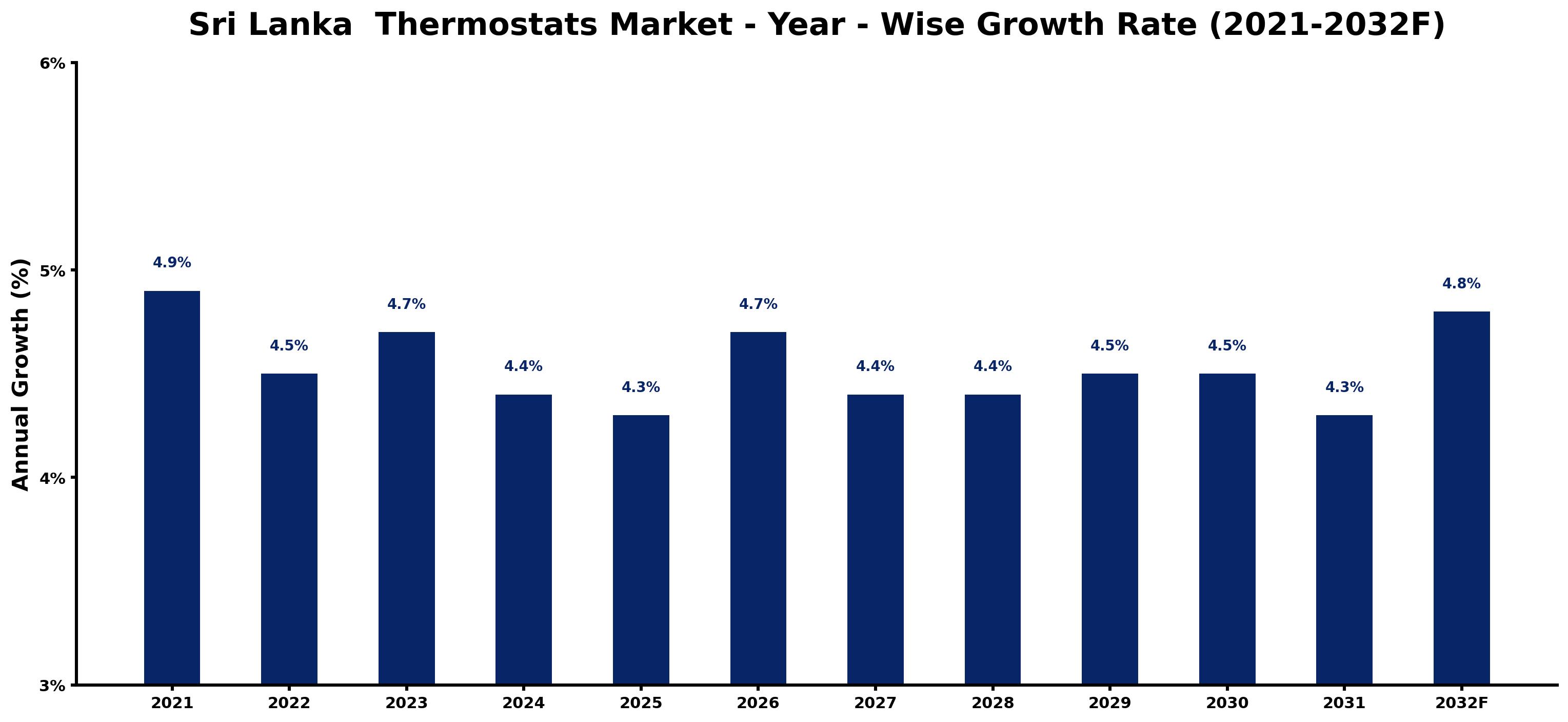
The table below presents the year wise growth rates along with the key drivers influencing the market
| Year | Growth Rate | Major Drivers |
| 2021 | 4.9% | Consumer interest in energy efficiency spurs thermostat market engagement across Sri Lanka. |
| 2022 | 4.5% | Technological innovations introduce smart thermostats, enhancing user experience and convenience. |
| 2023 | 4.7% | Rising urbanization trends lead to increased installation of HVAC systems in homes. |
| 2024 | 4.4% | Local manufacturers focus on affordability, expanding access to thermostat products nationwide. |
| 2025 | 4.3% | Climate change awareness prompts homeowners to consider energy-saving home solutions. |
| 2026 | 4.7% | Integration of IoT technologies in appliances creates demand for smart home systems. |
| 2027 | 4.4% | Growing construction projects in Colombo elevate demand for integrated climate control systems. |
| 2028 | 4.4% | Economic recovery post-pandemic drives consumer spending on home improvement products. |
| 2029 | 4.5% | Increased tourist arrivals boost hospitality sector investments in modern climate solutions. |
| 2030 | 4.5% | Home automation trends influence consumer preferences toward connected thermostat technologies. |
| 2031 | 4.3% | Partnerships with technology firms enhance product offerings and market penetration strategies. |
| 2032 | 4.8% | Shifts toward renewable energy source adoption change the landscape of thermostat utilization. |
Note - Market size estimations and growth projections presented in this report are based on 6Wresearch's advanced forecasting approach, validated with industry datasets as of June 2026.
Sri Lanka Thermostats Market Synopsis
The Sri Lanka Thermostats Market is projected to reach 4.7% and witness significant growth during the forecast period (2026-2032). The market is driven by a combination of technological advancements in HVAC systems and an increasing consumer focus on energy efficiency. As more households and commercial establishments embrace smart technologies, the demand for innovative thermostat solutions is expected to surge, offering opportunities for manufacturers and service providers alike.
Sri Lanka Thermostats Market Growth Drivers
Several factors are propelling the growth of the Sri Lanka thermostats market. Firstly, the rising adoption of smart home automation systems has led to a greater need for thermostats that integrate seamlessly with other smart devices. Secondly, ongoing government initiatives aimed at promoting energy efficiency have created a conducive environment for the expansion of this market segment. Thirdly, increased awareness among consumers about the benefits of programmable and smart thermostats is driving demand for more advanced solutions. Moreover, the growing emphasis on sustainability and reduced energy consumption in both residential and commercial sectors is further fueling the adoption of modern thermostat technologies. Lastly, advancements in wireless technology are facilitating easier access and control, making smart thermostats more appealing to the consumer base.
Sri Lanka Thermostats Market Trends and Opportunities
The Sri Lanka thermostats market is experiencing notable trends that present opportunities for growth. One significant trend is the shift toward smart thermostats that not only allow for remote temperature management via smartphone applications but also provide analytics for energy usage. Consumers are increasingly inclined to choose products that enable better control over their energy consumption, leading to cost savings. Another opportunity lies in the integration of thermostats with comprehensive home automation systems, which enhances user experience through customized heating and cooling settings. Additionally, there is a growing interest in thermostats equipped with air quality monitoring capabilities as consumers become more conscious about indoor air conditions. Overall, these trends underscore the necessity for innovation in thermostat design and functionality, indicating a ripe environment for investment and development.
Sri Lanka Thermostats Market Challenges and Restraints
Despite the promising growth prospects, the Sri Lanka thermostats market faces several challenges. A significant hurdle is the limited consumer awareness regarding the advantages of utilizing thermostats, which leads to slow adoption rates. Many potential customers are unaware of how thermostats can contribute to energy savings and enhanced comfort. Additionally, technological barriers such as inadequate infrastructure for smart HVAC systems may restrict the effective functioning of advanced thermostat technologies. Moreover, price sensitivity among consumers poses a challenge, particularly in a market where many are looking for cost-effective solutions. Regulatory obstacles may also hinder rapid expansion, necessitating a concerted effort to educate the market and improve accessibility of technology to facilitate growth.
Sri Lanka Thermostats Market Investment Opportunities
Investors are presented with significant opportunities within the Sri Lanka thermostats market owing to the escalating demand for energy-efficient solutions. The country's emphasis on sustainable living and energy conservation is creating a favorable atmosphere for new entrants focused on advanced thermostat technology. Opportunities for investment include supplying a range of products such as programmable and smart thermostats, which cater to the increasing consumer demand for enhanced control over their HVAC systems. Furthermore, collaborations with local HVAC service providers and property developers are a strategic approach to penetrate the market effectively. As urbanization continues to rise, along with ongoing developments in infrastructure, the potential for growth in the Sri Lanka thermostats market remains robust, making it a promising area for long-term investment.
Sri Lanka Thermostats Market Government Investment and Initiatives
The Sri Lankan government has embarked on various initiatives aimed at enhancing the thermostats market, emphasizing energy efficiency and sustainability. Policies have been introduced to regulate the importation of thermostats, ensuring adherence to quality standards that support consumer safety and product reliability. Furthermore, the government has implemented tariffs designed to protect local manufacturers, thereby promoting local entrepreneurship and production capabilities. Incentives for research and development in innovative thermostat technologies have also been established, encouraging companies to invest in developing advanced solutions. Overall, these initiatives reflect the government's commitment to fostering a competitive market while balancing consumer interests and environmental concerns.
Sri Lanka Thermostats Market Latest Developments (May 2025 - June 2026)
In the recent period from May 2025 to June 2026, the Sri Lanka thermostats market has displayed a range of developments reflecting an evolution towards more integrated and innovative solutions. The push for smart technology adoption has intensified, with an increasing number of products entering the market that offer enhanced connectivity features. Industry stakeholders are focusing on improving consumer awareness through educational campaigns that highlight the benefits of programmable and smart thermostats. Additionally, there have been visible shifts in product designs aimed at improving energy efficiency and indoor air quality. Companies are also exploring strategic collaborations with technology providers to enhance their offerings with IoT capabilities, ensuring that their products meet the growing consumer demands for convenience and functionality.
Sri Lanka Thermostats Market - Key Attractiveness of the Report
- 10 Years of Market Numbers
- Historical Data Starting from 2022 to 2025
- Base Year: 2025
- Forecast Data until 2032
- Key Performance Indicators Impacting the Market
- Major Upcoming Developments and Projects
Key Highlights of the Report:
- Sri Lanka Thermostats Market Outlook
- Market Size of Sri Lanka Thermostats Market, 2025
- Forecast of Sri Lanka Thermostats Market, 2032F
- Historical Data and Forecast of Sri Lanka Thermostats Revenues & Volume for the Period 2022-2032F
- Sri Lanka Thermostats Market Trend Evolution
- Sri Lanka Thermostats Market Drivers and Challenges
- Sri Lanka Thermostats Price Trends
- Sri Lanka Thermostats Porter's Five Forces
- Sri Lanka Thermostats Industry Life Cycle
- Historical Data and Forecast of Sri Lanka Thermostats Market Revenues & Volume By Products for the Period 2022-2032F
- Historical Data and Forecast of Sri Lanka Thermostats Market Revenues & Volume By Smart Thermostat for the Period 2022-2032F
- Historical Data and Forecast of Sri Lanka Thermostats Market Revenues & Volume By Mechanical Thermostat for the Period 2022-2032F
- Historical Data and Forecast of Sri Lanka Thermostats Market Revenues & Volume By Programmable Thermostat for the Period 2022-2032F
- Historical Data and Forecast of Sri Lanka Thermostats Market Revenues & Volume By Distribution Channel for the Period 2022-2032F
- Historical Data and Forecast of Sri Lanka Thermostats Market Revenues & Volume By Utility for the Period 2022-2032F
- Historical Data and Forecast of Sri Lanka Thermostats Market Revenues & Volume By Retail for the Period 2022-2032F
- Historical Data and Forecast of Sri Lanka Thermostats Market Revenues & Volume By Security for the Period 2022-2032F
- Historical Data and Forecast of Sri Lanka Thermostats Market Revenues & Volume By HVAC for the Period 2022-2032F
- Historical Data and Forecast of Sri Lanka Thermostats Market Revenues & Volume By Mode of Operations for the Period 2022-2032F
- Historical Data and Forecast of Sri Lanka Thermostats Market Revenues & Volume By Line Voltage for the Period 2022-2032F
- Historical Data and Forecast of Sri Lanka Thermostats Market Revenues & Volume By Low Voltage for the Period 2022-2032F
- Historical Data and Forecast of Sri Lanka Thermostats Market Revenues & Volume By Millivolt for the Period 2022-2032F
- Historical Data and Forecast of Sri Lanka Thermostats Market Revenues & Volume By Applications for the Period 2022-2032F
- Historical Data and Forecast of Sri Lanka Thermostats Market Revenues & Volume By Residential for the Period 2022-2032F
- Historical Data and Forecast of Sri Lanka Thermostats Market Revenues & Volume By Commercial for the Period 2022-2032F
- Sri Lanka Thermostats Import Export Trade Statistics
- Market Opportunity Assessment By Products
- Market Opportunity Assessment By Distribution Channel
- Market Opportunity Assessment By Mode of Operations
- Market Opportunity Assessment By Applications
- Sri Lanka Thermostats Top Companies Market Share
- Sri Lanka Thermostats Competitive Benchmarking By Technical and Operational Parameters
- Sri Lanka Thermostats Company Profiles
- Sri Lanka Thermostats Key Strategic Recommendations






































