Sri Lanka Toys and Games Market Size, Share & Growth Rate
The Sri Lanka Toys and Games Market was estimated at USD 437 Million in 2025 and is projected to reach USD 578 Million by 2032, growing at a CAGR of 4.1% from 2026 to 2032. This growth trajectory is primarily fueled by increasing disposable incomes, alongside a notable shift in consumer preferences towards educational and tech-driven products. Urbanization and a rising awareness of the importance of child development further drive demand for a diverse range of toys and games.
Sri Lanka Toys and Games Market Year-wise Growth Rate and Key Drivers
This graph highlights how the Sri Lanka Toys and Games Market has steadily grown over the years, supported by major growth factors.
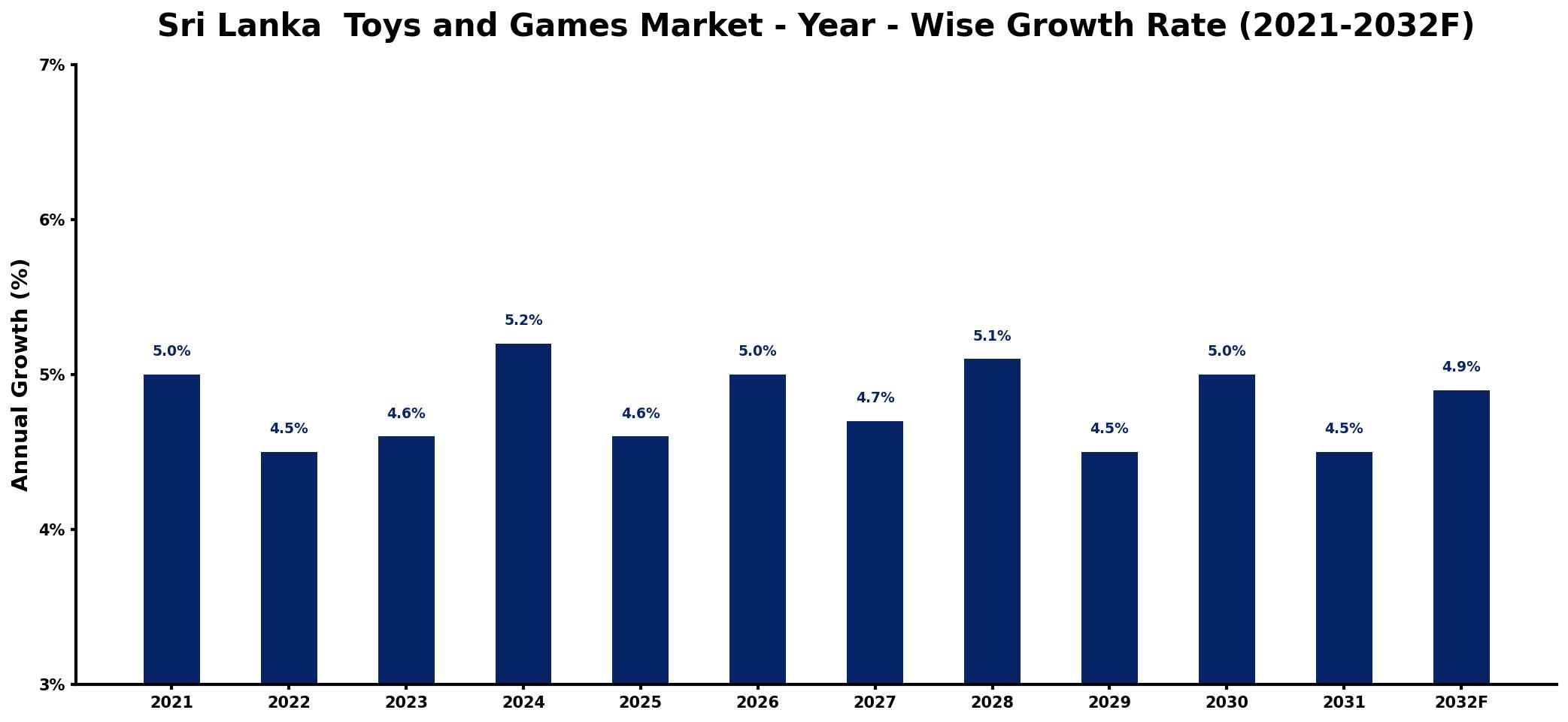
The table below presents the year‑wise growth rates along with the key drivers influencing the market
| Year | Growth Rate | Major Drivers |
| 2021 | 5.0% | Increased consumer spending power |
| 2022 | 4.5% | Growing online retail platforms |
| 2023 | 4.6% | Rise in family entertainment options |
| 2024 | 5.2% | Expansion of local manufacturing units |
| 2025 | 4.6% | Increase in disposable income levels |
| 2026 | 5.0% | Growing popularity of educational products |
| 2027 | 4.7% | Rising demand for eco-friendly products |
| 2028 | 5.1% | rising infrastructure development spending |
| 2029 | 4.5% | improved processing technologies adoption |
| 2030 | 5.0% | Growth in experiential marketing strategies |
| 2031 | 4.5% | Surge in social media influence |
| 2032 | 4.9% | Rising interest in collaborative play |
Note: Market size estimations and growth projections presented in this report are based on 6Wresearch's proprietary forecasting methodology, utilizing the latest available industry data, government publications, and primary research inputs.
Sri Lanka Toys and Games Market Synopsis
The Sri Lanka toys and games market has seen impressive momentum in recent years, largely characterized by a blend of traditional and modern offerings. However, as consumer preferences evolve, there is a notable shift towards innovative and educational toys that resonate with the growing emphasis on child development.
Looking ahead, the market is set for even greater transformation, as digital and interactive toys gain traction. The influence of global entertainment franchises and the increasing accessibility of e-commerce platforms are reshaping the landscape, paving the way for a more competitive and varied product offering.
Sri Lanka Toys and Games Market Key Takeaways
- The market is growing steadily due to rising disposable income and urbanization.
- There is an increasing demand for educational and STEM-focused toys, enhancing child development.
- Traditional toys remain popular, but tech-savvy options like interactive robots are gaining traction.
- E-commerce platforms are vital in expanding market access and product variety.
- Local manufacturing initiatives are needed to reduce reliance on imports and ensure product safety.
Evaluation of Restraints in Sri Lanka Toys and Games Market
Despite its growth potential, the Sri Lanka toys and games market faces several restraints. A significant dependence on imports leads to inflated prices for consumers, which can limit overall market access. Moreover, competition from international brands, combined with counterfeit products, can undermine market stability and consumer trust. Additionally, economic fluctuations and limited local manufacturing capacity further constrict the market's growth, making it essential for stakeholders to strategically address these challenges.
Sri Lanka Toys and Games Market Trends
Current trends in the Sri Lanka toys and games market indicate a growing focus on sustainability. Consumers are increasingly seeking eco-friendly products, prompting manufacturers to innovate with sustainable materials. The integration of technology into toys is also reshaping demand; products featuring augmented reality or coding capabilities are becoming popular among parents eager to invest in educational tools. Furthermore, the influence of popular media franchises on purchasing decisions is undeniable, driving sales in licensed toys and games.
Sri Lanka Toys and Games Market Opportunities
The Sri Lanka toys and games market presents ample investment opportunities. As disposable incomes rise, the demand for high-quality, innovative toys is set to increase. Investors could benefit from the growing e-commerce landscape by establishing online retail channels tailored to consumer preferences. Collaborating with local manufacturers to produce unique, culturally relevant toys could also enhance market penetration and cater to domestic demand.
Government Initiatives in the Sri Lanka Toys and Games Market
The Sri Lankan government is actively engaged in fostering a safe and robust toys and games market. The Standards Institution of Sri Lanka (SIS) has implemented regulations to ensure product safety and quality, particularly aimed at protecting children from hazards. Moreover, the government is promoting local toy manufacturing through various incentives, aiming to reduce dependency on imports and stimulate domestic production. Such initiatives align with the broader goal of enhancing consumer trust and supporting sustainable industry growth.
Future Insights of the Sri Lanka Toys and Games Market
The future of the Sri Lanka toys and games market appears promising, characterized by sustained growth from 2026 to 2032. Factors such as a burgeoning middle class, increased focus on education through play, and the continued rise of online shopping will drive demand for a diverse range of products. However, stakeholders must remain vigilant regarding the challenges posed by international competitors and counterfeit items. Overall, the market is expected to continue evolving, with quality and safety emerging as paramount consumer preferences.
Sri Lanka Toys and Games Market Latest Developments (2025 - 2026)
Recent developments in the Sri Lanka toys and games market highlight a robust push towards modern retail channels and digital engagement. Retailers are expanding their online presence, leveraging social media to reach a broader audience. Additionally, there has been an uptick in collaborations between local artisans and toy manufacturers, aimed at producing unique, culturally resonant products that cater to domestic consumers. These trends signal a dynamic shift in how toys are marketed and sold in the country.
Sri Lanka Toys and Games Market - Key Attractiveness of the Report
- 10 Years of Market Numbers
- Historical Data Starting from 2022 to 2025
- Base Year: 2025
- Forecast Data until 2032
- Key Performance Indicators Impacting the Market
- Major Upcoming Developments and Projects
Key Highlights of the Report:
- Sri Lanka ToysandGames Market Outlook
- Market Size of Sri Lanka ToysandGames Market, 2025
- Forecast of Sri Lanka ToysandGames Market, 2032
- Historical Data and Forecast of Sri Lanka ToysandGames Revenues & Volume for the Period 2022-2032F
- Sri Lanka ToysandGames Market Trend Evolution
- Sri Lanka ToysandGames Market Drivers and Challenges
- Sri Lanka ToysandGames Price Trends
- Sri Lanka ToysandGames Porter's Five Forces
- Sri Lanka ToysandGames Industry Life Cycle
- Historical Data and Forecast of Sri Lanka ToysandGames Market Revenues & Volume By Product Type for the Period 2022-2032F
- Historical Data and Forecast of Sri Lanka ToysandGames Market Revenues & Volume By Games and Puzzles for the Period 2022-2032F
- Historical Data and Forecast of Sri Lanka ToysandGames Market Revenues & Volume By Video Games for the Period 2022-2032F
- Historical Data and Forecast of Sri Lanka ToysandGames Market Revenues & Volume By Construction Toys for the Period 2022-2032F
- Historical Data and Forecast of Sri Lanka ToysandGames Market Revenues & Volume By Dolls and Accessories for the Period 2022-2032F
- Historical Data and Forecast of Sri Lanka ToysandGames Market Revenues & Volume By Outdoor and Sports Toys for the Period 2022-2032F
- Historical Data and Forecast of Sri Lanka ToysandGames Market Revenues & Volume By Other for the Period 2022-2032F
- Historical Data and Forecast of Sri Lanka ToysandGames Market Revenues & Volume By Distribution Channel for the Period 2022-2032F
- Historical Data and Forecast of Sri Lanka ToysandGames Market Revenues & Volume By Online Channel for the Period 2022-2032F
- Historical Data and Forecast of Sri Lanka ToysandGames Market Revenues & Volume By Offline Channel for the Period 2022-2032F
- Sri Lanka ToysandGames Import Export Trade Statistics
- Market Opportunity Assessment By Product Type
- Market Opportunity Assessment By Distribution Channel
- Sri Lanka ToysandGames Top Companies Market Share
- Sri Lanka ToysandGames Competitive Benchmarking By Technical and Operational Parameters
- Sri Lanka ToysandGames Company Profiles
- Sri Lanka ToysandGames Key Strategic Recommendations






































