Sri Lanka Trolley Market Size, Share & Growth Rate
The Sri Lanka Trolley Market was estimated at USD 445 Million in 2025 and is projected to reach USD 587 Million by 2032, growing at a CAGR of 4.0% from 2026 to 2032. This growth is primarily driven by the expansion of the retail and hospitality sectors, coupled with increasing urbanization and the surging demand for e-commerce. As consumers increasingly prefer convenience in shopping and transportation, the utilization of trolleys for efficient material handling is expected to rise significantly.
Sri Lanka Trolley Market Year-wise Growth Rate and Key Drivers
This graph highlights how the Sri Lanka Trolley Market has steadily grown over the years, supported by major growth factors.
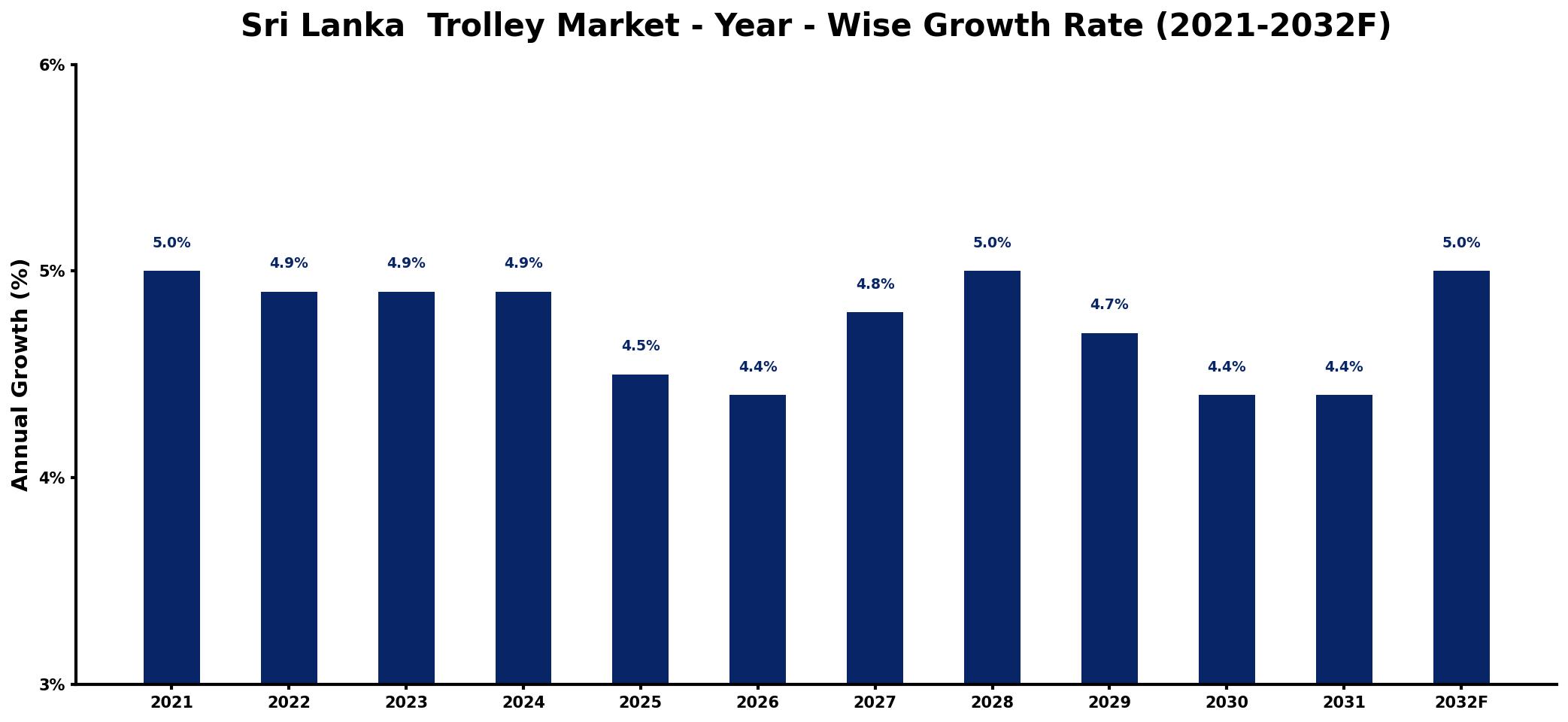
The table below presents the year‑wise growth rates along with the key drivers influencing the market
| Year | Growth Rate | Major Drivers |
| 2021 | 5.0% | Increased urban logistics investments |
| 2022 | 4.9% | Growing e-commerce delivery demands |
| 2023 | 4.9% | Expansion of retail distribution networks |
| 2024 | 4.9% | Rising tourism and hospitality sectors |
| 2025 | 4.5% | Development of smart city projects |
| 2026 | 4.4% | Enhancements in warehouse automation |
| 2027 | 4.8% | Surge in online grocery shopping |
| 2028 | 5.0% | Boom in food delivery services |
| 2029 | 4.7% | Increase in healthcare supply chains |
| 2030 | 4.4% | Growth in event management services |
| 2031 | 4.4% | expanding healthcare application demand |
| 2032 | 5.0% | Rising demand for sustainable solutions |
Note: Market size estimations and growth projections presented in this report are based on 6Wresearch's proprietary forecasting methodology, utilizing the latest available industry data, government publications, and primary research inputs.
Sri Lanka Trolley Market Synopsis
In Sri Lanka, the retail sector's rapid evolution has led to a substantial increase in trolley demand, particularly in supermarkets and warehouse settings. This trend is significantly shaped by the growing consumer preference for hassle-free shopping experiences, leading to an uptick in trolley usage for transporting goods within retail spaces.
Furthermore, logistics operations in Sri Lanka are increasingly recognizing the importance of trolleys for efficient material handling. The integration of trolleys into supply chains not only enhances productivity but also improves the overall customer experience by facilitating smoother transitions of goods in various commercial environments.
Sri Lanka Trolley Market Key Takeaways
- The trolley market is poised for steady growth, reflecting the evolving landscape of retail and logistics in Sri Lanka.
- Urbanization and consumer convenience are primary catalysts driving trolley demand across sectors.
- Advanced trolley technology poses both opportunities and challenges in terms of costs and performance reliability.
- Government initiatives are likely to enhance public infrastructure, fostering a favorable market environment.
- Emerging trends in e-commerce are expected to shape the future trajectory of the trolley market significantly.
Evaluation of Restraints in Sri Lanka Trolley Market
Despite the positive outlook, the Sri Lanka trolley market faces notable restraints that could temper its growth. The high cost associated with advanced trolley technologies presents a significant barrier for many businesses, particularly in the retail and logistics sectors. This challenge is compounded by the need for trolleys to demonstrate reliable performance across diverse applications, necessitating rigorous compliance with safety regulations. Additionally, logistics management, including the supply and maintenance of trolleys, poses operational difficulties that businesses must navigate to ensure seamless operations in this competitive landscape.
Sri Lanka Trolley Market Trends
The Sri Lanka trolley market is witnessing several current and emerging trends that are reshaping its dynamics. One prominent trend is the increasing adoption of ergonomically designed trolleys that enhance user comfort and efficiency. Additionally, as e-commerce continues to gain traction, businesses are investing in technologically advanced trolleys equipped with tracking and automation features. This shift not only streamlines material handling but also aligns with contemporary consumer expectations for speed and convenience in delivery.
Sri Lanka Trolley Market Opportunities
The future of the Sri Lanka trolley market presents genuine growth and investment opportunities across various sectors. Expanding urban areas provide a fertile ground for new retail developments, which in turn will drive demand for trolleys. Moreover, businesses that focus on integrating sustainable practices—such as using eco-friendly materials for trolley production—are likely to resonate with environmentally conscious consumers, setting the stage for a competitive advantage in the marketplace.
Government Initiatives in the Sri Lanka Trolley Market
Government policies and investments play a crucial role in shaping the Sri Lanka trolley market. Initiatives aimed at enhancing public infrastructure, coupled with supportive measures for the retail industry, are expected to create an environment conducive to growth. Moreover, government programs focused on modernization within the retail sector align with the increasing demand for efficient material handling solutions, further propelling market expansion.
Future Insights of the Sri Lanka Trolley Market
Looking ahead to 2026-2032, the Sri Lanka trolley market is set for an exciting trajectory marked by ongoing innovation and technological advancements. The integration of smart technology in trolleys, including IoT capabilities, will likely enhance their functionality and operational efficiency. Furthermore, as the urban landscape continues to evolve, businesses will need to adapt to new consumer behaviors, driving further demand for effective material handling solutions.
Sri Lanka Trolley Market Latest Developments (2025 - 2026)
Recent developments in the Sri Lanka trolley market have centered around advancements in design and functionality, with a focus on meeting the specific needs of the retail and logistics sectors. Enhanced collaboration among manufacturers is leading to innovative trolley solutions that prioritize both efficiency and user experience. Additionally, there has been an increased emphasis on safety compliance as businesses aim to optimize their operations while adhering to regulatory standards.
Sri Lanka Trolley Market - Key Attractiveness of the Report
- 10 Years of Market Numbers
- Historical Data Starting from 2022 to 2025
- Base Year: 2025
- Forecast Data until 2032
- Key Performance Indicators Impacting the Market
- Major Upcoming Developments and Projects
Key Highlights of the Report:
- Sri Lanka Trolley Market Outlook
- Market Size of Sri Lanka Trolley Market, 2025
- Forecast of Sri Lanka Trolley Market, 2032
- Historical Data and Forecast of Sri Lanka Trolley Revenues & Volume for the Period 2022-2032F
- Sri Lanka Trolley Market Trend Evolution
- Sri Lanka Trolley Market Drivers and Challenges
- Sri Lanka Trolley Price Trends
- Sri Lanka Trolley Porter's Five Forces
- Sri Lanka Trolley Industry Life Cycle
- Historical Data and Forecast of Sri Lanka Trolley Market Revenues & Volume By Product for the Period 2022-2032F
- Historical Data and Forecast of Sri Lanka Trolley Market Revenues & Volume By Manual for the Period 2022-2032F
- Historical Data and Forecast of Sri Lanka Trolley Market Revenues & Volume By Electric for the Period 2022-2032F
- Historical Data and Forecast of Sri Lanka Trolley Market Revenues & Volume By Application for the Period 2022-2032F
- Historical Data and Forecast of Sri Lanka Trolley Market Revenues & Volume By Commercial for the Period 2022-2032F
- Historical Data and Forecast of Sri Lanka Trolley Market Revenues & Volume By Non-commercial for the Period 2022-2032F
- Historical Data and Forecast of Sri Lanka Trolley Market Revenues & Volume By Distribution for the Period 2022-2032F
- Historical Data and Forecast of Sri Lanka Trolley Market Revenues & Volume By Offline for the Period 2022-2032F
- Historical Data and Forecast of Sri Lanka Trolley Market Revenues & Volume By Online for the Period 2022-2032F
- Sri Lanka Trolley Import Export Trade Statistics
- Market Opportunity Assessment By Product
- Market Opportunity Assessment By Application
- Market Opportunity Assessment By Distribution
- Sri Lanka Trolley Top Companies Market Share
- Sri Lanka Trolley Competitive Benchmarking By Technical and Operational Parameters
- Sri Lanka Trolley Company Profiles
- Sri Lanka Trolley Key Strategic Recommendations






































