Sri Lanka Tunnel Boring Machine Market Size, Share & Growth Rate
The Sri Lanka Tunnel Boring Machine Market was estimated at USD 1067 Million in 2025 and is projected to reach USD 1533 Million by 2032, growing at a CAGR of 5.3% from 2026 to 2032. This promising growth trajectory is fueled by substantial investments in infrastructure development, especially in urban areas, where the demand for precise and efficient tunneling solutions is critical. As the nation continues to urbanize, these machines will play an essential role in facilitating essential transportation and utility projects.
Sri Lanka Tunnel Boring Machine Market Growth Rate Analysis (2021-2032)
The Sri Lankan Tunnel Boring Machine market has shown a stable upward trend, with yearly growth rates ranging from 6.1% to 6.7% from 2021 through 2032. This steady expansion can be attributed to increasing investments in infrastructure development and a strong shift towards energy-efficient solutions, necessitating advanced tunneling technologies. Significant projects in urban transport and hydropower schemes have spurred demand, particularly observed in 2023 with a peak growth of 6.7%. Despite minor fluctuations, such as a dip to 6.0% in 2027, the overall trend reflects robust consumer demand and favorable government policies supporting infrastructure enhancements. Moving forward, digitalization and technological advancements are expected to further drive market efficiency and growth.
Sri Lanka Tunnel Boring Machine Market Year-wise Growth Rate and Key Drivers
This graph highlights how the Sri Lanka Tunnel Boring Machine Market has steadily grown over the past five years, supported by major growth factors.
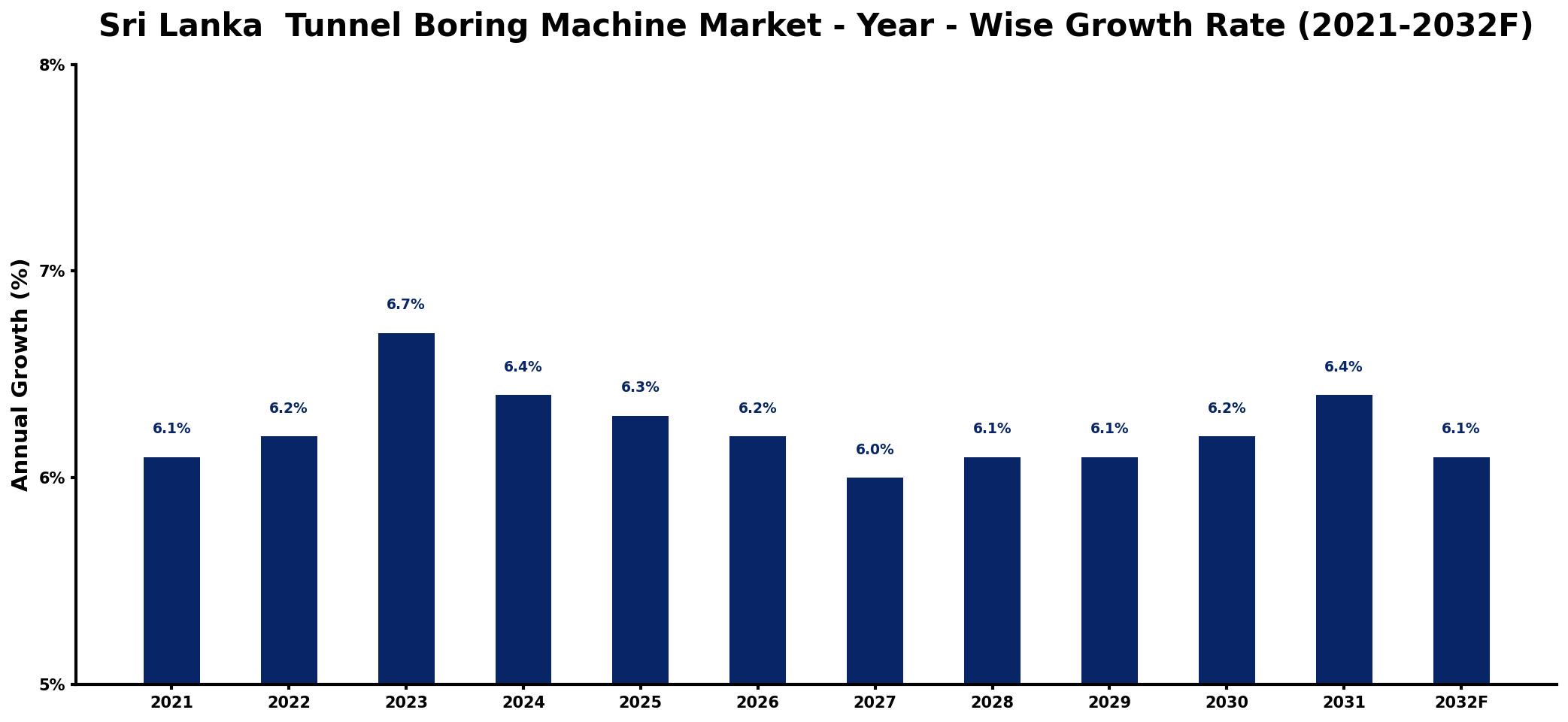
The table below presents the year‑wise growth rates along with the key drivers influencing the market
| Year | Growth Rate | Major Drivers |
| 2021 | 6.1% | Infrastructure investments increase significantly |
| 2022 | 6.2% | Urban development projects expand rapidly |
| 2023 | 6.7% | Government funding for construction rises |
| 2024 | 6.4% | Public-private partnerships promote growth |
| 2025 | 6.3% | Transportation network enhancements planned |
| 2026 | 6.2% | Environmental regulations encourage innovation |
| 2027 | 6.0% | Global demand for infrastructure rises |
| 2028 | 6.1% | Technological advancements drive efficiency |
| 2029 | 6.1% | Local manufacturing capabilities strengthen |
| 2030 | 6.2% | Sustainability initiatives gain traction |
| 2031 | 6.4% | Regional collaboration fosters projects |
| 2032 | 6.1% | Real estate developments increase demand |
Note: Market size estimations and growth projections presented in this report are based on 6Wresearch's proprietary forecasting methodology, utilizing the latest available industry data, government publications, and primary research inputs.
Sri Lanka Tunnel Boring Machine Market Synopsis
Recently, the Sri Lanka Tunnel Boring Machine market has experienced significant momentum, primarily driven by government-led infrastructure initiatives. However, as these projects scale up, the market is poised to enter a new phase characterized by advanced technological adoption and an expanding range of applications. The increasing demand for safer, more efficient tunneling solutions is likely to shape market dynamics profoundly in the coming years.
While the current focus is on completing ongoing infrastructure projects, future growth will hinge on overcoming the challenges related to high technology costs and logistical complexities. As urbanization accelerates, the need for streamlined, effective tunneling solutions will be imperative for sustaining the growth of the Sri Lanka Tunnel Boring Machine market.
Sri Lanka Tunnel Boring Machine Market Key Takeaways
- Infrastructure investments are driving rapid growth in the Sri Lanka Tunnel Boring Machine market.
- Urbanization is a primary factor, leading to an increased demand for effective tunneling solutions.
- High technology costs and logistical challenges pose significant constraints on market expansion.
- Government policies are pivotal in promoting modern tunneling technologies.
- The market is witnessing an emerging shift towards advanced technological solutions.
Evaluation of Restraints in Sri Lanka Tunnel Boring Machine Market
Despite its robust growth potential, the Sri Lanka Tunnel Boring Machine market faces several restraints that could hinder its trajectory. The high costs associated with advanced tunneling technologies can deter investment, particularly from smaller contractors or stakeholders. Additionally, there is a pressing need for reliable performance across diverse tunneling applications, which presents a challenge in selecting the right technology. Compliance with evolving safety regulations is also a major concern, necessitating ongoing training and investment in safety measures. Furthermore, the logistics of machine supply and maintenance are crucial to ensure the seamless operation of TBMs, yet they often complicate project timelines and budgets.
Sri Lanka Tunnel Boring Machine Market Trends
The Sri Lanka Tunnel Boring Machine market is currently influenced by several key trends. Firstly, there is a growing emphasis on sustainability, prompting the adoption of eco-friendly tunneling technologies and practices. Moreover, advancements in automation and digital technologies are being integrated into TBM operations, enhancing efficiency and safety. The trend towards urban rail systems, such as subways, is also driving demand, as these projects require precise tunneling methods to navigate complex underground environments. As global tunneling technologies evolve, Sri Lanka is likely to adopt these innovations, positioning itself as a forward-thinking player in the infrastructure sector.
Sri Lanka Tunnel Boring Machine Market Opportunities
Significant growth opportunities are emerging within the Sri Lanka Tunnel Boring Machine market. With ongoing government investments in large-scale infrastructure projects, stakeholders are poised to capitalize on the demand for modern tunneling solutions. There is also potential for collaborations between local and international firms to enhance technology transfer, fostering innovation. Furthermore, the expansion of urban transportation networks opens avenues for introducing advanced tunneling systems, which could streamline project execution while improving efficiency and safety.
Government Initiatives in the Sri Lanka Tunnel Boring Machine Market
The Sri Lankan government plays a crucial role in fostering the growth of the Tunnel Boring Machine market through proactive infrastructure development policies. Initiatives aimed at modernizing transportation networks and enhancing urban infrastructure are pivotal in shaping market dynamics. Public spending on large-scale projects, along with support for innovative tunneling technologies, reinforces the governments commitment to improving the countrys infrastructure landscape. This favorable policy environment is critical for attracting investment and driving advancements within the market.
Future Insights of the Sri Lanka Tunnel Boring Machine Market
Looking ahead to 2026-2032, the Sri Lanka Tunnel Boring Machine market is set for a transformative period characterized by enhanced technological adoption and increased efficiency in tunneling operations. The anticipated growth in urban infrastructure projects will further bolster demand for TBMs. Additionally, as the industry increasingly prioritizes safety and environmental sustainability, we can expect innovations in machine design and operation. Overall, the market is positioned to thrive, meeting the needs of a rapidly urbanizing society while addressing environmental concerns.
Sri Lanka Tunnel Boring Machine Market Latest Developments (2025 - 2026)
In the past year, the Sri Lanka Tunnel Boring Machine market has seen a noticeable shift towards adopting advanced tunneling technologies. Industry stakeholders are increasingly focusing on integrating automation and AI-driven solutions to enhance operational efficiency. Simultaneously, local authorities have ramped up initiatives to streamline regulatory processes for TBM operations, aiming to expedite project timelines and reduce costs. These developments reflect an ongoing commitment to improving infrastructure capabilities across the nation.
Sri Lanka Tunnel Boring Machine Market - Key Attractiveness of the Report
- 10 Years of Market Numbers
- Historical Data Starting from 2022 to 2025
- Base Year: 2025
- Forecast Data until 2032
- Key Performance Indicators Impacting the Market
- Major Upcoming Developments and Projects
Key Highlights of the Report:
- Sri Lanka Tunnel Boring Machine Market Outlook
- Market Size of Sri Lanka Tunnel Boring Machine Market, 2025
- Forecast of Sri Lanka Tunnel Boring Machine Market, 2032
- Historical Data and Forecast of Sri Lanka Tunnel Boring Machine Revenues & Volume for the Period 2022-2032F
- Sri Lanka Tunnel Boring Machine Market Trend Evolution
- Sri Lanka Tunnel Boring Machine Market Drivers and Challenges
- Sri Lanka Tunnel Boring Machine Price Trends
- Sri Lanka Tunnel Boring Machine Porter's Five Forces
- Sri Lanka Tunnel Boring Machine Industry Life Cycle
- Historical Data and Forecast of Sri Lanka Tunnel Boring Machine Market Revenues & Volume By Machine Type for the Period 2022-2032F
- Historical Data and Forecast of Sri Lanka Tunnel Boring Machine Market Revenues & Volume By Slurry TBM for the Period 2022-2032F
- Historical Data and Forecast of Sri Lanka Tunnel Boring Machine Market Revenues & Volume By Earth Pressure Balance Shield TBM for the Period 2022-2032F
- Historical Data and Forecast of Sri Lanka Tunnel Boring Machine Market Revenues & Volume By Shielded TBM for the Period 2022-2032F
- Historical Data and Forecast of Sri Lanka Tunnel Boring Machine Market Revenues & Volume By Multi-Mode TBM for the Period 2022-2032F
- Historical Data and Forecast of Sri Lanka Tunnel Boring Machine Market Revenues & Volume By Others for the Period 2022-2032F
- Historical Data and Forecast of Sri Lanka Tunnel Boring Machine Market Revenues & Volume By Geology Type for the Period 2022-2032F
- Historical Data and Forecast of Sri Lanka Tunnel Boring Machine Market Revenues & Volume By Soft Ground for the Period 2022-2032F
- Historical Data and Forecast of Sri Lanka Tunnel Boring Machine Market Revenues & Volume By Hard Rock Ground for the Period 2022-2032F
- Historical Data and Forecast of Sri Lanka Tunnel Boring Machine Market Revenues & Volume By Heterogenous Ground for the Period 2022-2032F
- Historical Data and Forecast of Sri Lanka Tunnel Boring Machine Market Revenues & Volume By Variable Ground for the Period 2022-2032F
- Historical Data and Forecast of Sri Lanka Tunnel Boring Machine Market Revenues & Volume By End-users for the Period 2022-2032F
- Historical Data and Forecast of Sri Lanka Tunnel Boring Machine Market Revenues & Volume By Road Transport for the Period 2022-2032F
- Historical Data and Forecast of Sri Lanka Tunnel Boring Machine Market Revenues & Volume By Railway Transport for the Period 2022-2032F
- Historical Data and Forecast of Sri Lanka Tunnel Boring Machine Market Revenues & Volume By Metro & Transit for the Period 2022-2032F
- Historical Data and Forecast of Sri Lanka Tunnel Boring Machine Market Revenues & Volume By Utilities for the Period 2022-2032F
- Historical Data and Forecast of Sri Lanka Tunnel Boring Machine Market Revenues & Volume By Mining for the Period 2022-2032F
- Historical Data and Forecast of Sri Lanka Tunnel Boring Machine Market Revenues & Volume By Oil & Gas for the Period 2022-2032F
- Historical Data and Forecast of Sri Lanka Tunnel Boring Machine Market Revenues & Volume By Others for the Period 2022-2032F
- Sri Lanka Tunnel Boring Machine Import Export Trade Statistics
- Market Opportunity Assessment By Machine Type
- Market Opportunity Assessment By Geology Type
- Market Opportunity Assessment By End-users
- Sri Lanka Tunnel Boring Machine Top Companies Market Share
- Sri Lanka Tunnel Boring Machine Competitive Benchmarking By Technical and Operational Parameters
- Sri Lanka Tunnel Boring Machine Company Profiles
- Sri Lanka Tunnel Boring Machine Key Strategic Recommendations






































