Sri Lanka Vacuum Pumps Market Summary
The sri lanka vacuum pumps market was estimated at USD 158 Million in 2025 and is projected to reach USD 209 Million by 2032, growing at a CAGR of 4.5% from 2026 to 2032.
Sri Lanka Vacuum Pumps Market Year-wise Growth Rate and Key Drivers
This graph highlights how the Sri Lanka Vacuum Pumps Market has steadily grown over the past five years, supported by major growth factors.
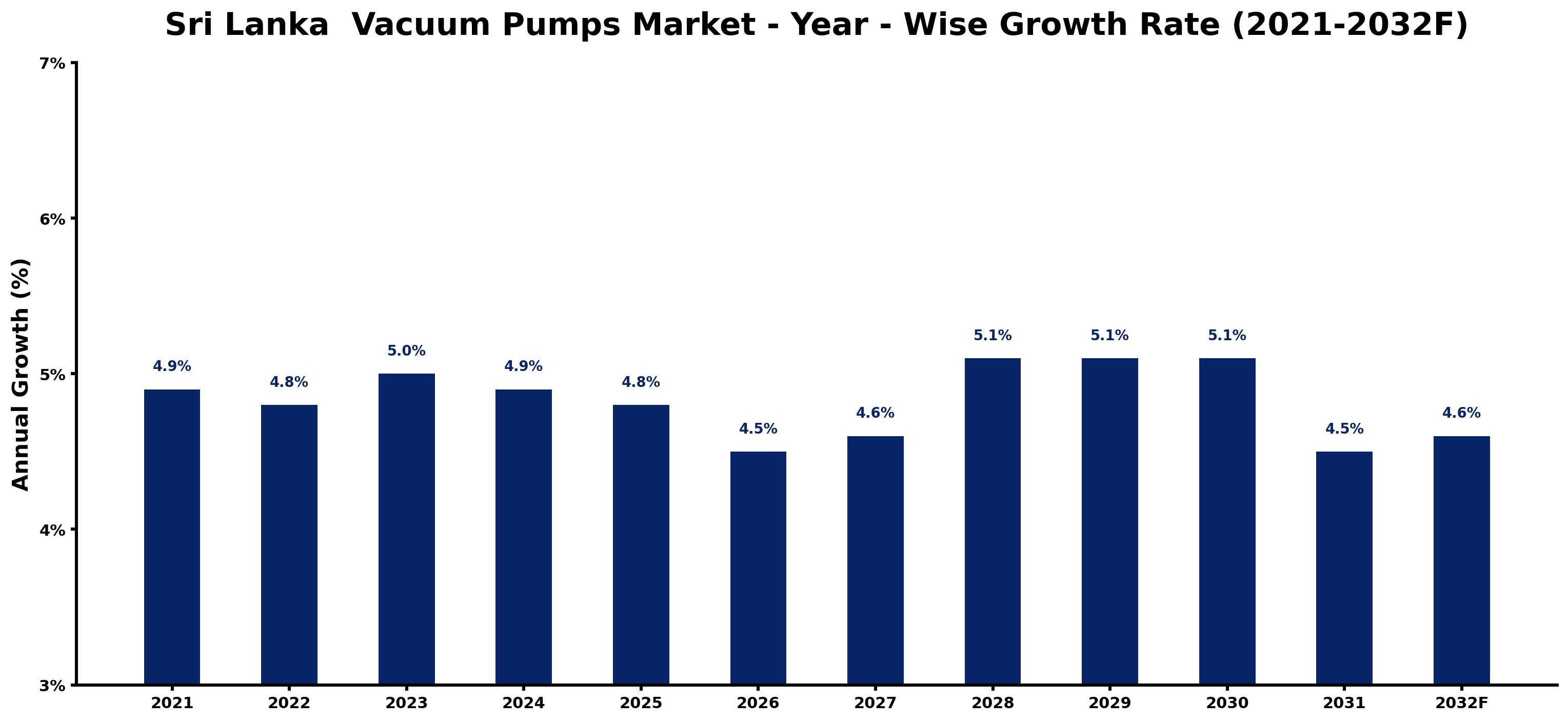
The table below presents the year wise growth rates along with the key drivers influencing the market
| Year | Growth Rate | Major Drivers |
| 2021 | 4.9% | Post-lockdown recovery led to increased industrial activity in Sri Lanka. |
| 2022 | 4.8% | Manufacturing sector expansion created a surge in vacuum pump requirements. |
| 2023 | 5.0% | Infrastructure development projects emphasized the need for reliable pumping solutions. |
| 2024 | 4.9% | Environmental awareness prompted industries to shift towards energy-efficient technologies. |
| 2025 | 4.8% | Local manufacturing capabilities began to emerge, reducing dependency on imports. |
| 2026 | 4.5% | Emerging sectors, like pharmaceuticals, demanded precision in vacuum applications. |
| 2027 | 4.6% | Investment in renewable energy increased the need for high-performance vacuum pumps. |
| 2028 | 5.1% | Technological advancements improved the efficiency and reliability of vacuum systems. |
| 2029 | 5.1% | Export-driven industries sought to enhance productivity with advanced pumping solutions. |
| 2030 | 5.1% | Smart manufacturing trends encouraged the integration of vacuum systems in automation. |
| 2031 | 4.5% | Competitive market environment pushed companies to innovate their product offerings. |
| 2032 | 4.6% | Collaborations between local firms and global players accelerated market growth. |
Note - Market size estimations and growth projections presented in this report are based on 6Wresearch's advanced forecasting approach, validated with industry datasets as of June 2026.
Sri Lanka Vacuum Pumps Market Synopsis
The Sri Lanka Vacuum Pumps Market is projected to reach 4.5% and witness significant growth during the forecast period (2026-2032). This growth is primarily driven by increasing industrialization across several sectors, including pharmaceuticals, food processing, and electronics. The demand for vacuum pumps is being propelled by the necessity for efficient and reliable vacuum technologies in manufacturing processes, alongside a growing emphasis on energy efficiency and sustainability.
Sri Lanka Vacuum Pumps Market Growth Drivers
The factors contributing to the growth of the Sri Lanka Vacuum Pumps Market are multifaceted and reflect the evolving industrial landscape of the country.
- Industrialization has become a cornerstone of economic development, with an increasing number of industries requiring vacuum pump solutions for diverse applications.
- The pharmaceutical sector's expansion has necessitated advanced vacuum technologies for processes like freeze-drying, ensuring higher growth in demand.
- In the food processing industry, vacuum pumps are essential for packaging and preserving products, further elevating their market presence.
- With rising energy costs, industries are particularly inclined towards energy-efficient vacuum pumps that promise reduced operational expenses.
- The transition towards automated manufacturing processes is fostering innovation in vacuum pump technology, leading to enhanced performance and reliability.
Sri Lanka Vacuum Pumps Market Trends and Opportunities
The Sri Lanka Vacuum Pumps Market displays notable trends that hint at future opportunities for growth and innovation.
- There is a discernible shift towards eco-friendly and energy-efficient vacuum pump solutions, as companies aim to ensure compliance with environmental regulations.
- The integration of digital technologies within vacuum pumps, such as IoT capabilities, is revolutionizing their functionality, allowing for remote monitoring and enhanced operational efficiency.
- Customization is becoming a significant trend, with businesses seeking tailored vacuum pump solutions that meet specific operational needs.
- Growing awareness regarding the advantages of vacuum technology is influencing various sectors, leading to increased adoption rates.
- Development in supporting infrastructure within Sri Lanka has led to better accessibility and reliability of vacuum pump solutions across different regions.
Sri Lanka Vacuum Pumps Market Challenges and Restraints
Despite the positive outlook, the Sri Lanka Vacuum Pumps Market faces several challenges that could impede its growth trajectory.
- Limited awareness and understanding of vacuum technology among potential end-users restricts the adoption of advanced vacuum pumps.
- Local manufacturers face stiff competition from imported vacuum pumps, leading to pricing pressures and reduced market shares.
- A shortage of skilled technicians for the maintenance and repair of vacuum pumps creates service gaps, affecting overall market performance.
- Infrastructure deficiencies, including unreliable power supply in certain areas, can disrupt the efficient operation of vacuum pump systems.
- Regulatory hurdles and import tariffs can complicate the operational landscape for manufacturers, affecting market dynamics.
Sri Lanka Vacuum Pumps Market Investment Opportunities
The investment landscape in the Sri Lanka Vacuum Pumps Market appears promising, fueled by a burgeoning industrial sector and a rising demand for vacuum pump technologies.
- Investors can capitalize on the growing demand for high-quality, energy-efficient vacuum pumps, particularly within the pharmaceutical and automotive sectors.
- Opportunities exist for companies specializing in the development of innovative vacuum pump solutions tailored to the unique needs of varied industries.
- With the government's push for foreign direct investment, the market is becoming increasingly attractive to outside investors looking for growth in Sri Lanka.
- Investing in research and development focused on automation and smart technologies will position companies favorably in the evolving market landscape.
- Collaborations with local manufacturing entities can enhance market presence and foster innovative product offerings, leading to mutual growth.
Sri Lanka Vacuum Pumps Market Government Investment and Initiatives
The government of Sri Lanka has instituted various policies and initiatives that positively impact the Vacuum Pumps Market.
- Programs such as the Industrial Technology Institute (ITI) facilitate the development and adoption of advanced technologies in local industries.
- The Board of Investment (BOI) provides incentives for local manufacturers, enhancing the competitive edge of domestic producers in the vacuum pumps sector.
- Government initiatives emphasize energy efficiency, prompting companies to adopt high-quality vacuum pumps that meet environmental standards.
- Import regulations and tariffs are in place to protect local manufacturers, which can stimulate growth in the domestic vacuum pump market.
- Overall, government investment in infrastructure development supports the broader manufacturing ecosystem, including the vacuum pumps industry.
Sri Lanka Vacuum Pumps Market Latest Developments (May 2025 - June 2026)
Recent developments in the Sri Lanka Vacuum Pumps Market indicate a strengthening of industry dynamics, with a focus on innovation and sustainability.
- There has been a noticeable increase in investments directed towards the research and development of energy-efficient vacuum pump models.
- Many companies are integrating digital monitoring features into their vacuum pump offerings, aiming to enhance efficiency and attract technologically-savvy clients.
- The market has seen a growing collaboration between educational institutions and industry players to address the skills gap in vacuum pump maintenance and operation.
- Trade shows and exhibitions held in the country have provided platforms for showcasing advancements in vacuum pump technology, generating greater awareness among potential users.
- Overall, the period has been marked by a commitment to enhancing the quality and reliability of vacuum pump solutions available in the Sri Lankan market.
Sri Lanka Vacuum Pumps Market - Key Attractiveness of the Report
- 10 Years of Market Numbers
- Historical Data Starting from 2022 to 2025
- Base Year: 2025
- Forecast Data until 2032
- Key Performance Indicators Impacting the Market
- Major Upcoming Developments and Projects
Key Highlights of the Report:
- Sri Lanka Vacuum Pumps Market Outlook
- Market Size of Sri Lanka Vacuum Pumps Market, 2025
- Forecast of Sri Lanka Vacuum Pumps Market, 2032F
- Historical Data and Forecast of Sri Lanka Vacuum Pumps Revenues & Volume for the Period 2022-2032F
- Sri Lanka Vacuum Pumps Market Trend Evolution
- Sri Lanka Vacuum Pumps Market Drivers and Challenges
- Sri Lanka Vacuum Pumps Price Trends
- Sri Lanka Vacuum Pumps Porter's Five Forces
- Sri Lanka Vacuum Pumps Industry Life Cycle
- Historical Data and Forecast of Sri Lanka Vacuum Pumps Market Revenues & Volume By Lubrication for the Period 2022-2032F
- Historical Data and Forecast of Sri Lanka Vacuum Pumps Market Revenues & Volume By Dry for the Period 2022-2032F
- Historical Data and Forecast of Sri Lanka Vacuum Pumps Market Revenues & Volume By Wet for the Period 2022-2032F
- Historical Data and Forecast of Sri Lanka Vacuum Pumps Market Revenues & Volume By Technology for the Period 2022-2032F
- Historical Data and Forecast of Sri Lanka Vacuum Pumps Market Revenues & Volume By Gas Capture/Binding Pumps for the Period 2022-2032F
- Historical Data and Forecast of Sri Lanka Vacuum Pumps Market Revenues & Volume By Gas Transfer Pumps for the Period 2022-2032F
- Historical Data and Forecast of Sri Lanka Vacuum Pumps Market Revenues & Volume By Product Type for the Period 2022-2032F
- Historical Data and Forecast of Sri Lanka Vacuum Pumps Market Revenues & Volume By Low vacuum pumps for the Period 2022-2032F
- Historical Data and Forecast of Sri Lanka Vacuum Pumps Market Revenues & Volume By Medium vacuum pumps for the Period 2022-2032F
- Historical Data and Forecast of Sri Lanka Vacuum Pumps Market Revenues & Volume By High vacuum pumps for the Period 2022-2032F
- Historical Data and Forecast of Sri Lanka Vacuum Pumps Market Revenues & Volume By End-Users for the Period 2022-2032F
- Historical Data and Forecast of Sri Lanka Vacuum Pumps Market Revenues & Volume By Chemical & pharmaceutical for the Period 2022-2032F
- Historical Data and Forecast of Sri Lanka Vacuum Pumps Market Revenues & Volume By Semiconductor & electronics for the Period 2022-2032F
- Historical Data and Forecast of Sri Lanka Vacuum Pumps Market Revenues & Volume By Oil & gas for the Period 2022-2032F
- Historical Data and Forecast of Sri Lanka Vacuum Pumps Market Revenues & Volume By Food & beverages for the Period 2022-2032F
- Historical Data and Forecast of Sri Lanka Vacuum Pumps Market Revenues & Volume By Wood, paper & pulp for the Period 2022-2032F
- Historical Data and Forecast of Sri Lanka Vacuum Pumps Market Revenues & Volume By Other for the Period 2022-2032F
- Sri Lanka Vacuum Pumps Import Export Trade Statistics
- Market Opportunity Assessment By Lubrication
- Market Opportunity Assessment By Technology
- Market Opportunity Assessment By Product Type
- Market Opportunity Assessment By End-Users
- Sri Lanka Vacuum Pumps Top Companies Market Share
- Sri Lanka Vacuum Pumps Competitive Benchmarking By Technical and Operational Parameters
- Sri Lanka Vacuum Pumps Company Profiles
- Sri Lanka Vacuum Pumps Key Strategic Recommendations






































