Sri Lanka Vending machines Market Summary
The sri lanka vending machines market was estimated at USD 420 Million in 2025 and is projected to reach USD 554 Million by 2032, growing at a CAGR of 4.6% from 2026 to 2032.
Sri Lanka Vending machines Market Year-wise Growth Rate and Key Drivers
This graph highlights how the Sri Lanka Vending machines Market has steadily grown over the past five years, supported by major growth factors.
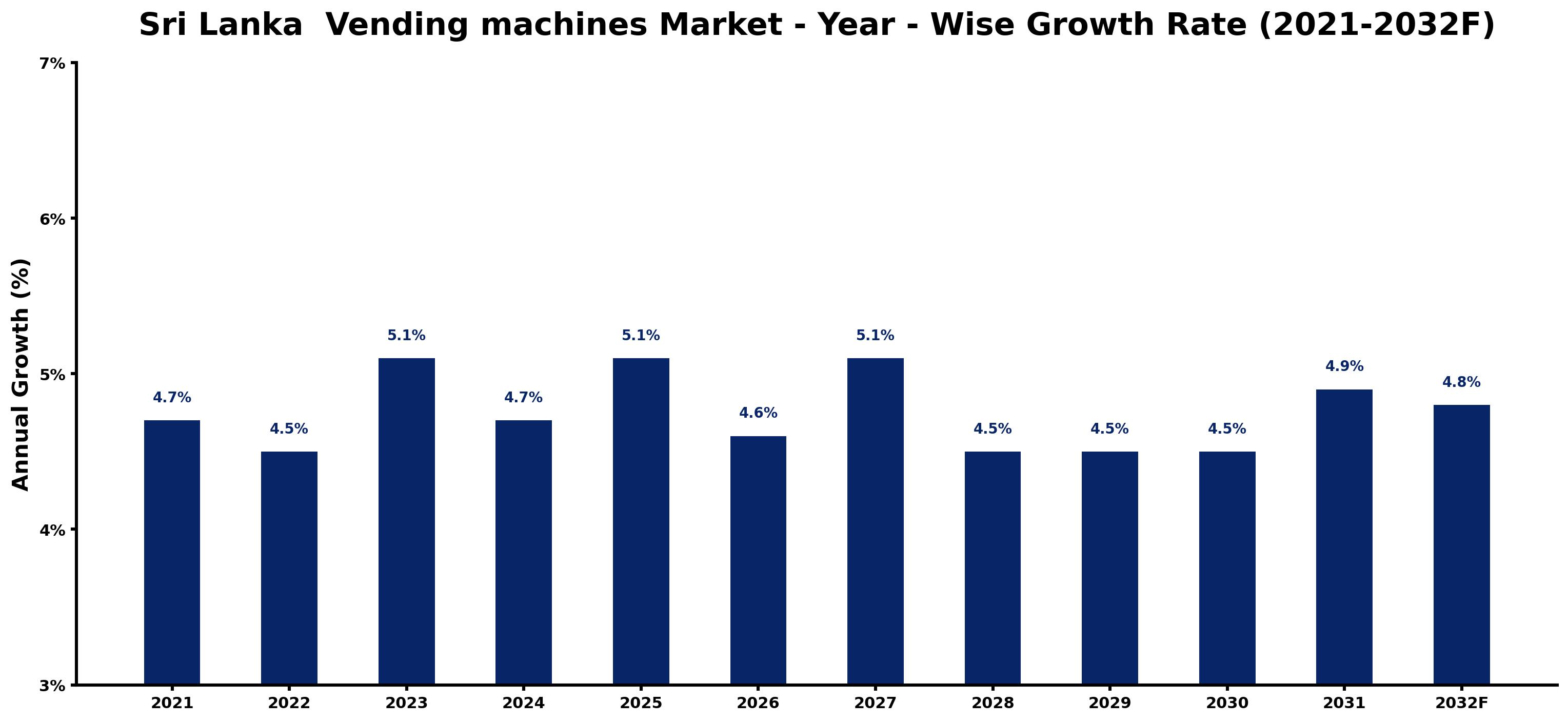
The table below presents the year wise growth rates along with the key drivers influencing the market
| Year | Growth Rate | Major Drivers |
| 2021 | 4.7% | Post-lockdown retail projects increased interest in contactless purchasing solutions. |
| 2022 | 4.5% | Emerging urban areas show a spike in demand for convenient snack options. |
| 2023 | 5.1% | Local entrepreneurs are exploring vending machine franchises, diversifying product offerings. |
| 2024 | 4.7% | E-commerce growth encourages businesses to integrate vending solutions for last-mile delivery. |
| 2025 | 5.1% | Technological upgrades are enhancing vending machine interactivity and user experience. |
| 2026 | 4.6% | Rural communities are adopting vending machines for essential goods accessibility. |
| 2027 | 5.1% | Health awareness trends prompt the introduction of healthier product selections. |
| 2028 | 4.5% | Tourism rebounds, leading to higher foot traffic at key vending machine locations. |
| 2029 | 4.5% | Corporate offices are increasingly installing vending machines for employee convenience. |
| 2030 | 4.5% | Sustainability efforts drive demand for eco-friendly vending machine designs. |
| 2031 | 4.9% | Mobile payment adoption enables seamless transactions, boosting sales across vending operators. |
| 2032 | 4.8% | Changing consumer lifestyles favor quick, accessible food options promoting machine growth. |
Note - Market size estimations and growth projections presented in this report are based on 6Wresearch's advanced forecasting approach, validated with industry datasets as of June 2026.
Sri Lanka Vending machines Market Synopsis
The Sri Lanka Vending machines Market is projected to reach 4.6% and witness significant growth during the forecast period (2026-2032). This market encompasses automated retail solutions designed to dispense snacks, beverages, and various consumer goods in high-traffic areas such as offices, schools, and transportation hubs. The convenience and accessibility offered by vending machines make them an appealing option for both consumers and businesses, contributing to their growing presence in the retail landscape.
Sri Lanka Vending machines Market Growth Drivers
The expansion of the Sri Lanka Vending machines Market is driven by several key factors:
- Urbanization continues to reshape the retail landscape, with more people living in urban centers. Increased foot traffic in these areas provides a fertile ground for vending machine proliferation.
- Changing consumer lifestyles emphasize convenience and instant access to products, which vending machines uniquely provide, catering especially to busy professionals and students.
- Advancements in vending technology, including cashless payment options and interactive screens, enhance the user experience and increase machine appeal.
- Businesses are increasingly adopting vending machines in workplaces, enhancing employee satisfaction through easy access to snacks and beverages during work hours.
- The growing popularity of healthy snack options has led to diversification in vending machine offerings, attracting health-conscious consumers.
Sri Lanka Vending machines Market Challenges and Restraints
Despite the promising growth, the Sri Lanka Vending machines Market faces several challenges:
- The initial investment and operational costs associated with advanced vending technologies can be prohibitive for many small businesses, limiting market entry.
- Reliability and performance in diverse environments are crucial; malfunctioning machines can lead to customer dissatisfaction and loss of revenue.
- Compliance with safety and health regulations is paramount, particularly for food and beverage vending, necessitating regular inspections and maintenance.
- Intense competition from traditional retail formats poses a challenge, as consumers may prefer established retail stores over automated solutions.
- Market fluctuations in consumer preferences can adversely impact sales, requiring operators to stay agile in their offerings to meet changing demands.
Sri Lanka Vending machines Market Government Investment and Initiatives
The government of Sri Lanka is playing a crucial role in shaping the vending machines market through various initiatives:
- Policies that encourage retail innovation are fostering an environment conducive to the growth of automated retail solutions, including vending machines.
- Government support for technological advancements promotes the integration of modern vending solutions across different sectors, including food and beverage distribution.
- Public investment in infrastructure improvements enhances the viability of vending machines in high-traffic areas, further increasing their accessibility.
- Regulatory frameworks focusing on product quality and consumer safety ensure that vending machines comply with health standards, boosting consumer confidence.
- Incentives for businesses adopting state-of-the-art vending technologies are encouraging investment in this sector, thereby stimulating market growth.
Sri Lanka Vending machines Market Latest Developments (May 2025 - June 2026)
The period between May 2025 and June 2026 has seen notable developments within the Sri Lanka Vending machines Market, indicating a shift towards modernization and increased adoption rates:
- There is a concerted effort to incorporate eco-friendly and sustainable practices in vending machine operations, with a focus on reducing waste from packaging materials.
- Advancements in mobile payment technologies have led to more vending machines offering contactless payment options, appealing to tech-savvy consumers.
- Growing partnerships between vending machine operators and local producers have resulted in more diverse product offerings, emphasizing local brands and ethically sourced goods.
- The introduction of smart vending machines that utilize AI technology is enabling more personalized consumer experiences through data analysis and tailored product suggestions.
- Increasing investments in user experience design have resulted in visually appealing and user-friendly machine interfaces, enhancing consumer interaction and satisfaction.
Sri Lanka Vending machines Market - Key Attractiveness of the Report
- 10 Years of Market Numbers
- Historical Data Starting from 2022 to 2025
- Base Year: 2025
- Forecast Data until 2032
- Key Performance Indicators Impacting the Market
- Major Upcoming Developments and Projects
Key Highlights of the Report:
- Sri Lanka Vending machines Market Outlook
- Market Size of Sri Lanka Vending machines Market, 2025
- Forecast of Sri Lanka Vending machines Market, 2032
- Historical Data and Forecast of Sri Lanka Vending machines Revenues & Volume for the Period 2022-2032F
- Sri Lanka Vending machines Market Trend Evolution
- Sri Lanka Vending machines Market Drivers and Challenges
- Sri Lanka Vending machines Price Trends
- Sri Lanka Vending machines Porter's Five Forces
- Sri Lanka Vending machines Industry Life Cycle
- Historical Data and Forecast of Sri Lanka Vending machines Market Revenues & Volume By Applications for the Period 2022-2032F
- Historical Data and Forecast of Sri Lanka Vending machines Market Revenues & Volume By Commercial Places for the Period 2022-2032F
- Historical Data and Forecast of Sri Lanka Vending machines Market Revenues & Volume By Offices for the Period 2022-2032F
- Historical Data and Forecast of Sri Lanka Vending machines Market Revenues & Volume By Public Places for the Period 2022-2032F
- Historical Data and Forecast of Sri Lanka Vending machines Market Revenues & Volume By Others for the Period 2022-2032F
- Historical Data and Forecast of Sri Lanka Vending machines Market Revenues & Volume By Payment Mode for the Period 2022-2032F
- Historical Data and Forecast of Sri Lanka Vending machines Market Revenues & Volume By Cash for the Period 2022-2032F
- Historical Data and Forecast of Sri Lanka Vending machines Market Revenues & Volume By Cashless for the Period 2022-2032F
- Sri Lanka Vending machines Import Export Trade Statistics
- Market Opportunity Assessment By Applications
- Market Opportunity Assessment By Payment Mode
- Sri Lanka Vending machines Top Companies Market Share
- Sri Lanka Vending machines Competitive Benchmarking By Technical and Operational Parameters
- Sri Lanka Vending machines Company Profiles
- Sri Lanka Vending machines Key Strategic Recommendations






































