Sri Lanka Vision Screeners Market Size, Share & Growth Rate
The Sri Lanka Vision Screeners Market was estimated at USD 360 Million in 2025 and is projected to reach USD 497 Million by 2032, growing at a CAGR of 4.7% from 2026 to 2032. This growth is largely driven by the increasing prevalence of eye disorders among all age groups, coupled with the governments commitment to enhancing healthcare infrastructure. Furthermore, rising awareness about the importance of early detection of vision issues is significantly fueling the demand for innovative vision screening solutions across the nation.
Sri Lanka Vision Screeners Market Year-wise Growth Rate and Key Drivers
This graph highlights how the Sri Lanka Vision Screeners Market has steadily grown over the years, supported by major growth factors.
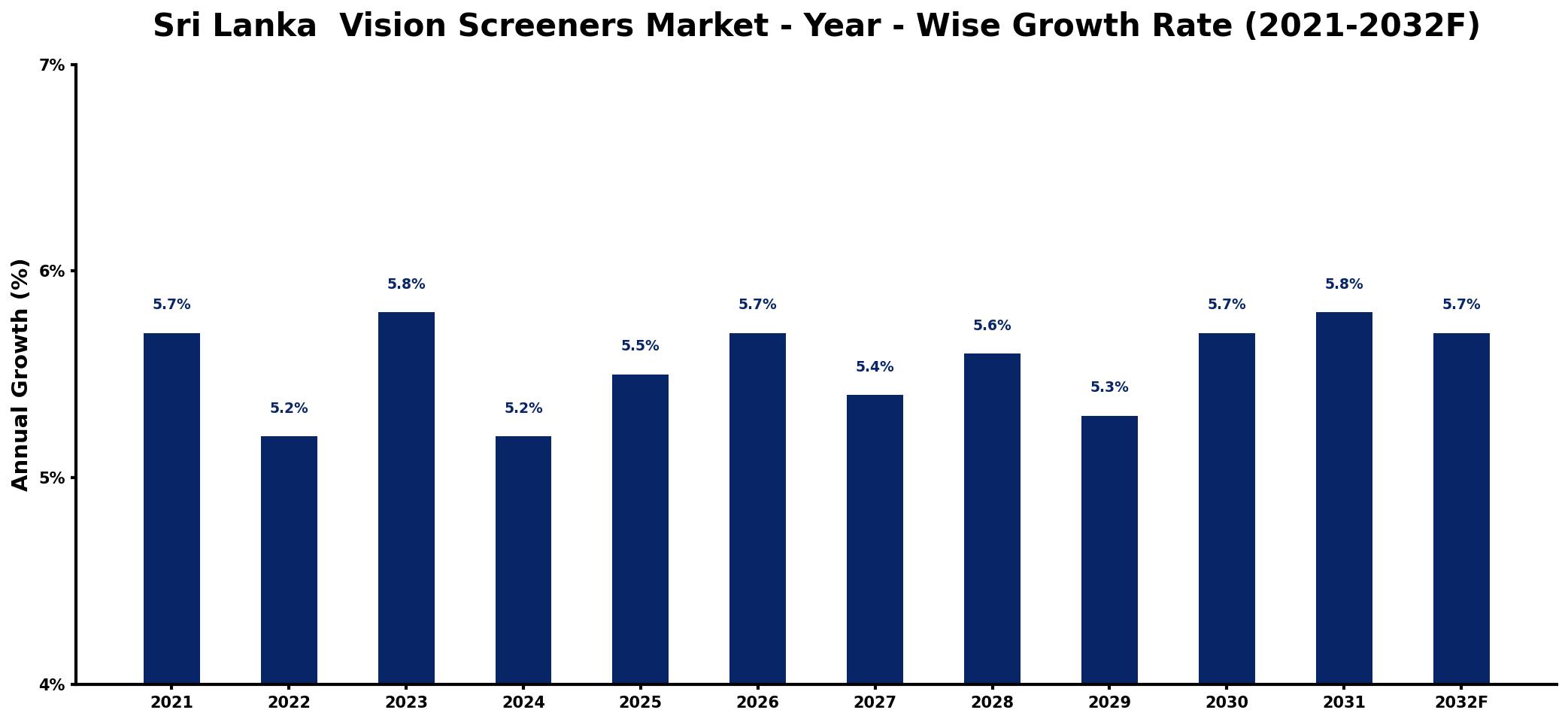
The table below presents the year‑wise growth rates along with the key drivers influencing the market
| Year | Growth Rate | Major Drivers |
| 2021 | 5.7% | Rising healthcare awareness among consumers |
| 2022 | 5.2% | Increased investments in healthcare infrastructure |
| 2023 | 5.8% | Growing demand for preventative care |
| 2024 | 5.2% | Expansion of telehealth services availability |
| 2025 | 5.5% | Technological advancements in diagnostics |
| 2026 | 5.7% | Higher government healthcare spending initiatives |
| 2027 | 5.4% | Surge in aging population demographics |
| 2028 | 5.6% | increased domestic production output |
| 2029 | 5.3% | Growth of public health campaigns |
| 2030 | 5.7% | Rising prevalence of chronic diseases |
| 2031 | 5.8% | Enhanced healthcare policies and regulations |
| 2032 | 5.7% | Growing partnerships in healthcare innovation |
Note: Market size estimations and growth projections presented in this report are based on 6Wresearch's proprietary forecasting methodology, utilizing the latest available industry data, government publications, and primary research inputs.
Sri Lanka Vision Screeners Market Synopsis
The Sri Lanka Vision Screeners Market is rapidly evolving, primarily due to the heightened incidence of eye disorders, such as myopia and cataracts, particularly among children and the elderly. The necessity for effective and accessible vision screening has never been more critical, prompting a surge in demand for advanced devices that can be utilized in diverse settings, including schools and rural health clinics.
In this context, vision screening devices have emerged as pivotal tools for preventive healthcare. The market is characterized by a shift towards portable and user-friendly models, designed to facilitate easy deployment and usage. As healthcare providers strive to integrate technology into their services, the adoption of vision screeners equipped with telemedicine capabilities and data management systems is on the rise, thereby enhancing service delivery.
Sri Lanka Vision Screeners Market Key Takeaways
- The market is driven by a growing emphasis on preventive eye care and the necessity for early detection of vision impairments.
- Portable and handheld vision screening devices are becoming increasingly popular, especially in underserved areas.
- Technological innovations, such as cloud-based systems and telemedicine, are enhancing the efficiency of vision screening practices.
- Government policies are aimed at improving healthcare access and quality, impacting the demand positively.
- Investment opportunities in the market are expanding, particularly in the development of cost-effective screening solutions.
Evaluation of Restraints in Sri Lanka Vision Screeners Market
Despite the promising trajectory of the Sri Lanka Vision Screeners Market, several restraints pose challenges to its full potential. Awareness of the importance of regular vision screening remains limited, particularly in rural regions where access to healthcare is scarce. High costs associated with advanced screening technologies deter many healthcare providers from upgrading their equipment. Additionally, there is a notable shortage of trained professionals capable of effectively operating and interpreting results from vision screeners, which can compromise the accuracy of screenings. Cultural perceptions surrounding vision impairments further complicate engagement, often discouraging individuals from seeking necessary screenings.
Sri Lanka Vision Screeners Market Trends
The trends shaping the Sri Lanka Vision Screeners Market are marked by a clear shift towards the adoption of portable and user-centric devices. The convenience and cost-effectiveness of handheld vision screeners are particularly appealing in remote areas with limited access to traditional healthcare facilities. Additionally, as technology evolves, there is an increasing incorporation of advanced features, such as data analytics and real-time reporting, into vision screening devices. Public awareness initiatives focusing on the importance of regular screenings for school children and the elderly are also gaining momentum, further stimulating demand.
Sri Lanka Vision Screeners Market Opportunities
Investors looking for growth opportunities in the Sri Lanka Vision Screeners Market will find a fertile ground due to the escalating awareness surrounding eye health. The demand for advanced, portable screening devices is expected to surge, creating a lucrative avenue for innovation and investment. Collaborations with local healthcare providers and government initiatives focused on preventive care will enhance market stability. Moreover, as the healthcare landscape expands to include more efficient services in both urban and rural areas, stakeholders can capitalize on the pressing need for effective early detection and management of vision disorders.
Government Initiatives in the Sri Lanka Vision Screeners Market
The Sri Lankan government has been proactive in enhancing healthcare infrastructure, particularly concerning eye health. Regulations and policies have been introduced to ensure the quality and safety of vision screening devices utilized in healthcare settings. These policies establish comprehensive guidelines for the manufacturing and distribution of vision screeners, aimed at ensuring accuracy and reliability. Moreover, initiatives are in place to promote the training and certification of healthcare professionals in operating these devices, ultimately striving for improved patient care and broader access to eye health services.
Future Insights of the Sri Lanka Vision Screeners Market
Looking ahead to 2026-2032, the Sri Lanka Vision Screeners Market is set for steady growth, bolstered by increasing public awareness of preventive healthcare and the growing prevalence of vision-related disorders. Factors such as the expanding geriatric population and heightened focus on early detection will further propel the demand for innovative vision screening solutions. Additionally, advancements in technology, including the development of more portable and user-friendly devices, are expected to significantly enhance market accessibility and efficiency. With ongoing government initiatives aimed at expanding healthcare services, the future of the Sri Lanka Vision Screeners Market appears promising.
Sri Lanka Vision Screeners Market Latest Developments (2025 - 2026)
In recent months, the Sri Lanka Vision Screeners Market has seen a number of developments aimed at enhancing the availability and effectiveness of vision screening services. There has been a noticeable shift toward integrating digital technologies with traditional screening processes, promoting telehealth solutions for remote consultations. Additionally, several awareness campaigns targeting schools and communities are underway to emphasize the importance of regular eye checks, particularly for children. These initiatives are expected to play a crucial role in increasing market penetration and improving overall eye health across the country.
Sri Lanka Vision Screeners Market - Key Attractiveness of the Report
- 10 Years of Market Numbers
- Historical Data Starting from 2022 to 2025
- Base Year: 2025
- Forecast Data until 2032
- Key Performance Indicators Impacting the Market
- Major Upcoming Developments and Projects
Key Highlights of the Report:
- Sri Lanka Vision Screeners Market Outlook
- Market Size of Sri Lanka Vision Screeners Market, 2025
- Forecast of Sri Lanka Vision Screeners Market, 2032
- Historical Data and Forecast of Sri Lanka Vision Screeners Revenues & Volume for the Period 2022-2032F
- Sri Lanka Vision Screeners Market Trend Evolution
- Sri Lanka Vision Screeners Market Drivers and Challenges
- Sri Lanka Vision Screeners Price Trends
- Sri Lanka Vision Screeners Porter's Five Forces
- Sri Lanka Vision Screeners Industry Life Cycle
- Historical Data and Forecast of Sri Lanka Vision Screeners Market Revenues & Volume By Product for the Period 2022-2032F
- Historical Data and Forecast of Sri Lanka Vision Screeners Market Revenues & Volume By Table-Top Vision Screeners for the Period 2022-2032F
- Historical Data and Forecast of Sri Lanka Vision Screeners Market Revenues & Volume By Portable/Handheld Vision Screeners for the Period 2022-2032F
- Historical Data and Forecast of Sri Lanka Vision Screeners Market Revenues & Volume By Vision Screening Software for the Period 2022-2032F
- Historical Data and Forecast of Sri Lanka Vision Screeners Market Revenues & Volume By Technology for the Period 2022-2032F
- Historical Data and Forecast of Sri Lanka Vision Screeners Market Revenues & Volume By Digital Vision Screeners for the Period 2022-2032F
- Historical Data and Forecast of Sri Lanka Vision Screeners Market Revenues & Volume By Computer-Based Vision Screeners for the Period 2022-2032F
- Historical Data and Forecast of Sri Lanka Vision Screeners Market Revenues & Volume By Application for the Period 2022-2032F
- Historical Data and Forecast of Sri Lanka Vision Screeners Market Revenues & Volume By Vision Screening Tests for the Period 2022-2032F
- Historical Data and Forecast of Sri Lanka Vision Screeners Market Revenues & Volume By Color Vision Test for the Period 2022-2032F
- Historical Data and Forecast of Sri Lanka Vision Screeners Market Revenues & Volume By Binocular Testing for the Period 2022-2032F
- Historical Data and Forecast of Sri Lanka Vision Screeners Market Revenues & Volume By Others for the Period 2022-2032F
- Historical Data and Forecast of Sri Lanka Vision Screeners Market Revenues & Volume By End Users for the Period 2022-2032F
- Historical Data and Forecast of Sri Lanka Vision Screeners Market Revenues & Volume By Hospitals for the Period 2022-2032F
- Historical Data and Forecast of Sri Lanka Vision Screeners Market Revenues & Volume By Homecare Settings for the Period 2022-2032F
- Historical Data and Forecast of Sri Lanka Vision Screeners Market Revenues & Volume By Specialized Clinics for the Period 2022-2032F
- Historical Data and Forecast of Sri Lanka Vision Screeners Market Revenues & Volume By Rehabilitation Centers for the Period 2022-2032F
- Historical Data and Forecast of Sri Lanka Vision Screeners Market Revenues & Volume By Ambulatory Surgical Centers for the Period 2022-2032F
- Sri Lanka Vision Screeners Import Export Trade Statistics
- Market Opportunity Assessment By Product
- Market Opportunity Assessment By Technology
- Market Opportunity Assessment By Application
- Market Opportunity Assessment By End Users
- Sri Lanka Vision Screeners Top Companies Market Share
- Sri Lanka Vision Screeners Competitive Benchmarking By Technical and Operational Parameters
- Sri Lanka Vision Screeners Company Profiles
- Sri Lanka Vision Screeners Key Strategic Recommendations






































