Sri Lanka Washing Machine Market Size, Share & Growth Rate
The Sri Lanka Washing Machine Market was estimated at USD 254 Million in 2025 and is projected to reach USD 350 Million by 2032, growing at a CAGR of 4.7% from 2026 to 2032. This growth trajectory is primarily driven by increasing urbanization, which is prompting a shift in consumer preferences toward modern household appliances. Furthermore, the heightened awareness of energy efficiency and water conservation among consumers is pushing demand for advanced washing machines that deliver superior performance and convenience.
Sri Lanka Washing Machine Market Growth Rate Analysis (2021-2032)
The Sri Lankan washing machine market has exhibited stable growth, with yearly increases reflecting a consistent demand. In 2022, the market grew by 5.9%, bolstered by rising disposable incomes and an expanding middle class that prioritize convenience. Although growth dipped slightly to 5.3% in 2023, it rebounded to 5.5% in both 2024 and 2025 as investments in infrastructure and energy-efficient technologies gained traction, catering to eco-conscious consumers. Continued digitalization in retail and enhanced consumer awareness around appliance functionality are expected to sustain this momentum, with projections indicating 5.6% growth in 2032. This stability highlights the resilience of the market amid evolving consumer preferences and advancements in washing technology.
Sri Lanka Washing Machine Market Year-wise Growth Rate and Key Drivers
This graph highlights how the Sri Lanka Washing Machine Market has steadily grown over the past five years, supported by major growth factors.
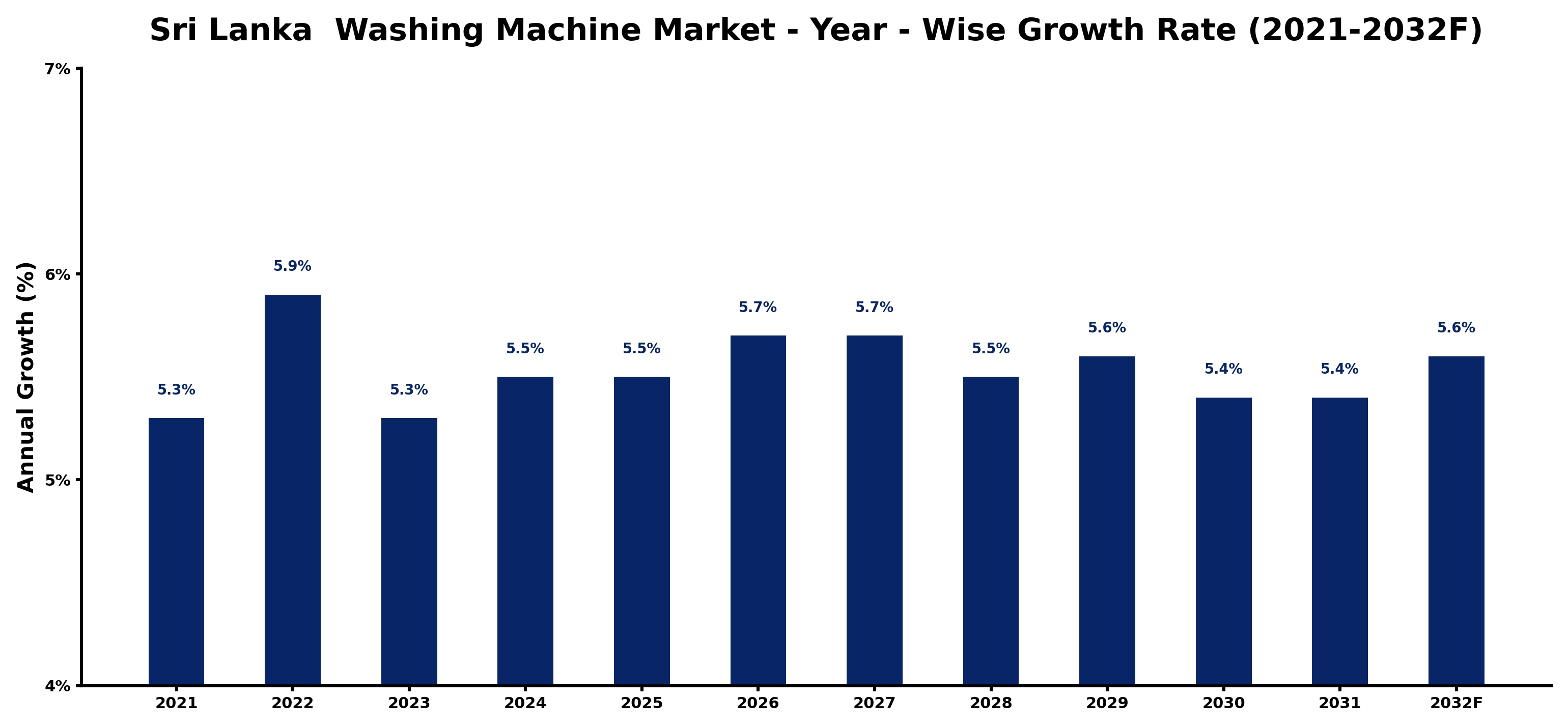
The table below presents the year‑wise growth rates along with the key drivers influencing the market
| Year | Growth Rate | Major Drivers |
| 2021 | 5.3% | New assembly plant investments boost washing machine production capacity |
| 2022 | 5.9% | Local assembly plants boost domestic washing machine production capacity |
| 2023 | 5.3% | Capacity utilization advancements boosted local washing machine production efficiency |
| 2024 | 5.5% | Smart washing machine technology adoption boosts local manufacturing capabilities |
| 2025 | 5.5% | Local assembly operations boost washing machine production capacity and efficiency |
| 2026 | 5.7% | Resurgent housing demand boosts washing machine manufacturing capacity expansion |
| 2027 | 5.7% | Localized assembly facilities boost washing machine production capacity and efficiency |
| 2028 | 5.5% | Technology integration in manufacturing streamlined washing machine production processes |
| 2029 | 5.6% | Accelerated washing machine production lines improved capacity utilization rates |
| 2030 | 5.4% | Local assembly plants enhance washing machine production capabilities and speed |
| 2031 | 5.4% | Improved manufacturing technologies boost washing machine production efficiency |
| 2032 | 5.6% | Manufacturing investments in local supply chains boost washing machine production |
Note - Market size estimations and growth projections presented in this report are based on 6Wresearch’s advanced forecasting approach, validated with industry datasets as of June 2026.
Sri Lanka Washing Machine Market Synopsis
The dominant force currently shaping the Sri Lanka Washing Machine Market is the strong trend toward urbanization. As more people migrate to urban areas, the demand for efficient household appliances has surged, making washing machines a household essential rather than a luxury. Coupled with this trend is the growing emphasis on sustainability, leading consumers to seek out energy-efficient options that align with their values.
Another key factor influencing the market is the ongoing shift in consumer lifestyles. With busy schedules and a growing middle class, there is an increasing preference for appliances that save time and simplify daily chores. This shift not only supports the rise of washing machines in residential settings but also encourages their use in commercial sectors.
Sri Lanka Washing Machine Market Key Takeaways
- The market is witnessing strong growth fueled by urbanization and changing consumer lifestyles.
- Energy efficiency and advanced technologies are pivotal in driving consumer purchasing decisions.
- Government policies promoting innovation play a significant role in market development.
- Household appliance replacement cycles contribute significantly to market dynamics.
- Awareness of modern washing machines' benefits remains a challenge to wider adoption.
Evaluation of Restraints in Sri Lanka Washing Machine Market
Despite the promising growth outlook, several restraints limit the Sri Lanka Washing Machine Market's potential. High costs associated with advanced washing machines pose a significant barrier for many consumers, particularly in economically volatile times. Additionally, competition from alternative laundry methods, such as manual washing, remains a challenge. There is also a noticeable gap in consumer awareness regarding the advantages of modern washing machines, which could hinder market penetration. Fluctuations in raw material prices further complicate production, impacting pricing strategies and profitability.
Sri Lanka Washing Machine Market Trends
Current trends in the Sri Lanka Washing Machine Market highlight a growing interest in IoT-enabled appliances, allowing consumers to monitor and control their washing machines remotely. Additionally, the integration of steam technology is on the rise, appealing to those who prioritize hygiene and fabric care. On the sustainability front, more brands are focusing on eco-friendly materials and designs, responding to the increasing consumer demand for products that minimize environmental impact.
Sri Lanka Washing Machine Market Opportunities
The market offers significant growth and investment opportunities, particularly in the realm of product innovation. Companies that focus on developing affordable, energy-efficient washing machines tailored for the local market can capture a larger share. Furthermore, as urban areas continue to expand, targeting newly constructed residential complexes and commercial establishments can provide additional avenues for growth. The rising trend of online shopping also presents opportunities for brands to enhance their visibility and reach a wider audience.
Government Initiatives in the Sri Lanka Washing Machine Market
Government policies aimed at promoting household appliance innovation are crucial for the development of the Sri Lanka Washing Machine Market. Initiatives that incentivize the adoption of energy-efficient technologies encourage both manufacturers and consumers to invest in modern appliances. Regulations concerning product quality and safety standards also significantly shape market dynamics, ensuring that consumers have access to reliable and efficient washing machines.
Future Insights of the Sri Lanka Washing Machine Market
Looking ahead to 2026-2032, the Sri Lanka Washing Machine Market is poised for continued growth, supported by ongoing urbanization and evolving consumer preferences. As awareness of energy efficiency and advanced washing technologies increases, manufacturers will likely innovate further to meet the demands of a more discerning consumer base. Additionally, the expansion of e-commerce platforms is expected to play a key role in shaping market dynamics, providing consumers with easier access to a wider range of washing machine options.
Sri Lanka Washing Machine Market Latest Developments (May 2025 - June 2026)
Recent industry developments indicate a shift toward greater collaboration between manufacturers and technology providers to enhance product offerings. Innovations in smart technology, including mobile applications that provide users with operational control, are gaining traction. Moreover, sustainability initiatives are leading brands to adopt more eco-friendly manufacturing processes, reflecting an overall commitment to environmental stewardship. The push for improved product quality continues to drive competition among companies, ultimately benefiting consumers.
Sri Lanka Washing Machine Market - Key Attractiveness of the Report
- 10 Years of Market Numbers
- Historical Data Starting from 2022 to 2025
- Base Year: 2025
- Forecast Data until 2032
- Key Performance Indicators Impacting the Market
- Major Upcoming Developments and Projects
Key Highlights of the Report:
- Sri Lanka Washing Machine Market Outlook
- Market Size of Sri Lanka Washing Machine Market, 2025
- Forecast of Sri Lanka Washing Machine Market, 2032F
- Historical Data and Forecast of Sri Lanka Washing Machine Revenues & Volume for the Period 2022-2032F
- Sri Lanka Washing Machine Market Trend Evolution
- Sri Lanka Washing Machine Market Drivers and Challenges
- Sri Lanka Washing Machine Price Trends
- Sri Lanka Washing Machine Porter's Five Forces
- Sri Lanka Washing Machine Industry Life Cycle
- Historical Data and Forecast of Sri Lanka Washing Machine Market Revenues & Volume By Product for the Period 2022-2032F
- Historical Data and Forecast of Sri Lanka Washing Machine Market Revenues & Volume By Fully automatic for the Period 2022-2032F
- Historical Data and Forecast of Sri Lanka Washing Machine Market Revenues & Volume By Semi-automatic for the Period 2022-2032F
- Historical Data and Forecast of Sri Lanka Washing Machine Market Revenues & Volume By Dryers for the Period 2022-2032F
- Historical Data and Forecast of Sri Lanka Washing Machine Market Revenues & Volume By Technology for the Period 2022-2032F
- Historical Data and Forecast of Sri Lanka Washing Machine Market Revenues & Volume By Smart connected washing machine for the Period 2022-2032F
- Historical Data and Forecast of Sri Lanka Washing Machine Market Revenues & Volume By Conventional washing machine for the Period 2022-2032F
- Historical Data and Forecast of Sri Lanka Washing Machine Market Revenues & Volume By Capacity for the Period 2022-2032F
- Historical Data and Forecast of Sri Lanka Washing Machine Market Revenues & Volume By Below 6 kg for the Period 2022-2032F
- Historical Data and Forecast of Sri Lanka Washing Machine Market Revenues & Volume By 6.1 to 8 kg for the Period 2022-2032F
- Historical Data and Forecast of Sri Lanka Washing Machine Market Revenues & Volume By Above 8 kg for the Period 2022-2032F
- Historical Data and Forecast of Sri Lanka Washing Machine Market Revenues & Volume By End-use for the Period 2022-2032F
- Historical Data and Forecast of Sri Lanka Washing Machine Market Revenues & Volume By Commercial for the Period 2022-2032F
- Historical Data and Forecast of Sri Lanka Washing Machine Market Revenues & Volume By Residential for the Period 2022-2032F
- Historical Data and Forecast of Sri Lanka Washing Machine Market Revenues & Volume By Application for the Period 2022-2032F
- Historical Data and Forecast of Sri Lanka Washing Machine Market Revenues & Volume By Healthcare for the Period 2022-2032F
- Historical Data and Forecast of Sri Lanka Washing Machine Market Revenues & Volume By Hospitality for the Period 2022-2032F
- Historical Data and Forecast of Sri Lanka Washing Machine Market Revenues & Volume By Others for the Period 2022-2032F
- Sri Lanka Washing Machine Import Export Trade Statistics
- Market Opportunity Assessment By Product
- Market Opportunity Assessment By Technology
- Market Opportunity Assessment By Capacity
- Market Opportunity Assessment By End-use
- Market Opportunity Assessment By Application
- Sri Lanka Washing Machine Top Companies Market Share
- Sri Lanka Washing Machine Competitive Benchmarking By Technical and Operational Parameters
- Sri Lanka Washing Machine Company Profiles
- Sri Lanka Washing Machine Key Strategic Recommendations






































