Sri Lanka Water Desalination Equipment Market Size, Share & Growth Rate
The Sri Lanka Water Desalination Equipment Market was estimated at USD 331 Million in 2025 and is projected to reach USD 443 Million by 2032, growing at a CAGR of 4.3% from 2026 to 2032. This growth trajectory is primarily driven by escalating concerns over water scarcity, intensified by climate change and rapid urban expansion. Furthermore, the increasing demand for sustainable water solutions across domestic, industrial, and agricultural sectors underscores the urgency for advanced desalination technologies in the region.
Sri Lanka Water Desalination Equipment Market Year-wise Growth Rate and Key Drivers
This graph highlights how the Sri Lanka Water Desalination Equipment Market has steadily grown over the years, supported by major growth factors.
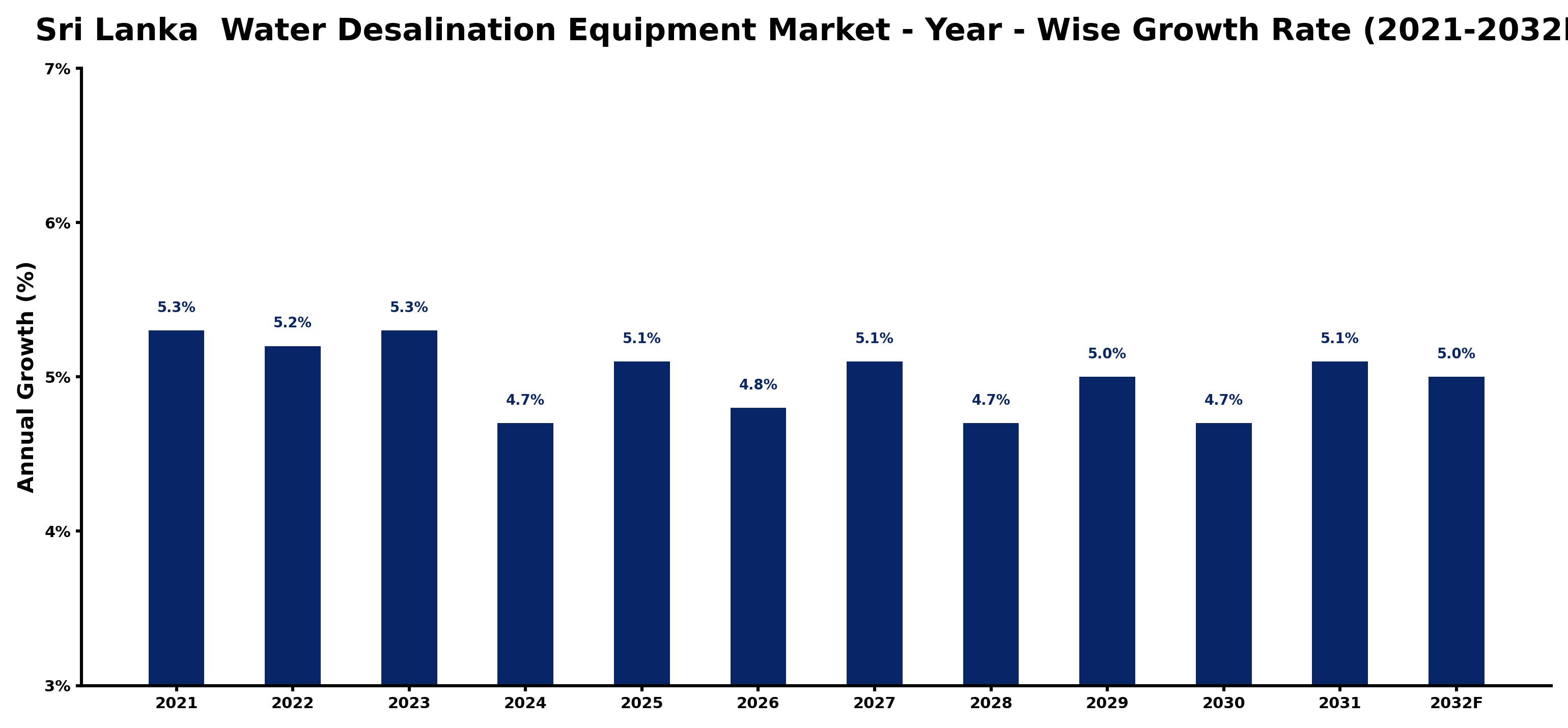
The table below presents the year‑wise growth rates along with the key drivers influencing the market
| Year | Growth Rate | Major Drivers |
| 2021 | 5.3% | Growing urbanization and commercial development |
| 2022 | 5.2% | Growing urbanization and commercial development |
| 2023 | 5.3% | Growing urbanization and commercial development |
| 2024 | 4.7% | Expansion of transportation and logistics networks |
| 2025 | 5.1% | Expansion of transportation and logistics networks |
| 2026 | 4.8% | Growing renewable energy integration projects |
| 2027 | 5.1% | Increasing smart city development projects |
| 2028 | 4.7% | Rising electricity demand across industries |
| 2029 | 5.0% | Government infrastructure modernization initiatives |
| 2030 | 4.7% | Increasing smart city development projects |
| 2031 | 5.1% | Increasing smart city development projects |
| 2032 | 5.0% | Increasing industrial automation investments |
Note - Market size estimations and growth projections presented in this report are based on 6Wresearch's advanced forecasting approach, validated with industry datasets as of June 2026.
Sri Lanka Water Desalination Equipment Market Synopsis
The current landscape of the Sri Lanka Water Desalination Equipment Market reveals a dynamic shift towards innovative water management strategies. With the government pushing for cleaner and more efficient water solutions, there has been a notable increase in investments aimed at enhancing desalination capacities nationwide.
Moreover, industry players are adopting cutting-edge technologies to streamline the desalination process, making it more energy-efficient and environmentally friendly. This concerted effort reflects a commitment to addressing the pressing water needs of Sri Lanka's growing population.
Sri Lanka Water Desalination Equipment Market Key Takeaways
- The market is poised for steady growth, driven by water scarcity and government support.
- There is a significant shift towards sustainable desalination methods incorporating renewable energy.
- Technological innovations are enhancing the efficiency and reliability of desalination systems.
- Investment opportunities abound for companies developing cost-effective desalination technologies.
- Government initiatives are critical in bolstering infrastructure and promoting water security.
Evaluation of Restraints in Sri Lanka Water Desalination Equipment Market
Despite the promising growth outlook, the Sri Lanka Water Desalination Equipment Market faces several restraints. High initial capital costs for establishing desalination plants remain a significant barrier, often deterring potential investments. Additionally, the limited availability of suitable installation sites can complicate the deployment of new technologies. Concerns regarding energy consumption and the environmental impacts of brine discharge further add to the complexities faced by operators. Finally, political instability and regulatory challenges may inhibit the market's progress and investment potential.
Sri Lanka Water Desalination Equipment Market Trends
A growing trend in the Sri Lanka Water Desalination Equipment Market is the increasing integration of renewable energy sources into desalination processes. This shift aims to decrease both operational costs and the ecological footprint of desalination plants. Additionally, there is a pronounced focus on research and development to enhance the efficiency of desalination technologies, which is essential for meeting the diverse needs of municipalities and industries alike.
Moreover, urbanization is prompting a re-evaluation of water infrastructure, leading to new approaches for improving water distribution and quality. Enhanced collaboration between the public and private sectors is also gaining momentum, as stakeholders recognize the necessity for comprehensive solutions to the water crisis.
Sri Lanka Water Desalination Equipment Market Opportunities
With water scarcity becoming a critical concern, the Sri Lanka Water Desalination Equipment Market presents numerous investment opportunities. Companies focused on developing advanced desalination technologies are likely to find significant demand. Additionally, there is a burgeoning market for maintenance and support services for existing desalination plants, creating avenues for partnerships and collaborations. Furthermore, engaging with local governments and communities for large-scale projects can lead to mutually beneficial outcomes, capitalizing on the urgent need for alternative water sources in the region.
Government Initiatives in the Sri Lanka Water Desalination Equipment Market
The Sri Lankan government is actively promoting initiatives that facilitate sustainable water management and enhance water security. Projects under the National Water Supply and Drainage Board Act aim to strengthen regulations surrounding water supply services while ensuring quality standards. Furthermore, investments are being made to augment the capacity of desalination plants and improve the broader water distribution infrastructure, addressing the increasing water demands across various sectors. Incentives and subsidies are also being offered to encourage the adoption of desalination technologies among industries and local communities.
Future Insights of the Sri Lanka Water Desalination Equipment Market
The future outlook for the Sri Lanka Water Desalination Equipment Market is bright, driven by persistent challenges in water availability and an expanding population. The government's emphasis on sustainable practices and infrastructure development will further enhance market growth. As awareness of the benefits of desalination technology spreads, the demand for reliable and safe drinking water will propel the market forward. Innovations in technology, combined with a commitment to sustainability, are expected to shape the industry landscape significantly over the next several years.
Sri Lanka Water Desalination Equipment Market Latest Developments (May 2025 - June 2026)
Recent industry developments indicate a strong commitment to advancing desalination technologies in Sri Lanka. Research and development initiatives are being pursued to improve the efficiency and sustainability of existing systems. Concurrently, dialogues between government bodies and private enterprises are intensifying, aiming to roll out large-scale desalination projects that align with national water security goals. The focus on integrating renewable energy sources continues to gain traction, signifying a shift towards environmentally friendly solutions within the industry.
Sri Lanka Water Desalination Equipment Market - Key Attractiveness of the Report
- 10 Years of Market Numbers
- Historical Data Starting from 2022 to 2025
- Base Year: 2025
- Forecast Data until 2032
- Key Performance Indicators Impacting the Market
- Major Upcoming Developments and Projects
Key Highlights of the Report:
- Sri Lanka Water Desalination Equipment Market Outlook
- Market Size of Sri Lanka Water Desalination Equipment Market, 2025
- Forecast of Sri Lanka Water Desalination Equipment Market, 2032
- Historical Data and Forecast of Sri Lanka Water Desalination Equipment Revenues & Volume for the Period 2022-2032F
- Sri Lanka Water Desalination Equipment Market Trend Evolution
- Sri Lanka Water Desalination Equipment Market Drivers and Challenges
- Sri Lanka Water Desalination Equipment Price Trends
- Sri Lanka Water Desalination Equipment Porter's Five Forces
- Sri Lanka Water Desalination Equipment Industry Life Cycle
- Historical Data and Forecast of Sri Lanka Water Desalination Equipment Market Revenues & Volume By Technology for the Period 2022-2032F
- Historical Data and Forecast of Sri Lanka Water Desalination Equipment Market Revenues & Volume By Reverse Osmosis for the Period 2022-2032F
- Historical Data and Forecast of Sri Lanka Water Desalination Equipment Market Revenues & Volume By Multi-Stage Flash (MSF) Distillation for the Period 2022-2032F
- Historical Data and Forecast of Sri Lanka Water Desalination Equipment Market Revenues & Volume By Multi-Effect Distillation (MED) for the Period 2022-2032F
- Historical Data and Forecast of Sri Lanka Water Desalination Equipment Market Revenues & Volume By Others for the Period 2022-2032F
- Historical Data and Forecast of Sri Lanka Water Desalination Equipment Market Revenues & Volume By Source for the Period 2022-2032F
- Historical Data and Forecast of Sri Lanka Water Desalination Equipment Market Revenues & Volume By Seawater for the Period 2022-2032F
- Historical Data and Forecast of Sri Lanka Water Desalination Equipment Market Revenues & Volume By Brackish water for the Period 2022-2032F
- Historical Data and Forecast of Sri Lanka Water Desalination Equipment Market Revenues & Volume By River water for the Period 2022-2032F
- Historical Data and Forecast of Sri Lanka Water Desalination Equipment Market Revenues & Volume By Others for the Period 2022-2032F
- Historical Data and Forecast of Sri Lanka Water Desalination Equipment Market Revenues & Volume By Application for the Period 2022-2032F
- Historical Data and Forecast of Sri Lanka Water Desalination Equipment Market Revenues & Volume By Municipal for the Period 2022-2032F
- Historical Data and Forecast of Sri Lanka Water Desalination Equipment Market Revenues & Volume By Industrial for the Period 2022-2032F
- Historical Data and Forecast of Sri Lanka Water Desalination Equipment Market Revenues & Volume By Others for the Period 2022-2032F
- Sri Lanka Water Desalination Equipment Import Export Trade Statistics
- Market Opportunity Assessment By Technology
- Market Opportunity Assessment By Source
- Market Opportunity Assessment By Application
- Sri Lanka Water Desalination Equipment Top Companies Market Share
- Sri Lanka Water Desalination Equipment Competitive Benchmarking By Technical and Operational Parameters
- Sri Lanka Water Desalination Equipment Company Profiles
- Sri Lanka Water Desalination Equipment Key Strategic Recommendations






































