Sri Lanka Wheel Loader Market Size, Share & Growth Rate
The Sri Lanka Wheel Loader Market was estimated at USD 1319 Million in 2025 and is projected to reach USD 1905 Million by 2032, growing at a CAGR of 5.4% from 2026 to 2032. This growth trajectory is largely fueled by the country's significant infrastructure development projects, including road construction and urbanization initiatives. Furthermore, the expansion of the agriculture sector and increasing mining activities are also driving demand, as businesses seek efficient material handling solutions.
Sri Lanka Wheel Loader Market Year-wise Growth Rate and Key Drivers
This graph highlights how the Sri Lanka Wheel Loader Market has steadily grown over the years, supported by major growth factors.
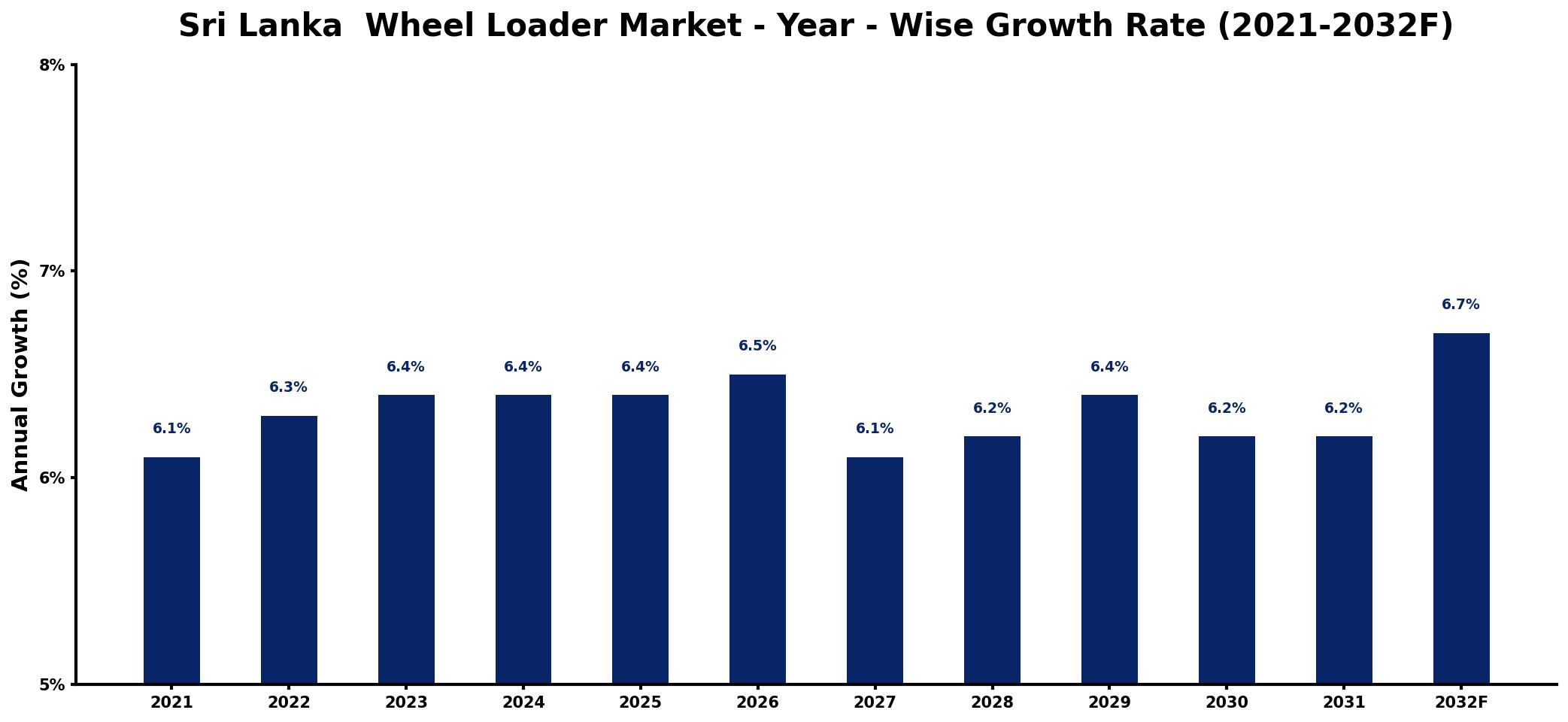
The table below presents the year‑wise growth rates along with the key drivers influencing the market
| Year | Growth Rate | Major Drivers |
| 2021 | 6.1% | Construction sector recovery initiatives |
| 2022 | 6.3% | Infrastructure development funding increases |
| 2023 | 6.4% | Rising demand for heavy machinery |
| 2024 | 6.4% | Boost in public sector projects |
| 2025 | 6.4% | Mining industry expansion plans |
| 2026 | 6.5% | Investment in transportation infrastructure |
| 2027 | 6.1% | Growing urbanization and housing projects |
| 2028 | 6.2% | Increased agricultural mechanization trends |
| 2029 | 6.4% | Government incentives for modernization |
| 2030 | 6.2% | Sustainable development project launches |
| 2031 | 6.2% | Technological advancements in construction |
| 2032 | 6.7% | Emerging markets driving demand growth |
Note: Market size estimations and growth projections presented in this report are based on 6Wresearch's proprietary forecasting methodology, utilizing the latest available industry data, government publications, and primary research inputs.
Sri Lanka Wheel Loader Market Synopsis
The Sri Lanka wheel loader market is currently witnessing a robust demand driven by various sectors, particularly construction and agriculture. With government-backed infrastructure programs, the need for heavy equipment, like wheel loaders, is surging, reflecting the economy's overall growth aspirations.
As the landscape of the industry evolves, the focus is increasingly shifting towards technologically advanced and environmentally friendly options. The demand is particularly strong for multi-functional wheel loaders capable of addressing diverse operational needs across different sectors, thus enhancing productivity and efficiency.
Sri Lanka Wheel Loader Market Key Takeaways
- Infrastructure development projects are significantly boosting demand for wheel loaders in Sri Lanka.
- There is an increasing preference for advanced technology features, including fuel efficiency and operator comfort.
- The market is experiencing a shift towards electric and hybrid wheel loaders, driven by sustainability goals.
- Investment in rental services for wheel loaders presents a profitable opportunity as construction firms seek cost-effective options.
- Government policies are fostering local industry growth while promoting eco-friendly equipment solutions.
Evaluation of Restraints in Sri Lanka Wheel Loader Market
Despite its potential, the Sri Lanka wheel loader market faces certain constraints that could impede growth. One of the primary challenges is the high initial acquisition costs of wheel loaders, which often deter smaller contractors from investing in this critical equipment. Additionally, the shortage of skilled operators and maintenance technicians hinders effective utilization and prolongs the equipments operational lifespan. Furthermore, poor infrastructure, including inadequate road conditions, can lead to performance issues and increased operational expenses for companies that rely on wheel loaders.
Sri Lanka Wheel Loader Market Trends
The market is embracing several noteworthy trends, with a strong emphasis on technological advancements. Equipment equipped with telematics and automation features is gaining traction as businesses strive for enhanced operational efficiency. The growing adoption of electric and hybrid models highlights a commitment to sustainability, aligning with global trends towards reducing carbon footprints. Additionally, the push for versatile and multi-functional machines allows operators to maximize utility across various applications, further solidifying the market's evolution.
Sri Lanka Wheel Loader Market Opportunities
Investors in the Sri Lankan wheel loader market have access to numerous growth avenues. The escalating demand for heavy machinery from the construction sector, propelled by extensive infrastructure projects, presents a ripe opportunity for investment in equipment rental services and dealerships. Moreover, the increasing emphasis on sustainability provides a lucrative landscape for innovations that enhance fuel efficiency and reduce environmental impact. These elements combined create an attractive investment environment for both local and international stakeholders.
Government Initiatives in the Sri Lanka Wheel Loader Market
The Sri Lankan government has instituted various initiatives aimed at bolstering the wheel loader market. Import duties and taxes are strategically imposed to protect local manufacturers while promoting domestic production. Furthermore, safety and environmental regulations ensure that all imported wheel loaders meet stringent compliance standards. Incentives for the adoption of eco-friendly equipment are also in place, supporting the industry's shift towards sustainable practices. These measures are designed to create a competitive and resilient market that prioritizes local industry growth and environmental stewardship.
Future Insights of the Sri Lanka Wheel Loader Market
Looking ahead to 2026-2032, the Sri Lanka wheel loader market is expected to maintain a positive growth trajectory, supported by ongoing infrastructure investments and expanding economic activities. As companies continue to seek efficient earthmoving and material handling solutions, the demand for wheel loaders will likely intensify. Innovations in technology, particularly in automation and sustainability, are anticipated to play a key role in shaping market dynamics. While challenges, such as raw material price fluctuations, remain, the overall outlook remains optimistic, buoyed by governmental support and strategic investments.
Sri Lanka Wheel Loader Market Latest Developments (2025 - 2026)
Recent developments in the Sri Lanka wheel loader market indicate a growing focus on technological upgrades and environmental sustainability. Numerous companies are actively exploring innovative solutions that cater to the demands for enhanced efficiency and reduced carbon emissions. Moreover, public and private sectors are aligning to support infrastructure development projects, fostering a conducive environment for market growth. As trends towards automation and electrification in heavy machinery continue to rise, stakeholders are adapting strategies to meet these evolving market dynamics.
Sri Lanka Wheel Loader Market - Key Attractiveness of the Report
- 10 Years of Market Numbers
- Historical Data Starting from 2022 to 2025
- Base Year: 2025
- Forecast Data until 2032
- Key Performance Indicators Impacting the Market
- Major Upcoming Developments and Projects
Key Highlights of the Report:
- Sri Lanka Wheel Loader Market Outlook
- Market Size of Sri Lanka Wheel Loader Market, 2025
- Forecast of Sri Lanka Wheel Loader Market, 2032
- Historical Data and Forecast of Sri Lanka Wheel Loader Revenues & Volume for the Period 2022-2032F
- Sri Lanka Wheel Loader Market Trend Evolution
- Sri Lanka Wheel Loader Market Drivers and Challenges
- Sri Lanka Wheel Loader Price Trends
- Sri Lanka Wheel Loader Porter's Five Forces
- Sri Lanka Wheel Loader Industry Life Cycle
- Historical Data and Forecast of Sri Lanka Wheel Loader Market Revenues & Volume By Types for the Period 2022-2032F
- Historical Data and Forecast of Sri Lanka Wheel Loader Market Revenues & Volume By Armored Wheel Loaders for the Period 2022-2032F
- Historical Data and Forecast of Sri Lanka Wheel Loader Market Revenues & Volume By Tractor Front Loaders for the Period 2022-2032F
- Historical Data and Forecast of Sri Lanka Wheel Loader Market Revenues & Volume By Compact Front End Loaders for the Period 2022-2032F
- Historical Data and Forecast of Sri Lanka Wheel Loader Market Revenues & Volume By Skid Loaders & Track Loaders for the Period 2022-2032F
- Historical Data and Forecast of Sri Lanka Wheel Loader Market Revenues & Volume By Operating Power for the Period 2022-2032F
- Historical Data and Forecast of Sri Lanka Wheel Loader Market Revenues & Volume By 20 ?? 40 Hp for the Period 2022-2032F
- Historical Data and Forecast of Sri Lanka Wheel Loader Market Revenues & Volume By 40 ?? 80 Hp for the Period 2022-2032F
- Historical Data and Forecast of Sri Lanka Wheel Loader Market Revenues & Volume By 80 ?? 120 Hp for the Period 2022-2032F
- Historical Data and Forecast of Sri Lanka Wheel Loader Market Revenues & Volume By 120 ?? 160 Hp for the Period 2022-2032F
- Historical Data and Forecast of Sri Lanka Wheel Loader Market Revenues & Volume By 160 Hp for the Period 2022-2032F
- Historical Data and Forecast of Sri Lanka Wheel Loader Market Revenues & Volume By Above for the Period 2022-2032F
- Historical Data and Forecast of Sri Lanka Wheel Loader Market Revenues & Volume By Types Of Bucket for the Period 2022-2032F
- Historical Data and Forecast of Sri Lanka Wheel Loader Market Revenues & Volume By Bottom Bucket for the Period 2022-2032F
- Historical Data and Forecast of Sri Lanka Wheel Loader Market Revenues & Volume By Flat Bottom Bucket for the Period 2022-2032F
- Historical Data and Forecast of Sri Lanka Wheel Loader Market Revenues & Volume By Backhoe Bucket for the Period 2022-2032F
- Historical Data and Forecast of Sri Lanka Wheel Loader Market Revenues & Volume By Demolition Bucket for the Period 2022-2032F
- Historical Data and Forecast of Sri Lanka Wheel Loader Market Revenues & Volume By Excavating Buckets for the Period 2022-2032F
- Historical Data and Forecast of Sri Lanka Wheel Loader Market Revenues & Volume By Others for the Period 2022-2032F
- Historical Data and Forecast of Sri Lanka Wheel Loader Market Revenues & Volume By End-use Application for the Period 2022-2032F
- Historical Data and Forecast of Sri Lanka Wheel Loader Market Revenues & Volume By Stone Quarries for the Period 2022-2032F
- Historical Data and Forecast of Sri Lanka Wheel Loader Market Revenues & Volume By Mining Zones for the Period 2022-2032F
- Historical Data and Forecast of Sri Lanka Wheel Loader Market Revenues & Volume By Construction Sites for the Period 2022-2032F
- Historical Data and Forecast of Sri Lanka Wheel Loader Market Revenues & Volume By Military & Defense for the Period 2022-2032F
- Historical Data and Forecast of Sri Lanka Wheel Loader Market Revenues & Volume By Public Sectors for the Period 2022-2032F
- Sri Lanka Wheel Loader Import Export Trade Statistics
- Market Opportunity Assessment By Types
- Market Opportunity Assessment By Operating Power
- Market Opportunity Assessment By Types Of Bucket
- Market Opportunity Assessment By End-use Application
- Sri Lanka Wheel Loader Top Companies Market Share
- Sri Lanka Wheel Loader Competitive Benchmarking By Technical and Operational Parameters
- Sri Lanka Wheel Loader Company Profiles
- Sri Lanka Wheel Loader Key Strategic Recommendations






































