Sri Lanka Whipping Cream Market Size, Share & Growth Rate
The Sri Lanka Whipping Cream Market was estimated at USD 1393 Million in 2025 and is projected to reach USD 1985 Million by 2032, growing at a CAGR of 5.2% from 2026 to 2032. This growth trajectory is significantly driven by the rising consumer interest in baking and homemade desserts, as well as the increasing number of cafes and bakeries that cater to the growing demand for high-quality ingredients. The trend towards gourmet cooking at home and special occasions celebrated with elaborate desserts has created a robust market environment for whipping cream.
Sri Lanka Whipping Cream Market Growth Rate Analysis (2021-2032)
The Sri Lankan whipping cream market has shown notable stability, with growth rates peaking at 6.4% in 2022 and hovering around 6.2% in 2023, before slightly moderating to 5.9% in 2024. This growth can be attributed to rising consumer demand for premium baking and dessert products, bolstered by a thriving tourism sector that fuels the hospitality industry. Investments in more efficient production technologies and the expansion of distribution channels have further contributed to market resilience. Although growth rates exhibit minor fluctuations, with projected figures of 5.8% in 2030 and a rebound to 6.3% in subsequent years, the overarching trend remains positive, supported by consistent consumer preferences for high-quality dairy ingredients.
Sri Lanka Whipping Cream Market Year-wise Growth Rate and Key Drivers
This graph highlights how the Sri Lanka Whipping Cream Market has steadily grown over the past five years, supported by major growth factors.
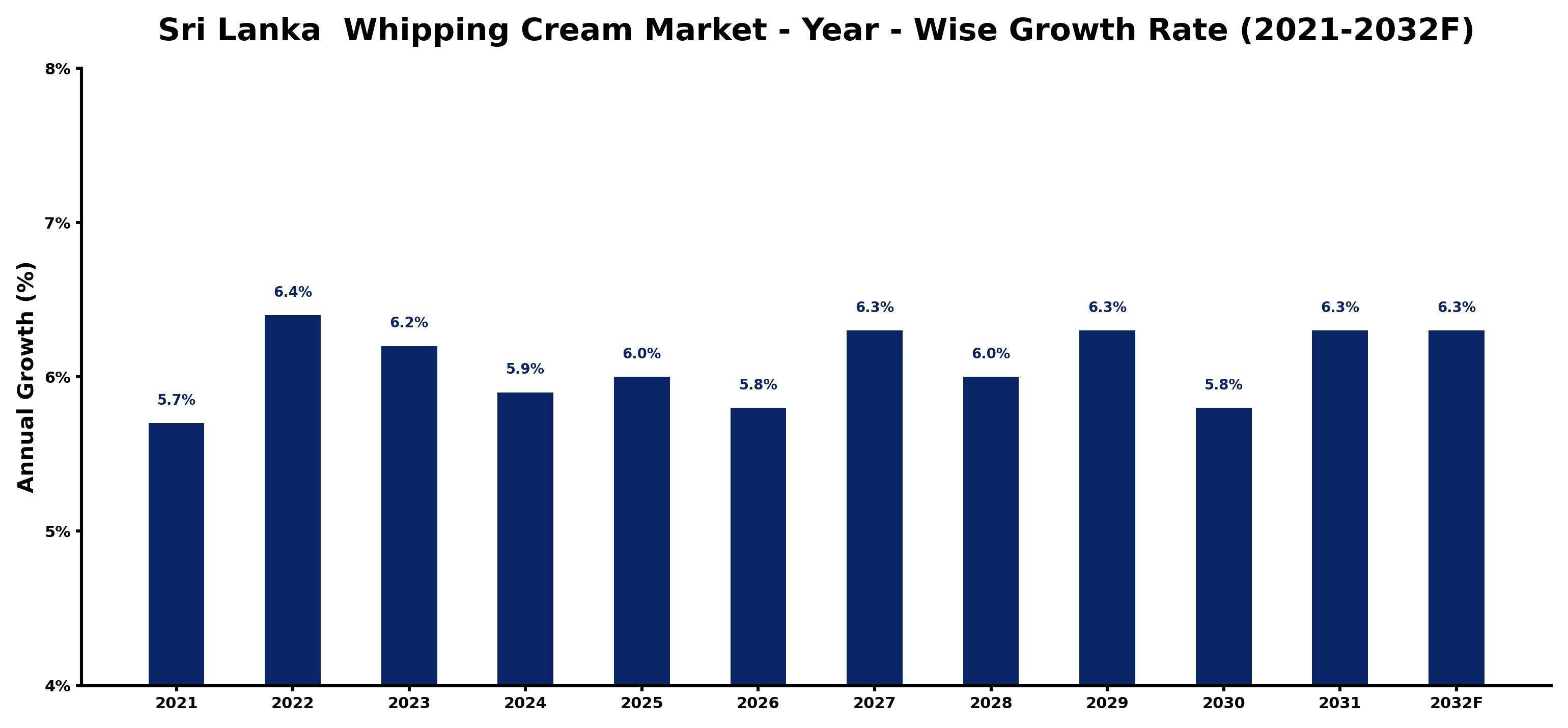
The table below presents the year‑wise growth rates along with the key drivers influencing the market
| Year | Growth Rate | Major Drivers |
| 2021 | 5.7% | Increased demand for desserts |
| 2022 | 6.4% | Growth in bakery sector demand |
| 2023 | 6.2% | Rising popularity of whipped toppings |
| 2024 | 5.9% | Expansion of foodservice industry |
| 2025 | 6.0% | Innovative product offerings launched |
| 2026 | 5.8% | Health-conscious consumer trends emerged |
| 2027 | 6.3% | Culinary trends embraced cream usage |
| 2028 | 6.0% | Home baking popularity surged upward |
| 2029 | 6.3% | Diverse flavor options attracted consumers |
| 2030 | 5.8% | Sustainable sourcing gained consumer interest |
| 2031 | 6.3% | Increased availability of premium brands |
| 2032 | 6.3% | E-commerce growth facilitated purchases |
Note - Market size estimations and growth projections presented in this report are based on 6Wresearch’s advanced forecasting approach, validated with industry datasets as of June 2026.
Sri Lanka Whipping Cream Market Synopsis
The primary force shaping the Sri Lanka Whipping Cream Market is the increasing trend of home baking, supported by a burgeoning culture of dessert-making. As more consumers aspire to recreate professional-quality pastries in their kitchens, whipping cream has become an essential ingredient in their culinary endeavors.
Additionally, the proliferation of cafes and artisanal bakeries is expanding the availability and acceptance of whipping cream as a standard ingredient. This demand not only highlights the consumer's shift towards quality but also showcases an evolving palate that appreciates the richness and versatility of whipped dairy products.
Sri Lanka Whipping Cream Market Key Takeaways
- The market is witnessing consistent growth driven by home baking and the rise of dessert culture.
- Health-conscious consumers are influencing product development, leading to a rise in low-fat and non-dairy options.
- Innovation in flavors and packaging formats is becoming critical for manufacturers to attract a broader audience.
- Local producers are competing with international brands to meet the diverse needs of the market.
- The growing foodservice sector provides ample opportunities for expansion in the whipping cream market.
Evaluation of Restraints in Sri Lanka Whipping Cream Market
While the Sri Lanka Whipping Cream Market shows promise, several restraints hinder its growth. Consumer awareness regarding the benefits and uses of whipping cream remains limited, constraining its appeal compared to more widely understood dairy products. The challenge of maintaining consistent quality and supply of high-grade whipping cream is also prevalent, which can impede market growth. Pricing perceptions position whipping cream as a premium product, potentially alienating cost-conscious consumers. Additionally, the rise of non-dairy alternatives may shift consumer preferences, posing a further threat to traditional whipping cream products.
Sri Lanka Whipping Cream Market Trends
A notable trend in the Sri Lanka Whipping Cream Market is the increasing consumer preference for natural and healthier ingredient options. As the health-conscious demographic continues to grow, demand for low-fat and non-dairy whipping cream alternatives is on the rise. Furthermore, the convenience factor is becoming crucial, with manufacturers focusing on easy-to-use packaging that appeals to busy consumers. Alongside this, a shift towards gourmet cooking is driving innovation in flavors, where unique offerings are capturing consumer interest and expanding the market further.
Sri Lanka Whipping Cream Market Opportunities
Investment opportunities in the Sri Lanka Whipping Cream Market are abundant, particularly for those looking to establish manufacturing facilities to meet local demand. With an increasing number of cafes, bakeries, and a budding home baking culture, there is a significant need for high-quality whipping cream. Additionally, innovating product lines to include new flavors or healthier options can attract a broader consumer base. Forming strategic partnerships with local distributors and retailers also presents a pathway to enhance market penetration and visibility.
Government Initiatives in the Sri Lanka Whipping Cream Market
The government of Sri Lanka plays a crucial role in regulating the Whipping Cream Market through food safety standards and import regulations. The Sri Lanka Standards Institution (SLSI) enforces strict quality measures and safety standards for dairy products, ensuring that manufacturers adhere to regulations that protect consumers. Accurate labeling requirements also mandate that nutritional information and ingredient lists be clearly presented, fostering informed consumer choices. These government initiatives aim to sustain a competitive market while ensuring consumer safety and product quality.
Future Insights of the Sri Lanka Whipping Cream Market
Looking ahead, the Sri Lanka Whipping Cream Market is poised for sustained growth through 2032. Factors such as rising disposable incomes and an increasing interest in premium dairy products suggest an expanding consumer base. As culinary trends continue to evolve, the demand for high-quality whipping cream will remain strong, fueled by the proliferation of the foodservice sector and new bakery businesses. The emphasis on innovation and adaptability within the industry will be pivotal for manufacturers as they seek to capture the attention of discerning consumers.
Sri Lanka Whipping Cream Market Latest Developments (May 2025 - June 2026)
In the most recent period, the Sri Lanka whipping cream market has seen a notable increase in product diversification, with companies launching new flavors and convenient packaging solutions to cater to evolving consumer preferences. The trend towards sustainability is also becoming prominent, with initiatives focusing on eco-friendly packaging and sourcing practices being adopted by several manufacturers. The emphasis on quality and local sourcing is reshaping the competitive landscape, encouraging both domestic and international players to innovate and adapt to the changing market dynamics.
Sri Lanka Whipping Cream Market - Key Attractiveness of the Report
- 10 Years of Market Numbers
- Historical Data Starting from 2022 to 2025
- Base Year: 2025
- Forecast Data until 2032
- Key Performance Indicators Impacting the Market
- Major Upcoming Developments and Projects
Key Highlights of the Report:
- Sri Lanka Whipping Cream Market Outlook
- Market Size of Sri Lanka Whipping Cream Market, 2025
- Forecast of Sri Lanka Whipping Cream Market, 2032
- Historical Data and Forecast of Sri Lanka Whipping Cream Revenues & Volume for the Period 2022-2032F
- Sri Lanka Whipping Cream Market Trend Evolution
- Sri Lanka Whipping Cream Market Drivers and Challenges
- Sri Lanka Whipping Cream Price Trends
- Sri Lanka Whipping Cream Porter's Five Forces
- Sri Lanka Whipping Cream Industry Life Cycle
- Historical Data and Forecast of Sri Lanka Whipping Cream Market Revenues & Volume By Product for the Period 2022-2032F
- Historical Data and Forecast of Sri Lanka Whipping Cream Market Revenues & Volume By Dairy for the Period 2022-2032F
- Historical Data and Forecast of Sri Lanka Whipping Cream Market Revenues & Volume By Non-Dairy for the Period 2022-2032F
- Historical Data and Forecast of Sri Lanka Whipping Cream Market Revenues & Volume By Application for the Period 2022-2032F
- Historical Data and Forecast of Sri Lanka Whipping Cream Market Revenues & Volume By B2B for the Period 2022-2032F
- Historical Data and Forecast of Sri Lanka Whipping Cream Market Revenues & Volume By B2C for the Period 2022-2032F
- Historical Data and Forecast of Sri Lanka Whipping Cream Market Revenues & Volume By Distribution Channel for the Period 2022-2032F
- Historical Data and Forecast of Sri Lanka Whipping Cream Market Revenues & Volume By Warehouse Clubs for the Period 2022-2032F
- Historical Data and Forecast of Sri Lanka Whipping Cream Market Revenues & Volume By Variety Stores for the Period 2022-2032F
- Historical Data and Forecast of Sri Lanka Whipping Cream Market Revenues & Volume By Department Stores for the Period 2022-2032F
- Historical Data and Forecast of Sri Lanka Whipping Cream Market Revenues & Volume By Online Retail for the Period 2022-2032F
- Historical Data and Forecast of Sri Lanka Whipping Cream Market Revenues & Volume By Convenience Stores for the Period 2022-2032F
- Historical Data and Forecast of Sri Lanka Whipping Cream Market Revenues & Volume By Supermarkets and Hypermarket for the Period 2022-2032F
- Historical Data and Forecast of Sri Lanka Whipping Cream Market Revenues & Volume By Specialist Retailers for the Period 2022-2032F
- Historical Data and Forecast of Sri Lanka Whipping Cream Market Revenues & Volume By Others for the Period 2022-2032F
- Sri Lanka Whipping Cream Import Export Trade Statistics
- Market Opportunity Assessment By Product
- Market Opportunity Assessment By Application
- Market Opportunity Assessment By Distribution Channel
- Sri Lanka Whipping Cream Top Companies Market Share
- Sri Lanka Whipping Cream Competitive Benchmarking By Technical and Operational Parameters
- Sri Lanka Whipping Cream Company Profiles
- Sri Lanka Whipping Cream Key Strategic Recommendations






































