Sri Lanka Winding Wire Market Size, Share & Growth Rate
The Sri Lanka Winding Wire Market was estimated at USD 1045 Million in 2025 and is projected to reach USD 1494 Million by 2032, growing at a CAGR of 5.2% from 2026 to 2032. This growth trajectory is primarily fueled by the burgeoning manufacturing sector, which is increasingly reliant on high-quality winding wires for electrical applications. Additionally, infrastructure development initiatives and rising investments in renewable energy further bolster the demand for effective winding wire solutions across multiple industries.
Sri Lanka Winding Wire Market Growth Rate Analysis (2021-2032)
The Sri Lanka winding wire market has experienced stable growth, with an annual growth rate of 6.0% in 2021, slightly dipping to 5.9% in 2022 and 2023. However, as the demand for energy-efficient solutions escalates, the market is projected to rebound with a growth of 6.1% in 2024 and maintain similar rates through 2027. Factors such as increasing investments in infrastructure and a surge in production across various industries, including renewable energy, contribute to this trend. The gradual advancement of technology and ongoing digitalization further drive consumer demand, helping the market achieve a forecasted growth of 6.4% by 2029. Overall, a robust industrial landscape supports sustained momentum.
Sri Lanka Winding Wire Market Year-wise Growth Rate and Key Drivers
This graph highlights how the Sri Lanka Winding Wire Market has steadily grown over the past five years, supported by major growth factors.
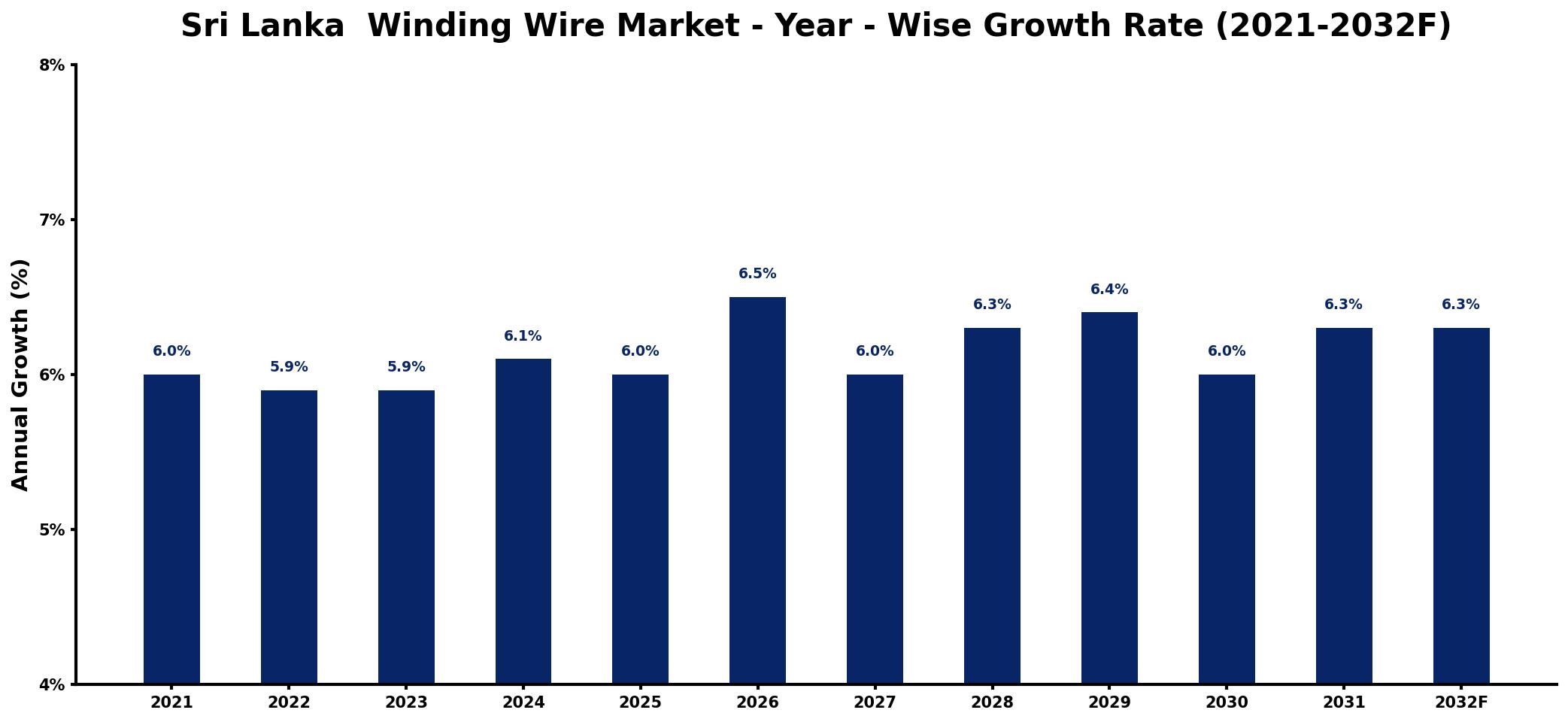
The table below presents the year‑wise growth rates along with the key drivers influencing the market
| Year | Growth Rate | Major Drivers |
| 2021 | 6.0% | Rising construction sector investments |
| 2022 | 5.9% | Growth in renewable energy projects |
| 2023 | 5.9% | Expansion of electrical infrastructure |
| 2024 | 6.1% | Increased automotive manufacturing demand |
| 2025 | 6.0% | Surge in telecommunication networks |
| 2026 | 6.5% | Advancements in technology adoption |
| 2027 | 6.0% | Growing demand for industrial equipment |
| 2028 | 6.3% | Boost in residential development projects |
| 2029 | 6.4% | Rising electronics manufacturing activities |
| 2030 | 6.0% | Enhanced government infrastructure spending |
| 2031 | 6.3% | Increased focus on energy efficiency |
| 2032 | 6.3% | increased capital investment inflows |
Note: Market size estimations and growth projections presented in this report are based on 6Wresearch's proprietary forecasting methodology, utilizing the latest available industry data, government publications, and primary research inputs.
Sri Lanka Winding Wire Market Synopsis
The most significant force shaping the Sri Lanka Winding Wire Market is the rising demand from key sectors such as electronics, automotive, and electrical equipment manufacturing. This increasing consumption is directly linked to the country's rapid industrialization and ongoing infrastructure projects aimed at enhancing productivity and efficiency.
Furthermore, a notable trend is the shift towards environmentally friendly products, as manufacturers strive to meet sustainable standards and regulations. This is steering investments in innovative technologies that facilitate the production of high-quality winding wires, which in turn supports the countrys economic growth and commitment to sustainability.
Sri Lanka Winding Wire Market Key Takeaways
- The market is witnessing a marked transition towards aluminum winding wires, owing to their cost-effectiveness and lightweight characteristics.
- Investment in infrastructure development is a crucial driver for demand in the winding wire segment.
- Technological advancements are enhancing production processes, leading to improved wire quality and efficiency.
- Market players are increasingly forming partnerships to customize products and fulfill specific industry requirements.
- Government incentives aimed at supporting local manufacturing are playing a significant role in shaping market dynamics.
Evaluation of Restraints in Sri Lanka Winding Wire Market
Despite its growth potential, the Sri Lanka Winding Wire Market faces notable restraints. Key among these are the fluctuating prices of raw materials like copper and aluminum, which can significantly affect production costs. Additionally, the market contends with increasing competition from low-cost imports, challenging local manufacturers. The economic landscape, influenced by political instability and currency fluctuations, further complicates operational strategies, making it imperative for companies to innovate and adapt to remain competitive.
Sri Lanka Winding Wire Market Trends
Current trends in the Sri Lanka Winding Wire Market reflect a growing emphasis on eco-friendly and energy-efficient products. Manufacturers are increasingly focused on developing winding wires that not only enhance performance but also comply with stringent environmental regulations. Moreover, the integration of automation and IoT technology into production processes is streamlining operations, reducing waste, and improving overall efficiency. This technological shift is crucial as the market seeks to meet the evolving demands of modern industries.
Sri Lanka Winding Wire Market Opportunities
The Sri Lanka Winding Wire Market presents substantial investment opportunities, particularly in sectors that are poised for growth, such as renewable energy and electric vehicle manufacturing. As the government accelerates infrastructure development projects, there will be a sustained demand for high-quality winding wires in various applications, including motors and transformers. This, coupled with the push for more energy-efficient solutions, creates fertile ground for investors looking to capitalize on the burgeoning industrial landscape of Sri Lanka.
Government Initiatives in the Sri Lanka Winding Wire Market
Government policies in Sri Lanka are increasingly designed to bolster the local winding wire industry. This includes the imposition of import duties on raw materials to protect domestic manufacturers and various incentives such as tax breaks to encourage investment in local production facilities. Moreover, the government is actively promoting quality standards and regulations to ensure that winding wire products meet safety and performance benchmarks, thereby fostering confidence in local manufacturing.
Future Insights of the Sri Lanka Winding Wire Market
Looking ahead to 2026-2032, the Sri Lanka Winding Wire Market is set to expand significantly, driven by the ongoing industrial growth and a shift towards renewable energy solutions. As infrastructure projects continue to gain momentum, the demand for high-quality winding wires will rise correspondingly. Additionally, ongoing advancements in technology will facilitate the production of more efficient and durable winding wires, positioning the market for sustained growth. The strategic focus on domestic manufacturing by the government further enhances the outlook for a robust and resilient market.
Sri Lanka Winding Wire Market Latest Developments (2025 - 2026)
Recent developments in the Sri Lanka Winding Wire Market indicate a strong movement towards product innovation and enhanced production efficiency. Industry players are increasingly investing in research and development to create advanced winding wire solutions tailored to specific applications. This period has also seen a surge in collaborations between manufacturers and end-users, aimed at achieving customized solutions that meet the specific requirements of various sectors. Additionally, initiatives to adopt sustainable practices in manufacturing are becoming more prevalent, in line with global environmental trends.
Sri Lanka Winding Wire Market - Key Attractiveness of the Report
- 10 Years of Market Numbers
- Historical Data Starting from 2022 to 2025
- Base Year: 2025
- Forecast Data until 2032
- Key Performance Indicators Impacting the Market
- Major Upcoming Developments and Projects
Key Highlights of the Report:
- Sri Lanka Winding Wire Market Outlook
- Market Size of Sri Lanka Winding Wire Market, 2025
- Forecast of Sri Lanka Winding Wire Market, 2032
- Historical Data and Forecast of Sri Lanka Winding Wire Revenues & Volume for the Period 2022-2032F
- Sri Lanka Winding Wire Market Trend Evolution
- Sri Lanka Winding Wire Market Drivers and Challenges
- Sri Lanka Winding Wire Price Trends
- Sri Lanka Winding Wire Porter's Five Forces
- Sri Lanka Winding Wire Industry Life Cycle
- Historical Data and Forecast of Sri Lanka Winding Wire Market Revenues & Volume By Product for the Period 2022-2032F
- Historical Data and Forecast of Sri Lanka Winding Wire Market Revenues & Volume By Copper Winding Wire for the Period 2022-2032F
- Historical Data and Forecast of Sri Lanka Winding Wire Market Revenues & Volume By Aluminum Winding Wire for the Period 2022-2032F
- Sri Lanka Winding Wire Import Export Trade Statistics
- Market Opportunity Assessment By Product
- Sri Lanka Winding Wire Top Companies Market Share
- Sri Lanka Winding Wire Competitive Benchmarking By Technical and Operational Parameters
- Sri Lanka Winding Wire Company Profiles
- Sri Lanka Winding Wire Key Strategic Recommendations






































