Sri Lanka Wooden Toys Market Size, Share & Growth Rate
The Sri Lanka Wooden Toys Market was estimated at USD 329 Million in 2025 and is projected to reach USD 467 Million by 2032, growing at a CAGR of 5.1% from 2026 to 2032. This growth trajectory is driven by the increasing awareness among parents about the benefits of natural materials for their children, alongside a rising trend towards sustainable and eco-friendly products. The market is further supported by a robust demand for educational toys that enhance children's development while retaining a focus on safety.
Sri Lanka Wooden Toys Market Year-wise Growth Rate and Key Drivers
This graph highlights how the Sri Lanka Wooden Toys Market has steadily grown over the years, supported by major growth factors.
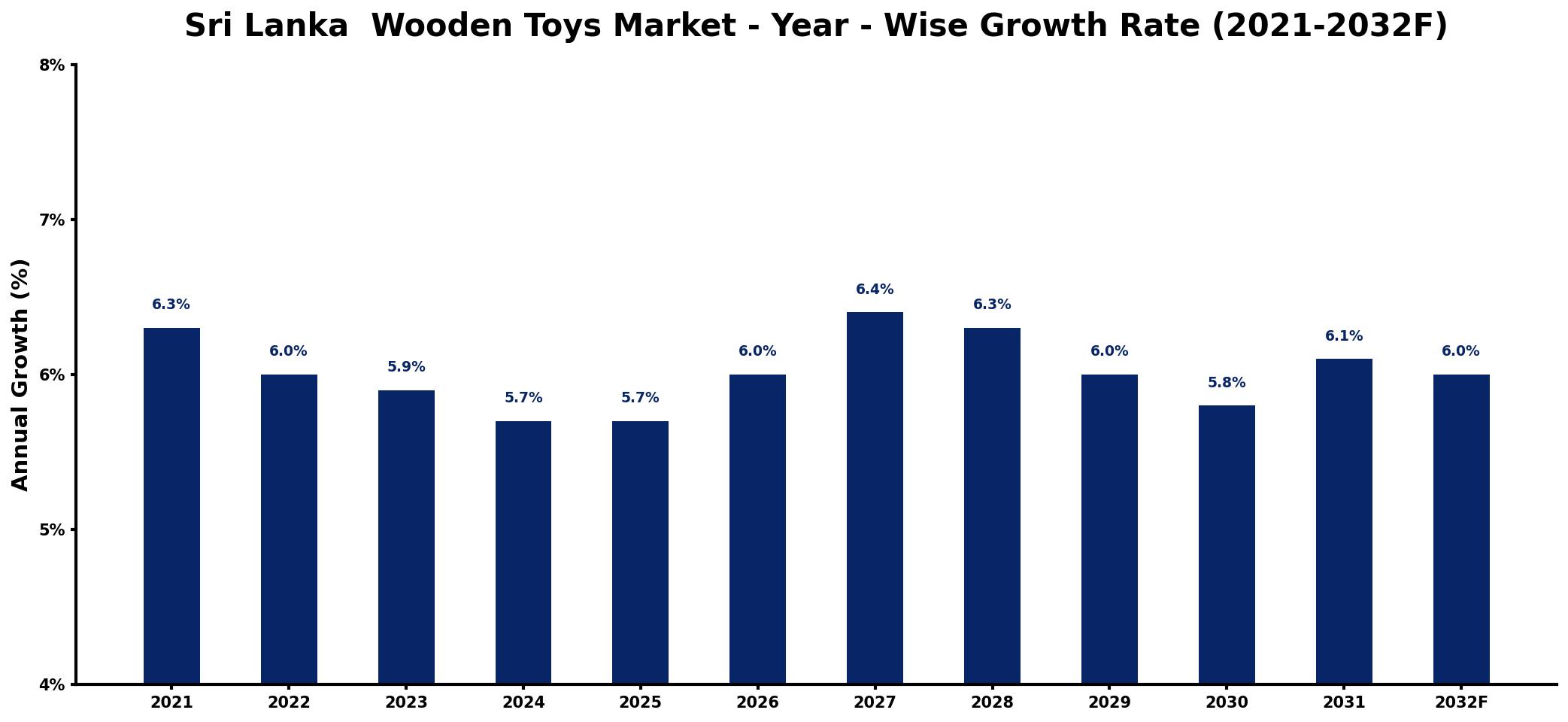
The table below presents the year‑wise growth rates along with the key drivers influencing the market
| Year | Growth Rate | Major Drivers |
| 2021 | 6.3% | Increased consumer interest in sustainability |
| 2022 | 6.0% | Rising disposable income among families |
| 2023 | 5.9% | Growing popularity of eco-friendly products |
| 2024 | 5.7% | Expansion of online retail platforms |
| 2025 | 5.7% | Increased investment in manufacturing technology |
| 2026 | 6.0% | increased overall sector activity |
| 2027 | 6.4% | Growth in domestic craftsmanship initiatives |
| 2028 | 6.3% | strengthening underlying market demand |
| 2029 | 6.0% | Increase in international trade agreements |
| 2030 | 5.8% | rising end-use demand growth |
| 2031 | 6.1% | Increased focus on quality standards |
| 2032 | 6.0% | growing commercial sector adoption |
Note: Market size estimations and growth projections presented in this report are based on 6Wresearch's proprietary forecasting methodology, utilizing the latest available industry data, government publications, and primary research inputs.
Sri Lanka Wooden Toys Market Synopsis
Currently, the Sri Lankan wooden toys market is witnessing a rejuvenation, characterized by an increasing number of artisans and manufacturers embracing traditional craftsmanship techniques. The emphasis on handmade, durable toys resonates well with environmentally conscious consumers, creating a niche that aligns with contemporary educational paradigms.
The diverse range of products includes not just toys for recreational use but also educational tools that enhance cognitive development in children. Such offerings underscore a significant shift in parental preferences towards materials that are safer and more beneficial than their plastic counterparts, thereby promoting a culture of sustainability.
Sri Lanka Wooden Toys Market Key Takeaways
- The market exhibits a strong growth forecast with a notable CAGR of 5.1% through 2032.
- Consumer demand is increasingly centered on eco-friendly, non-toxic wooden toys.
- There is a significant revival of artisanal craftsmanship contributing to market differentiation.
- Government initiatives are fostering the export potential of Sri Lankan wooden toys.
- Heightened consumer awareness is driving preferences toward educational and durable toy options.
Evaluation of Restraints in Sri Lanka Wooden Toys Market
Despite promising growth, the Sri Lanka wooden toys market grapples with several restraints that hinder its full potential. High production costs remain a significant barrier, limiting the scalability of manufacturers and their ability to compete against cheaper plastic alternatives. Moreover, the availability of sustainable raw materials is constrained, impacting the supply chain and overall production. Compounding these challenges is a general lack of awareness among consumers regarding the advantages of modern wooden toys, which could limit market penetration. Economic instability further adds to the uncertainty, influencing both production and consumption patterns in this sector.
Sri Lanka Wooden Toys Market Trends
Several trends are shaping the Sri Lanka wooden toys market. Firstly, the demand for non-toxic finishes and sustainable sourcing methods is becoming the norm, as consumers increasingly prioritize safety and environmental impact. Additionally, the rise of educational toys designed to stimulate learning and creativity reflects a broader shift in how parents view playtime, considering it an integral part of child development. Artisanal craftsmanship is gaining traction, as more consumers seek unique, handcrafted items that tell a story and support local economies.
Sri Lanka Wooden Toys Market Opportunities
The wooden toys market in Sri Lanka presents ample opportunities for growth and investment, particularly in niche segments that emphasize educational value and eco-friendliness. Expanding online retail channels could further enhance market reach, allowing local manufacturers to penetrate wider markets, including exports. There is also significant potential in collaborating with educational institutions to develop toys that align with curricula, thereby catering to a dual demand for both recreational and educational products.
Government Initiatives in the Sri Lanka Wooden Toys Market
Government initiatives play a crucial role in shaping the landscape of the Sri Lanka wooden toys market. Policies focused on enforcing safety standards and promoting traditional craftsmanship are vital for ensuring product reliability. Furthermore, the government is actively pursuing programs aimed at supporting local artisans, enhancing their skills, and promoting export opportunities. Consumer awareness campaigns about the benefits of wooden toys also align with broader efforts to foster sustainable practices within the industry.
Future Insights of the Sri Lanka Wooden Toys Market
Looking ahead to 2026-2032, the Sri Lanka wooden toys market is poised for a significant transformation. As consumer preferences continue to evolve towards sustainability and educational value, the market is likely to witness a diversification of product offerings. Increased collaboration between artisans and educational experts could yield innovative designs that captivate modern parents. Additionally, enhanced online retail strategies and globalization will further elevate the market's stature, allowing it to tap into the growing international demand for eco-friendly products.
Sri Lanka Wooden Toys Market Latest Developments (2025 - 2026)
In recent months, the Sri Lankan wooden toys market has seen a notable shift towards artisanal products, with an increase in local fairs and exhibitions dedicated to handcrafted toys. These events have not only showcased local talent but have also attracted international buyers, enhancing export potential. Moreover, manufacturers are increasingly adopting sustainable practices in their production processes, reflecting a growing commitment to eco-friendliness. Industry stakeholders are also collaborating to improve supply chain efficiencies, aiming to mitigate challenges related to raw material availability.
Sri Lanka Wooden Toys Market - Key Attractiveness of the Report
- 10 Years of Market Numbers
- Historical Data Starting from 2022 to 2025
- Base Year: 2025
- Forecast Data until 2032
- Key Performance Indicators Impacting the Market
- Major Upcoming Developments and Projects
Key Highlights of the Report:
- Sri Lanka Wooden Toys Market Outlook
- Market Size of Sri Lanka Wooden Toys Market, 2025
- Forecast of Sri Lanka Wooden Toys Market, 2032
- Historical Data and Forecast of Sri Lanka Wooden Toys Revenues & Volume for the Period 2022-2032F
- Sri Lanka Wooden Toys Market Trend Evolution
- Sri Lanka Wooden Toys Market Drivers and Challenges
- Sri Lanka Wooden Toys Price Trends
- Sri Lanka Wooden Toys Porter's Five Forces
- Sri Lanka Wooden Toys Industry Life Cycle
- Historical Data and Forecast of Sri Lanka Wooden Toys Market Revenues & Volume By Product Type for the Period 2022-2032F
- Historical Data and Forecast of Sri Lanka Wooden Toys Market Revenues & Volume By Educational Toys for the Period 2022-2032F
- Historical Data and Forecast of Sri Lanka Wooden Toys Market Revenues & Volume By Construction Toys for the Period 2022-2032F
- Historical Data and Forecast of Sri Lanka Wooden Toys Market Revenues & Volume By Musical Toys for the Period 2022-2032F
- Historical Data and Forecast of Sri Lanka Wooden Toys Market Revenues & Volume By Game Toys for the Period 2022-2032F
- Historical Data and Forecast of Sri Lanka Wooden Toys Market Revenues & Volume By Dolls & Miniatures for the Period 2022-2032F
- Historical Data and Forecast of Sri Lanka Wooden Toys Market Revenues & Volume By Automotive Toys for the Period 2022-2032F
- Historical Data and Forecast of Sri Lanka Wooden Toys Market Revenues & Volume By Pretend Play Toys for the Period 2022-2032F
- Historical Data and Forecast of Sri Lanka Wooden Toys Market Revenues & Volume By Wood Type for the Period 2022-2032F
- Historical Data and Forecast of Sri Lanka Wooden Toys Market Revenues & Volume By Softwood for the Period 2022-2032F
- Historical Data and Forecast of Sri Lanka Wooden Toys Market Revenues & Volume By Hardwood for the Period 2022-2032F
- Historical Data and Forecast of Sri Lanka Wooden Toys Market Revenues & Volume By Age Group for the Period 2022-2032F
- Historical Data and Forecast of Sri Lanka Wooden Toys Market Revenues & Volume By Below 1 Year for the Period 2022-2032F
- Historical Data and Forecast of Sri Lanka Wooden Toys Market Revenues & Volume By Age 1-3 for the Period 2022-2032F
- Historical Data and Forecast of Sri Lanka Wooden Toys Market Revenues & Volume By Age 3-5 for the Period 2022-2032F
- Historical Data and Forecast of Sri Lanka Wooden Toys Market Revenues & Volume By Age 5-12 for the Period 2022-2032F
- Historical Data and Forecast of Sri Lanka Wooden Toys Market Revenues & Volume By Age 12+ for the Period 2022-2032F
- Historical Data and Forecast of Sri Lanka Wooden Toys Market Revenues & Volume By Distribution Channel for the Period 2022-2032F
- Historical Data and Forecast of Sri Lanka Wooden Toys Market Revenues & Volume By Online for the Period 2022-2032F
- Historical Data and Forecast of Sri Lanka Wooden Toys Market Revenues & Volume By Offline for the Period 2022-2032F
- Sri Lanka Wooden Toys Import Export Trade Statistics
- Market Opportunity Assessment By Product Type
- Market Opportunity Assessment By Wood Type
- Market Opportunity Assessment By Age Group
- Market Opportunity Assessment By Distribution Channel
- Sri Lanka Wooden Toys Top Companies Market Share
- Sri Lanka Wooden Toys Competitive Benchmarking By Technical and Operational Parameters
- Sri Lanka Wooden Toys Company Profiles
- Sri Lanka Wooden Toys Key Strategic Recommendations






































