Sri Lanka Wool Market Size, Share & Growth Rate
The Sri Lanka Wool Market was estimated at USD 309 Million in 2025 and is projected to reach USD 425 Million by 2032, growing at a CAGR of 4.7% from 2026 to 2032. This trajectory is driven primarily by a surge in demand for high-quality and sustainable wool products, spurred by a global consumer shift towards environmentally friendly materials. Furthermore, the luxury segment is expanding, fueled by affluent consumers who prioritize durability and ethical sourcing in their purchases.
Sri Lanka Wool Market Year-wise Growth Rate and Key Drivers
This graph highlights how the Sri Lanka Wool Market has steadily grown over the years, supported by major growth factors.
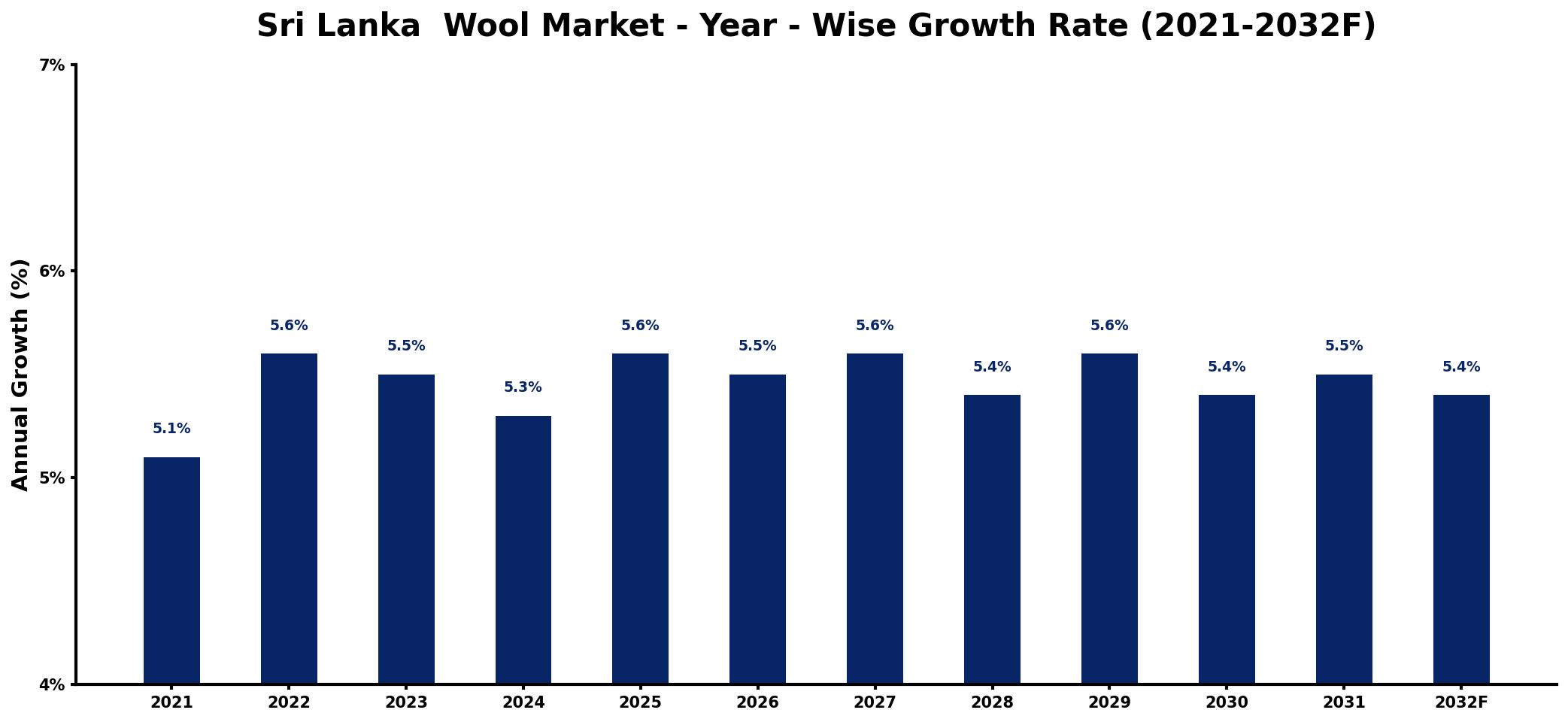
The table below presents the year‑wise growth rates along with the key drivers influencing the market
| Year | Growth Rate | Major Drivers |
| 2021 | 5.1% | Rising demand for textile applications |
| 2022 | 5.6% | Increased investment in sustainable practices |
| 2023 | 5.5% | Expansion of export markets globally |
| 2024 | 5.3% | Growing interest in eco-friendly materials |
| 2025 | 5.6% | Development of innovative manufacturing techniques |
| 2026 | 5.5% | Surge in fashion industry collaborations |
| 2027 | 5.6% | Strengthening of local production capabilities |
| 2028 | 5.4% | Enhancement of supply chain efficiency |
| 2029 | 5.6% | Increased consumer awareness of quality |
| 2030 | 5.4% | stronger distribution network expansion |
| 2031 | 5.5% | Growth in online shopping platforms |
| 2032 | 5.4% | Rising popularity of luxury products |
Note: Market size estimations and growth projections presented in this report are based on 6Wresearch's proprietary forecasting methodology, utilizing the latest available industry data, government publications, and primary research inputs.
Sri Lanka Wool Market Synopsis
The strongest force shaping the Sri Lanka wool market currently is the rising consumer demand for sustainably produced wool products. With an increased awareness of environmental impacts, buyers are actively seeking transparency in sourcing and are inclined to support ethical practices.
This evolving consumer mindset is prompting local producers to adopt innovative practices, focusing on organic and ethically sourced wool. Such shifts not only elevate product quality but also position Sri Lankan wool favorably in the competitive global market.
Sri Lanka Wool Market Key Takeaways
- The market is experiencing a shift towards premium and sustainably sourced wool products.
- Local producers are adapting to new consumer demands through sustainable practices.
- The government is implementing supportive policies aimed at enhancing domestic wool production.
- Opportunities exist for investment in production facilities and infrastructure modernization.
- Consumer preferences are increasingly leaning towards luxury and high-quality wool offerings.
Evaluation of Restraints in Sri Lanka Wool Market
Despite its growth prospects, the Sri Lanka wool market faces significant restraints. The limited domestic production capacity is a primary concern, as the local climate does not support large-scale sheep farming. This constraint leads to a heavy reliance on imported wool, exposing the market to external economic factors such as currency fluctuations and supply chain disruptions. Moreover, the volatility in global wool prices complicates cost management for local manufacturers, while competition from cheaper synthetic fibers continues to threaten the market's growth. Addressing these challenges will be essential for unlocking the market's full potential.
Sri Lanka Wool Market Trends
Current trends within the Sri Lanka wool market indicate a strong move towards sustainable and ethically sourced products. Consumers now prioritize not just the aesthetics of wool products but also the environmental footprint of their purchases. This has spurred producers to explore organic wool options and transparent supply chains. Additionally, the market is witnessing a growing preference for luxurious wool blends and innovative designs that cater to the discerning consumer, enhancing both style and functionality.
Sri Lanka Wool Market Opportunities
Investment opportunities in the Sri Lanka wool market are abundant, particularly as global demand for wool products continues to rise. Prospective ventures could include establishing modern production facilities to boost local capacity and diversifying product lines to appeal to niche markets. Furthermore, investing in collaborations with local farmers and manufacturers can yield mutual benefits, while promoting sustainable practices may resonate with the environmentally conscious consumer, thereby enhancing market appeal.
Government Initiatives in the Sri Lanka Wool Market
The Sri Lankan government has recognized the importance of the wool market and has implemented various supportive initiatives. These include subsidies for wool producers aimed at enhancing production capacities and encouraging research and development within the industry. Additionally, regulatory measures have been introduced to manage wool imports effectively, ensuring fair competition and protecting local producers. By focusing on quality and standards, the government is actively working to strengthen the global competitiveness of Sri Lankan wool products.
Future Insights of the Sri Lanka Wool Market
Looking ahead to 2026-2032, the Sri Lanka wool market is set to benefit from changing consumer behaviors, with an increasing number of individuals seeking sustainable and natural fiber options. The expected rise in disposable income among consumers will further amplify the demand for high-quality wool products. With e-commerce platforms expanding the reach of wool goods, the market's accessibility will likely enhance its growth trajectory. However, vigilance regarding raw material price fluctuations and ongoing competition from synthetic fibers will remain essential to ensure sustained success.
Sri Lanka Wool Market Latest Developments (2025 - 2026)
In the most recent months, the Sri Lanka wool market has seen a notable increase in initiatives aimed at improving sustainable farming practices among local producers. Collaborations with international organizations have also emerged, focused on introducing advanced wool processing technologies. Furthermore, several industry forums are being held to promote awareness and education on the benefits of wool products, fostering greater consumer interest and engagement.
Sri Lanka Wool Market - Key Attractiveness of the Report
- 10 Years of Market Numbers
- Historical Data Starting from 2022 to 2025
- Base Year: 2025
- Forecast Data until 2032
- Key Performance Indicators Impacting the Market
- Major Upcoming Developments and Projects
Key Highlights of the Report:
- Sri Lanka Wool Market Outlook
- Market Size of Sri Lanka Wool Market, 2025
- Forecast of Sri Lanka Wool Market, 2032
- Historical Data and Forecast of Sri Lanka Wool Revenues & Volume for the Period 2022-2032F
- Sri Lanka Wool Market Trend Evolution
- Sri Lanka Wool Market Drivers and Challenges
- Sri Lanka Wool Price Trends
- Sri Lanka Wool Porter's Five Forces
- Sri Lanka Wool Industry Life Cycle
- Historical Data and Forecast of Sri Lanka Wool Market Revenues & Volume By Source for the Period 2022-2032F
- Historical Data and Forecast of Sri Lanka Wool Market Revenues & Volume By Merino Wool for the Period 2022-2032F
- Historical Data and Forecast of Sri Lanka Wool Market Revenues & Volume By Peruvian Highland Wool for the Period 2022-2032F
- Historical Data and Forecast of Sri Lanka Wool Market Revenues & Volume By Teeswater Wool for the Period 2022-2032F
- Historical Data and Forecast of Sri Lanka Wool Market Revenues & Volume By Shetland Wool for the Period 2022-2032F
- Historical Data and Forecast of Sri Lanka Wool Market Revenues & Volume By Cashmere Wool for the Period 2022-2032F
- Historical Data and Forecast of Sri Lanka Wool Market Revenues & Volume By others for the Period 2022-2032F
- Historical Data and Forecast of Sri Lanka Wool Market Revenues & Volume By Type for the Period 2022-2032F
- Historical Data and Forecast of Sri Lanka Wool Market Revenues & Volume By Fine wool (? 25 ) for the Period 2022-2032F
- Historical Data and Forecast of Sri Lanka Wool Market Revenues & Volume By Medium wool (25 to 35 ) for the Period 2022-2032F
- Historical Data and Forecast of Sri Lanka Wool Market Revenues & Volume By Coarse wool (? 35 ) for the Period 2022-2032F
- Historical Data and Forecast of Sri Lanka Wool Market Revenues & Volume By Application for the Period 2022-2032F
- Historical Data and Forecast of Sri Lanka Wool Market Revenues & Volume By Apparels for the Period 2022-2032F
- Historical Data and Forecast of Sri Lanka Wool Market Revenues & Volume By Interior Textiles for the Period 2022-2032F
- Sri Lanka Wool Import Export Trade Statistics
- Market Opportunity Assessment By Source
- Market Opportunity Assessment By Type
- Market Opportunity Assessment By Application
- Sri Lanka Wool Top Companies Market Share
- Sri Lanka Wool Competitive Benchmarking By Technical and Operational Parameters
- Sri Lanka Wool Company Profiles
- Sri Lanka Wool Key Strategic Recommendations






































