Eswatini Hydraulic Cylinder Market Growth Rate Analysis (2021-2031)
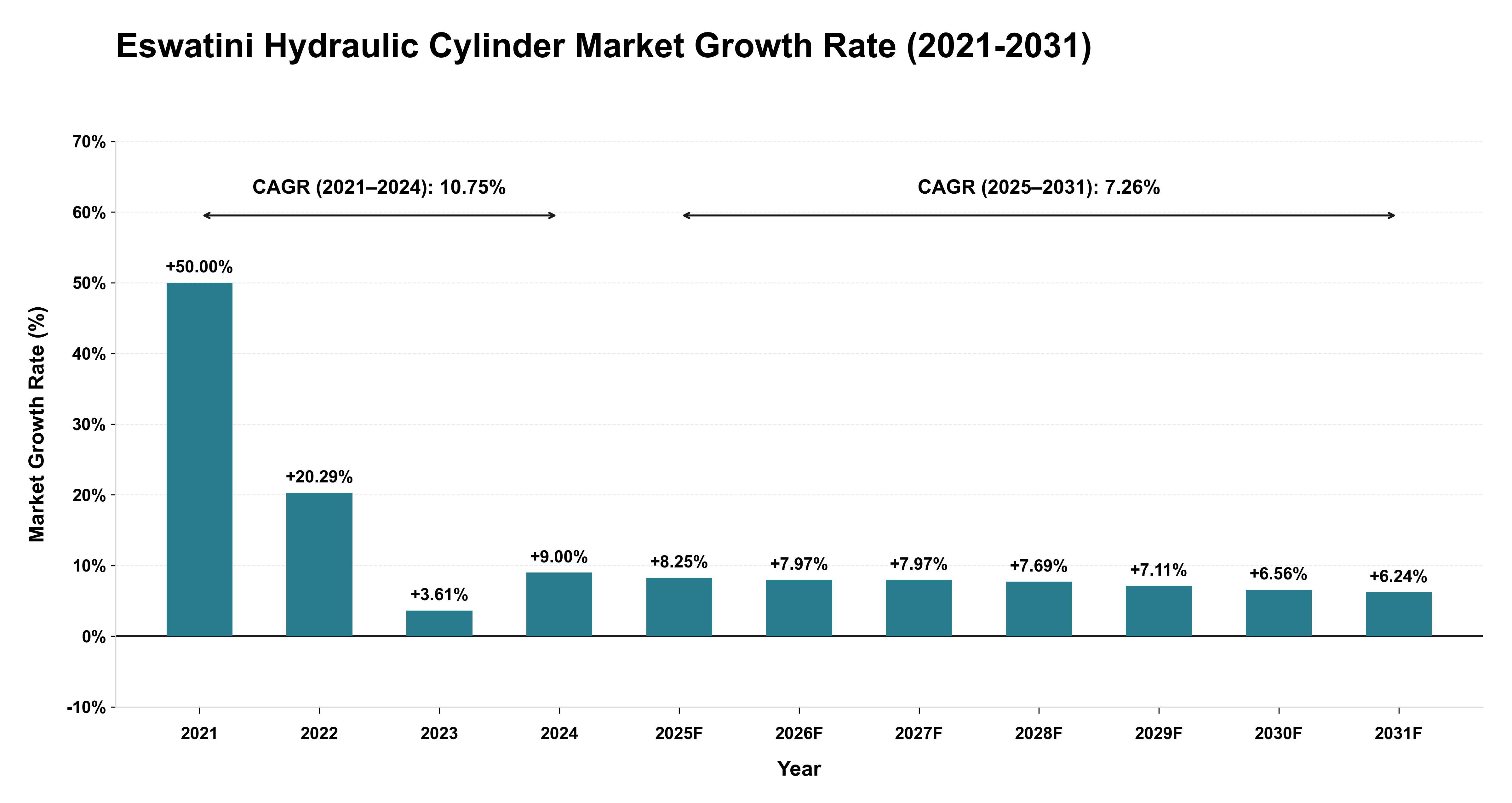
The Eswatini Hydraulic Cylinder Market exhibited robust growth from 2021 to 2024, with a CAGR of 10.75%. This period was marked by significant expansion, especially in 2021 with a remarkable growth rate of 50.00%, followed by strong but moderating growth rates in the subsequent years. The market saw a structural consolidation and stabilization phase post-2024, with growth rates gradually decreasing but remaining positive. Looking ahead to the forecast period from 2025 to 2031, the market is expected to continue growing at a slower pace, with a forecasted CAGR of 7.26%. This trajectory indicates a shift towards stabilizing expansion and market maturation, as the growth rates taper off gradually but remain positive, reflecting a more sustainable and steady growth path for the Eswatini Hydraulic Cylinder Market.
Key Highlights of the Report:
- Swaziland Hydraulic Cylinder Market Outlook
- Market Size of Swaziland Hydraulic Cylinder Market, 2024
- Forecast of Swaziland Hydraulic Cylinder Market, 2031
- Historical Data and Forecast of Swaziland Hydraulic Cylinder Revenues & Volume for the Period 2021-2031
- Swaziland Hydraulic Cylinder Market Trend Evolution
- Swaziland Hydraulic Cylinder Market Drivers and Challenges
- Swaziland Hydraulic Cylinder Price Trends
- Swaziland Hydraulic Cylinder Porter`s Five Forces
- Swaziland Hydraulic Cylinder Industry Life Cycle
- Historical Data and Forecast of Swaziland Hydraulic Cylinder Market Revenues & Volume By Function for the Period 2021-2031
- Historical Data and Forecast of Swaziland Hydraulic Cylinder Market Revenues & Volume By Single Acting Cylinders for the Period 2021-2031
- Historical Data and Forecast of Swaziland Hydraulic Cylinder Market Revenues & Volume By Double Acting Cylinders for the Period 2021-2031
- Historical Data and Forecast of Swaziland Hydraulic Cylinder Market Revenues & Volume By Design for the Period 2021-2031
- Historical Data and Forecast of Swaziland Hydraulic Cylinder Market Revenues & Volume By Tie-rod Cylinders for the Period 2021-2031
- Historical Data and Forecast of Swaziland Hydraulic Cylinder Market Revenues & Volume By Welded Cylinders for the Period 2021-2031
- Historical Data and Forecast of Swaziland Hydraulic Cylinder Market Revenues & Volume By Bore Size for the Period 2021-2031
- Historical Data and Forecast of Swaziland Hydraulic Cylinder Market Revenues & Volume By Less Than 50mm for the Period 2021-2031
- Historical Data and Forecast of Swaziland Hydraulic Cylinder Market Revenues & Volume By 51mm To 100mm for the Period 2021-2031
- Historical Data and Forecast of Swaziland Hydraulic Cylinder Market Revenues & Volume By 101mm To 150mm for the Period 2021-2031
- Historical Data and Forecast of Swaziland Hydraulic Cylinder Market Revenues & Volume By Greater Than 151mm for the Period 2021-2031
- Swaziland Hydraulic Cylinder Import Export Trade Statistics
- Market Opportunity Assessment By Function
- Market Opportunity Assessment By Design
- Market Opportunity Assessment By Bore Size
- Swaziland Hydraulic Cylinder Top Companies Market Share
- Swaziland Hydraulic Cylinder Competitive Benchmarking By Technical and Operational Parameters
- Swaziland Hydraulic Cylinder Company Profiles
- Swaziland Hydraulic Cylinder Key Strategic Recommendations






































