Eswatini Sugar Confectionery Market Growth Rate Analysis (2025 - 2031)
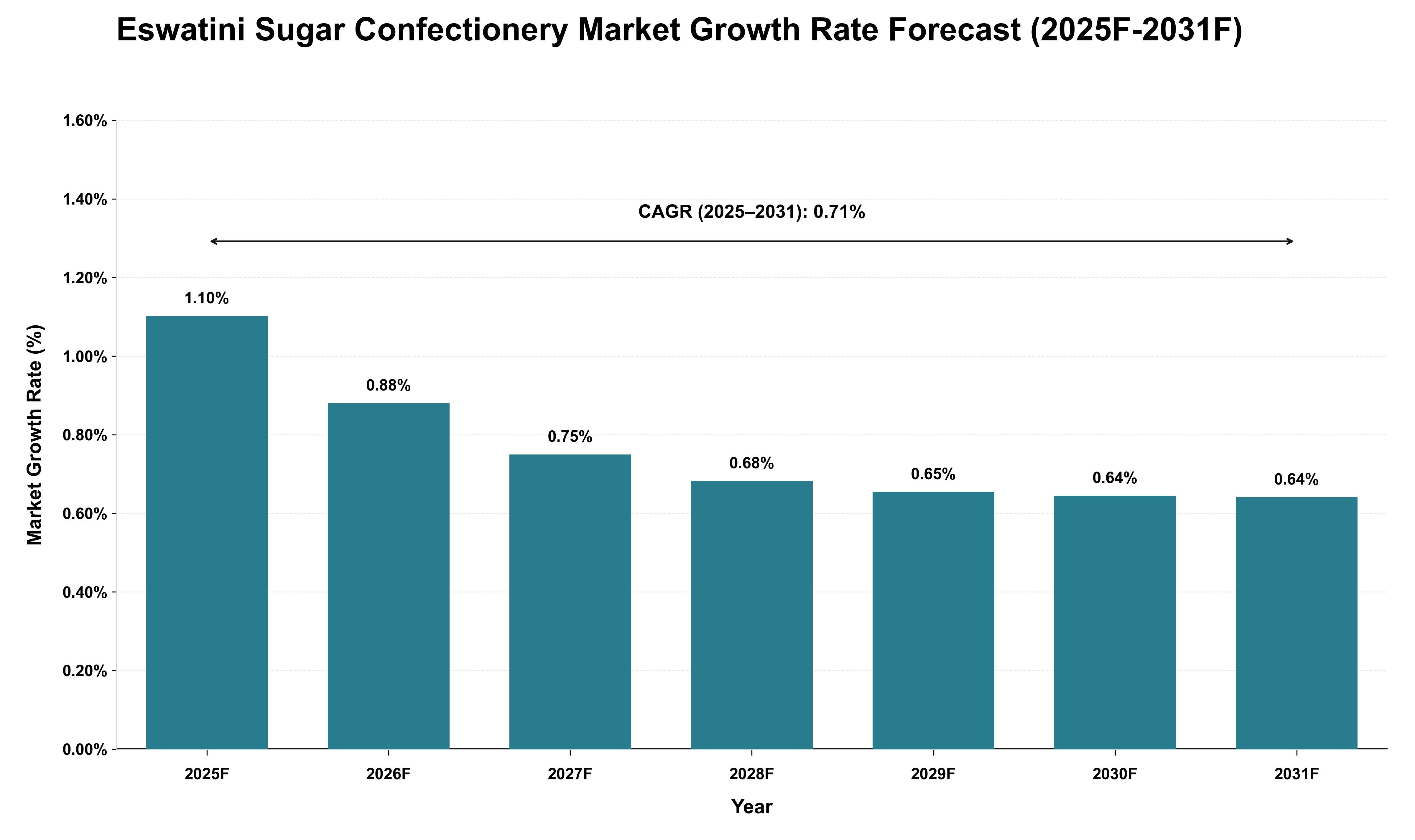
The Eswatini sugar confectionery market is poised to experience a gradual growth trajectory from 2025 to 2031, with an overall CAGR of 0.71%. This modest expansion will be driven by evolving consumer preferences towards healthier alternatives and the increasing incorporation of local ingredients, which may enhance product appeal. As disposable incomes rise, demand for indulgent treats is expected to shift towards premium offerings, albeit at a slow pace. Import dependencies will likely influence pricing dynamics and availability, as fluctuations in global sugar prices could impact production costs. Additionally, cyclical trends in consumer spending on non-essential goods may lead to variations in annual growth rates, with initial years showing stronger performance (1.10% in 2025) before tapering off (0.64% by 2031). Overall, the market will reflect a nuanced interplay between health-conscious consumption patterns and economic factors shaping discretionary spending.
Key Highlights of the Report:
- Swaziland Sugar Confectionery Market Outlook
- Market Size of Swaziland Sugar Confectionery Market, 2024
- Forecast of Swaziland Sugar Confectionery Market, 2031
- Historical Data and Forecast of Swaziland Sugar Confectionery Revenues & Volume for the Period 2021-2031
- Swaziland Sugar Confectionery Market Trend Evolution
- Swaziland Sugar Confectionery Market Drivers and Challenges
- Swaziland Sugar Confectionery Price Trends
- Swaziland Sugar Confectionery Porter`s Five Forces
- Swaziland Sugar Confectionery Industry Life Cycle
- Historical Data and Forecast of Swaziland Sugar Confectionery Market Revenues & Volume By Product Type for the Period 2021-2031
- Historical Data and Forecast of Swaziland Sugar Confectionery Market Revenues & Volume By Hard-Boiled Sweets for the Period 2021-2031
- Historical Data and Forecast of Swaziland Sugar Confectionery Market Revenues & Volume By Caramel & Toffees for the Period 2021-2031
- Historical Data and Forecast of Swaziland Sugar Confectionery Market Revenues & Volume By Gums & Jellies for the Period 2021-2031
- Historical Data and Forecast of Swaziland Sugar Confectionery Market Revenues & Volume By Medicated Confectionery for the Period 2021-2031
- Historical Data and Forecast of Swaziland Sugar Confectionery Market Revenues & Volume By Mints for the Period 2021-2031
- Historical Data and Forecast of Swaziland Sugar Confectionery Market Revenues & Volume By Othersfor the Period 2021-2031
- Historical Data and Forecast of Swaziland Sugar Confectionery Market Revenues & Volume By Packaging Type for the Period 2021-2031
- Historical Data and Forecast of Swaziland Sugar Confectionery Market Revenues & Volume By Sachet for the Period 2021-2031
- Historical Data and Forecast of Swaziland Sugar Confectionery Market Revenues & Volume By Box for the Period 2021-2031
- Historical Data and Forecast of Swaziland Sugar Confectionery Market Revenues & Volume By Others for the Period 2021-2031
- Historical Data and Forecast of Swaziland Sugar Confectionery Market Revenues & Volume By Distribution Channel for the Period 2021-2031
- Historical Data and Forecast of Swaziland Sugar Confectionery Market Revenues & Volume By Retail Stores for the Period 2021-2031
- Historical Data and Forecast of Swaziland Sugar Confectionery Market Revenues & Volume By Online Stores for the Period 2021-2031
- Historical Data and Forecast of Swaziland Sugar Confectionery Market Revenues & Volume By Others for the Period 2021-2031
- Swaziland Sugar Confectionery Import Export Trade Statistics
- Market Opportunity Assessment By Product Type
- Market Opportunity Assessment By Packaging Type
- Market Opportunity Assessment By Distribution Channel
- Swaziland Sugar Confectionery Top Companies Market Share
- Swaziland Sugar Confectionery Competitive Benchmarking By Technical and Operational Parameters
- Swaziland Sugar Confectionery Company Profiles
- Swaziland Sugar Confectionery Key Strategic Recommendations






































