Eswatini Vegetable Oil Market Growth Rate Analysis (2021-2031)
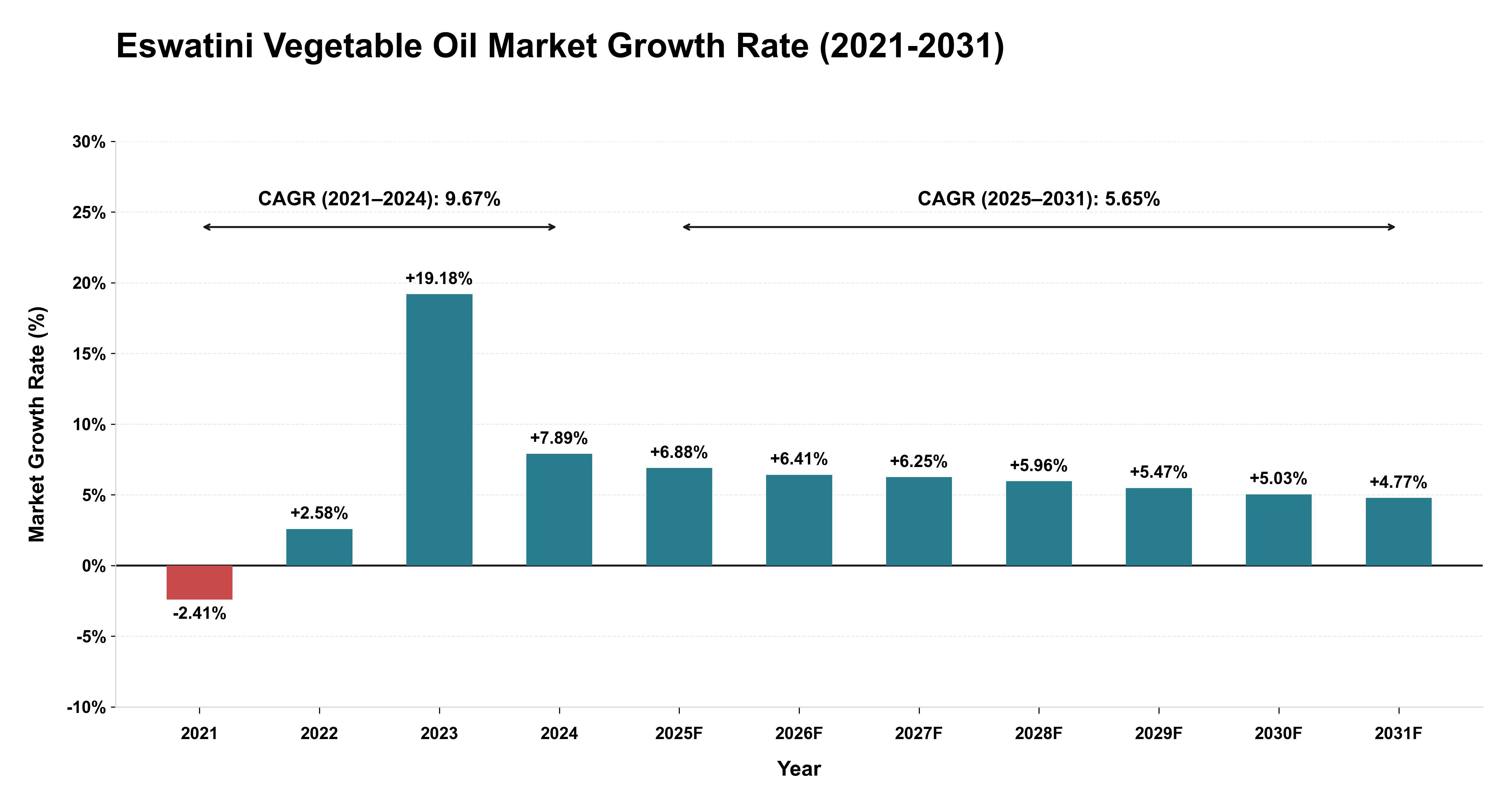
The Eswatini Vegetable Oil Market witnessed a turbulent phase from 2021 to 2024, with a negative growth rate in 2021, reflecting market challenges and structural adjustments. However, the market swiftly rebounded in the following years, showcasing a strong recovery with double-digit growth in 2023 and robust expansion in 2024. Moving forward to 2031, the market is set to continue its positive trajectory but at a more moderate pace, with a forecasted CAGR of 5.65%, indicating a phase of stabilization following the volatile historical base effect. This sector's resilience and adaptability are evident as it navigates through market fluctuations and consolidates its position with steady growth rates over the forecast period.
Key Highlights of the Report:
- Swaziland Vegetable Oil Market Outlook
- Market Size of Swaziland Vegetable Oil Market, 2024
- Forecast of Swaziland Vegetable Oil Market, 2031
- Historical Data and Forecast of Swaziland Vegetable Oil Revenues & Volume for the Period 2021- 2031
- Swaziland Vegetable Oil Market Trend Evolution
- Swaziland Vegetable Oil Market Drivers and Challenges
- Swaziland Vegetable Oil Price Trends
- Swaziland Vegetable Oil Porter's Five Forces
- Swaziland Vegetable Oil Industry Life Cycle
- Historical Data and Forecast of Swaziland Vegetable Oil Market Revenues & Volume By Type for the Period 2021- 2031
- Historical Data and Forecast of Swaziland Vegetable Oil Market Revenues & Volume By Sunflower Oil for the Period 2021- 2031
- Historical Data and Forecast of Swaziland Vegetable Oil Market Revenues & Volume By Rapeseed (Canola) Oil for the Period 2021- 2031
- Historical Data and Forecast of Swaziland Vegetable Oil Market Revenues & Volume By Soybean Oil for the Period 2021- 2031
- Historical Data and Forecast of Swaziland Vegetable Oil Market Revenues & Volume By Application for the Period 2021- 2031
- Historical Data and Forecast of Swaziland Vegetable Oil Market Revenues & Volume By Food for the Period 2021- 2031
- Historical Data and Forecast of Swaziland Vegetable Oil Market Revenues & Volume By Feed for the Period 2021- 2031
- Historical Data and Forecast of Swaziland Vegetable Oil Market Revenues & Volume By Industrial for the Period 2021- 2031
- Swaziland Vegetable Oil Import Export Trade Statistics
- Market Opportunity Assessment By Type
- Market Opportunity Assessment By Application
- Swaziland Vegetable Oil Top Companies Market Share
- Swaziland Vegetable Oil Competitive Benchmarking By Technical and Operational Parameters
- Swaziland Vegetable Oil Company Profiles
- Swaziland Vegetable Oil Key Strategic Recommendations






































