Sweden Adipic Acid Market Size (2020-2030)
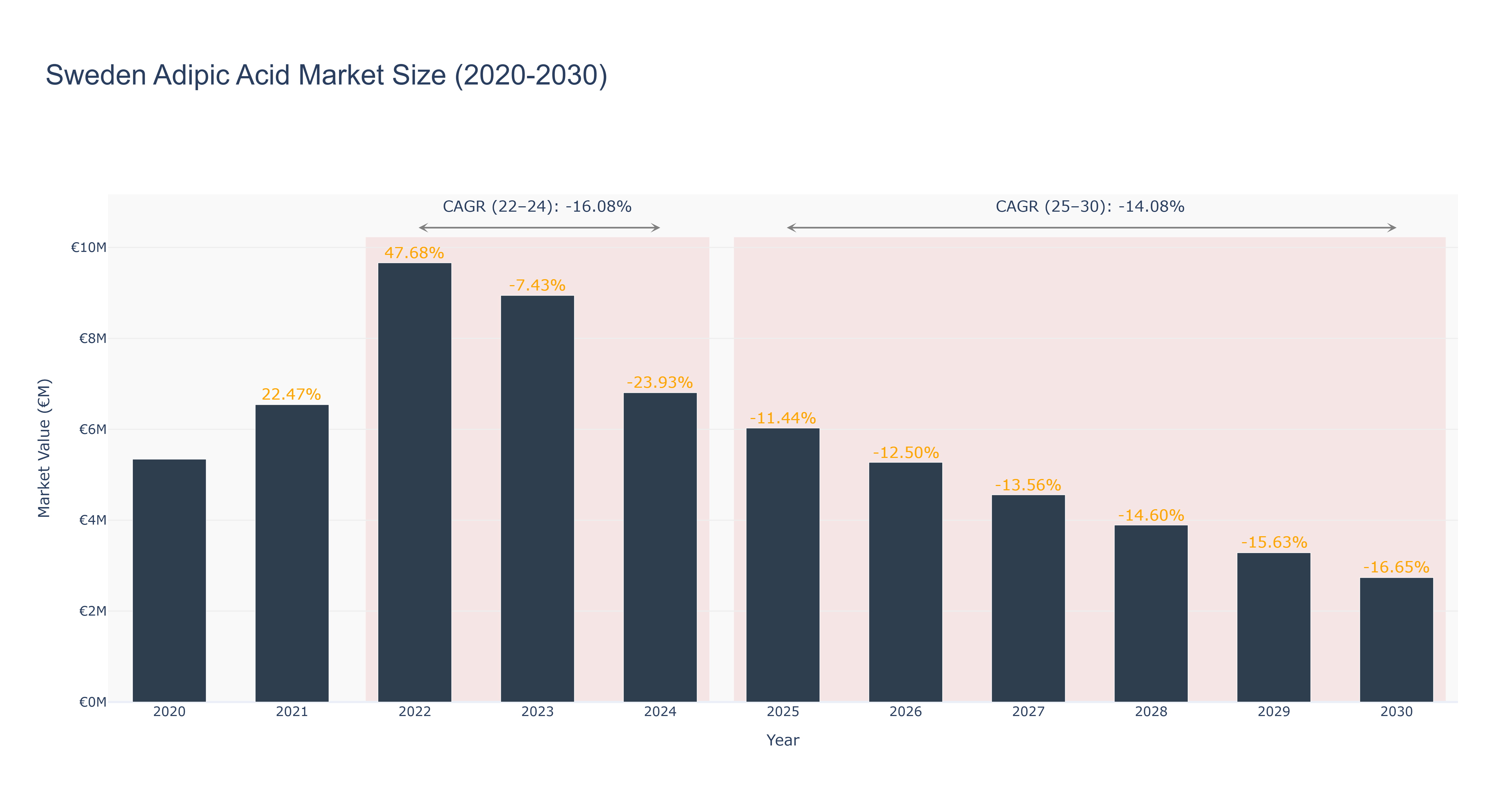
Sweden's Adipic Acid Market has seen a fluctuating trend over the years. The peak market size of €9.66 million was recorded in 2022, followed by a decline to €2.74 million in 2030. The market experienced a significant drop in market size from 2024 to 2025, possibly due to decreased demand or external economic factors. The forecasted CAGR for the period 2025-2030 is -14.08%, indicating a continued downward trend. Industry drivers such as changing consumer preferences towards eco-friendly alternatives and regulatory shifts may have impacted the market dynamics. Looking ahead, Sweden is focusing on sustainable production methods and green initiatives in the chemical industry, with upcoming projects aimed at reducing carbon footprint and enhancing environmental sustainability in the Adipic Acid sector.
Sweden Adipic Acid Market: Production & Trade Performance (2019-2025)
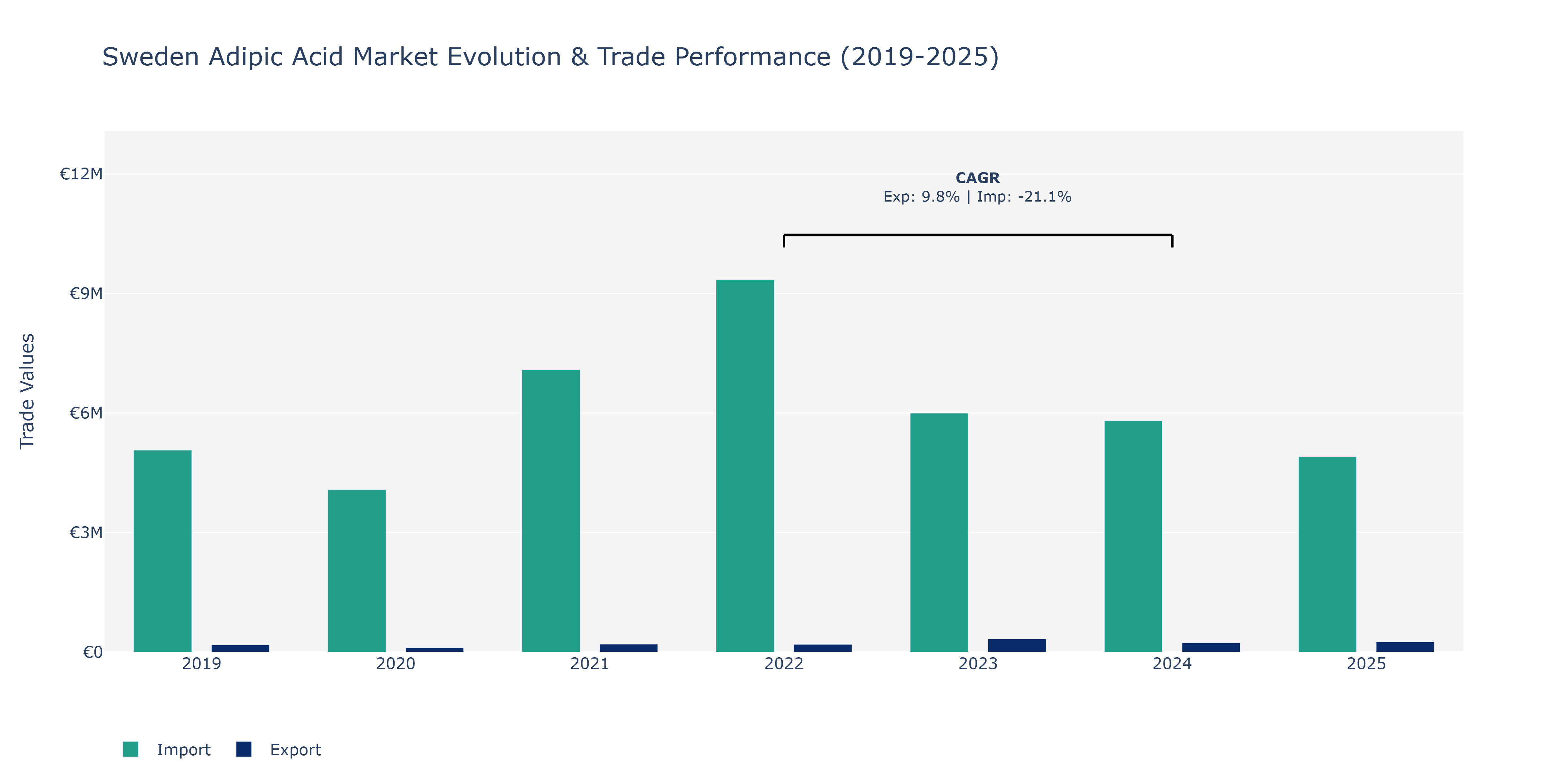
Between 2019 and 2025, Sweden's Adipic Acid Market showed varying trends in both exports and imports. In 2019, exports stood at €181.82 thousand, dipping to €108.21 thousand in 2020 before rebounding to €201.34 thousand in 2021, marking a peak. This was followed by a slight decline in 2022 to €194.08 thousand, before experiencing a substantial increase to €329.62 thousand in 2023, another peak point, and then stabilizing around €234.10 thousand in 2024 and €256.00 thousand in 2025. Conversely, imports demonstrated a different pattern, starting at €5.07 million in 2019 and fluctuating to €4.08 million in 2020, then surging to €7.09 million in 2021, reaching a peak. The trend reversed in 2022 with a slight decrease to €5.99 million, followed by a further decline to €5.81 million in 2023, and €4.90 million in 2025. These fluctuations in exports and imports can be attributed to global demand shifts, price variations, and regulatory changes impacting the Adipic Acid Market. The increase in exports could be linked to enhanced production capacities or improved product quality, while the import fluctuations might be influenced by changes in raw material sourcing strategies or domestic market dynamics.
Key Highlights of the Report:
- Sweden Adipic acid Market Outlook
- Market Size of Sweden Adipic acid Market, 2025
- Forecast of Sweden Adipic acid Market, 2032
- Historical Data and Forecast of Sweden Adipic acid Revenues & Volume for the Period 2022 - 2032F
- Sweden Adipic acid Market Trend Evolution
- Sweden Adipic acid Market Drivers and Challenges
- Sweden Adipic acid Price Trends
- Sweden Adipic acid Porter`s Five Forces
- Sweden Adipic acid Industry Life Cycle
- Historical Data and Forecast of Sweden Adipic acid Market Revenues & Volume By Application for the Period 2022 - 2032F
- Historical Data and Forecast of Sweden Adipic acid Market Revenues & Volume By Nylon 6,6 Fiber for the Period 2022 - 2032F
- Historical Data and Forecast of Sweden Adipic acid Market Revenues & Volume By Nylon 6,6 Resin for the Period 2022 - 2032F
- Historical Data and Forecast of Sweden Adipic acid Market Revenues & Volume By Polyurethane for the Period 2022 - 2032F
- Historical Data and Forecast of Sweden Adipic acid Market Revenues & Volume By Adipate Esters for the Period 2022 - 2032F
- Historical Data and Forecast of Sweden Adipic acid Market Revenues & Volume By Others for the Period 2022 - 2032F
- Historical Data and Forecast of Sweden Adipic acid Market Revenues & Volume By Raw Material for the Period 2022 - 2032F
- Historical Data and Forecast of Sweden Adipic acid Market Revenues & Volume By Cyclohexanol for the Period 2022 - 2032F
- Historical Data and Forecast of Sweden Adipic acid Market Revenues & Volume By Cyclohexanone for the Period 2022 - 2032F
- Sweden Adipic acid Import Export Trade Statistics
- Market Opportunity Assessment By Application
- Market Opportunity Assessment By Raw Material
- Sweden Adipic acid Top Companies Market Share
- Sweden Adipic acid Competitive Benchmarking By Technical and Operational Parameters
- Sweden Adipic acid Company Profiles
- Sweden Adipic acid Key Strategic Recommendations






































