Sweden Coal Tar Market Size Growth Rate
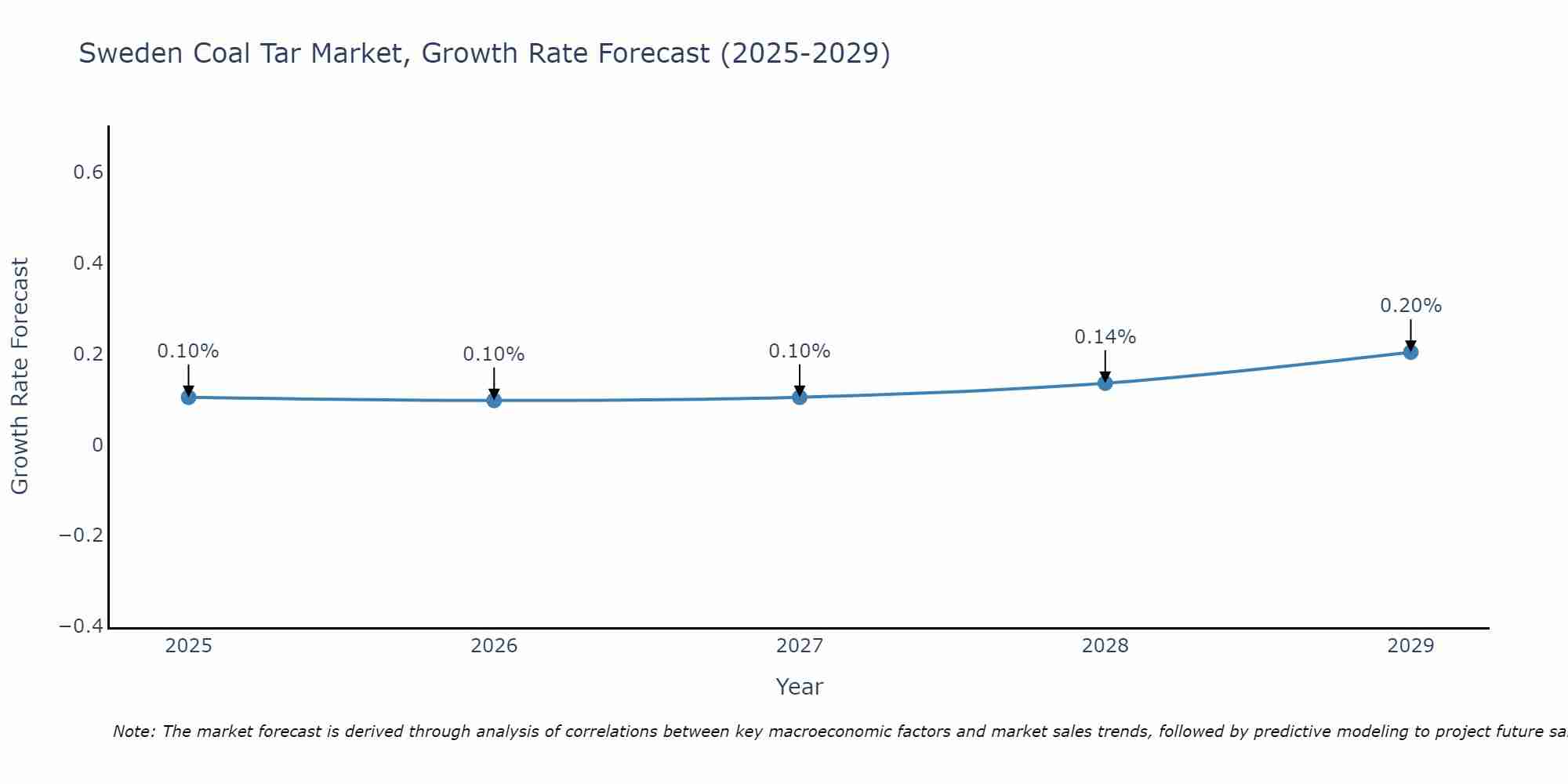
The Sweden Coal Tar Market is projected to witness mixed growth rate patterns during 2025 to 2029. From 0.10% in 2025, the growth rate steadily ascends to 0.20% in 2029.
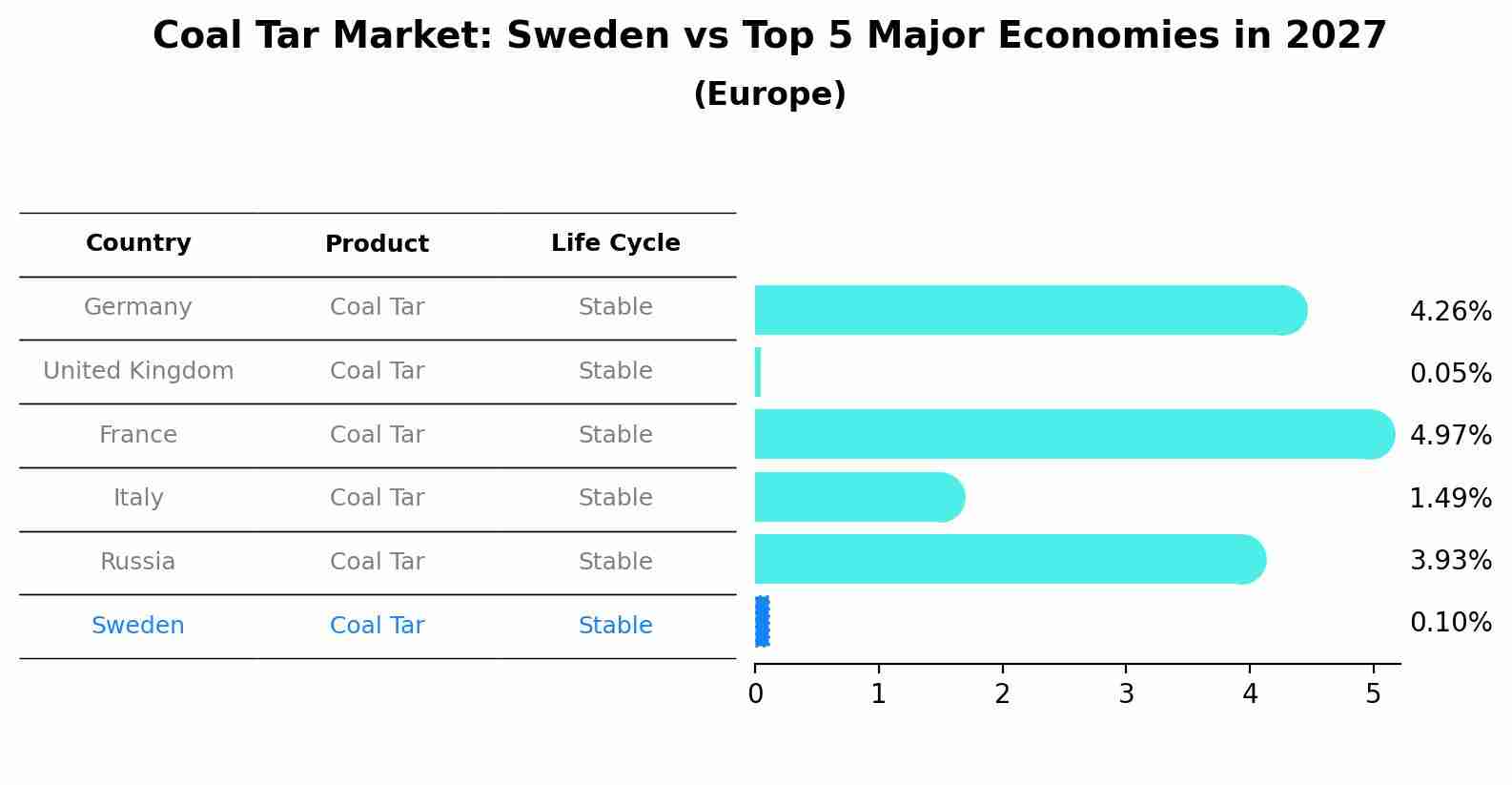
Coal Tar Market: Sweden vs Top 5 Major Economies in 2027 (Europe)
Sweden's Coal Tar market is anticipated to experience a stable growth rate of 0.10% by 2027, reflecting trends observed in the largest economy Germany, followed by United Kingdom, France, Italy and Russia.
Sweden Coal Tar Market Overview
The coal tar market in Sweden serves niche applications, particularly in the manufacturing of chemical products and coatings. Coal tar, a byproduct of coal carbonization, is utilized in various industrial applications, including the production of paints, sealants, and roofing materials. However, similar to other coal-related markets, the coal tar market faces challenges from environmental regulations and a growing preference for alternative materials. The focus on sustainability and the development of eco-friendly products have led to a decline in traditional coal tar applications, prompting manufacturers to seek innovative solutions that align with green standards.
Drivers of the market
The Sweden coal tar market is driven by its applications in various industries, particularly in the production of specialty chemicals, sealants, and roofing materials. Coal tar is a by-product of coal carbonization and is valued for its chemical properties. The demand for coal tar is supported by the growing construction and manufacturing sectors, where it is used in products that require durability and resistance to weathering. Furthermore, the increasing focus on sustainable products has led to innovations in coal tar applications, enhancing its market potential.
Challenges of the market
The coal tar market in Sweden faces headwinds due to the declining use of coal in industrial processes and the overall shift towards greener alternatives. Coal tar, a byproduct of coal processing, has seen reduced availability as coal consumption decreases. The market also struggles with stringent environmental regulations that limit the use of coal tar in various applications due to its hazardous properties. Additionally, industries that previously used coal tar, such as aluminum and steel production, are also transitioning to more sustainable inputs, further reducing demand.
Government Policy of the market
Swedens coal tar market is primarily influenced by the countrys strict environmental regulations. The government enforces stringent limits on the production and use of coal tar, particularly due to its classification as a hazardous material containing polycyclic aromatic hydrocarbons (PAHs). Swedens environmental legislation emphasizes reducing industrial emissions and encourages industries to find safer alternatives to coal tar. As a result, there has been a decline in the use of coal tar in applications like road construction and industrial coatings.
Key Highlights of the Report:
- Sweden Coal Tar Market Outlook
- Market Size of Sweden Coal Tar Market, 2024
- Forecast of Sweden Coal Tar Market, 2031
- Historical Data and Forecast of Sweden Coal Tar Revenues & Volume for the Period 2021-2031
- Sweden Coal Tar Market Trend Evolution
- Sweden Coal Tar Market Drivers and Challenges
- Sweden Coal Tar Price Trends
- Sweden Coal Tar Porter`s Five Forces
- Sweden Coal Tar Industry Life Cycle
- Historical Data and Forecast of Sweden Coal Tar Market Revenues & Volume By Type for the Period 2021-2031
- Historical Data and Forecast of Sweden Coal Tar Market Revenues & Volume By Low Temperature Coal Tar for the Period 2021-2031
- Historical Data and Forecast of Sweden Coal Tar Market Revenues & Volume By Medium Temperature Coal Tar for the Period 2021-2031
- Historical Data and Forecast of Sweden Coal Tar Market Revenues & Volume By High Temperature Coal Tar for the Period 2021-2031
- Historical Data and Forecast of Sweden Coal Tar Market Revenues & Volume By Application for the Period 2021-2031
- Historical Data and Forecast of Sweden Coal Tar Market Revenues & Volume By Coal Tar Pitch for the Period 2021-2031
- Historical Data and Forecast of Sweden Coal Tar Market Revenues & Volume By Carbon Black Oil for the Period 2021-2031
- Historical Data and Forecast of Sweden Coal Tar Market Revenues & Volume By Specialty Oils for the Period 2021-2031
- Historical Data and Forecast of Sweden Coal Tar Market Revenues & Volume By End-use for the Period 2021-2031
- Historical Data and Forecast of Sweden Coal Tar Market Revenues & Volume By Aluminum Industry for the Period 2021-2031
- Historical Data and Forecast of Sweden Coal Tar Market Revenues & Volume By Roofing for the Period 2021-2031
- Historical Data and Forecast of Sweden Coal Tar Market Revenues & Volume By Tire Industry for the Period 2021-2031
- Historical Data and Forecast of Sweden Coal Tar Market Revenues & Volume By Paint Industry for the Period 2021-2031
- Historical Data and Forecast of Sweden Coal Tar Market Revenues & Volume By Wood Preservation for the Period 2021-2031
- Historical Data and Forecast of Sweden Coal Tar Market Revenues & Volume By Others for the Period 2021-2031
- Historical Data and Forecast of Sweden Coal Tar Market Revenues & Volume By Marketing Channel for the Period 2021-2031
- Historical Data and Forecast of Sweden Coal Tar Market Revenues & Volume By Online for the Period 2021-2031
- Historical Data and Forecast of Sweden Coal Tar Market Revenues & Volume By Offline for the Period 2021-2031
- Sweden Coal Tar Import Export Trade Statistics
- Market Opportunity Assessment By Type
- Market Opportunity Assessment By Application
- Market Opportunity Assessment By End-use
- Market Opportunity Assessment By Marketing Channel
- Sweden Coal Tar Top Companies Market Share
- Sweden Coal Tar Competitive Benchmarking By Technical and Operational Parameters
- Sweden Coal Tar Company Profiles
- Sweden Coal Tar Key Strategic Recommendations






































