Sweden Cyclohexanone Market Size (2020-2030)
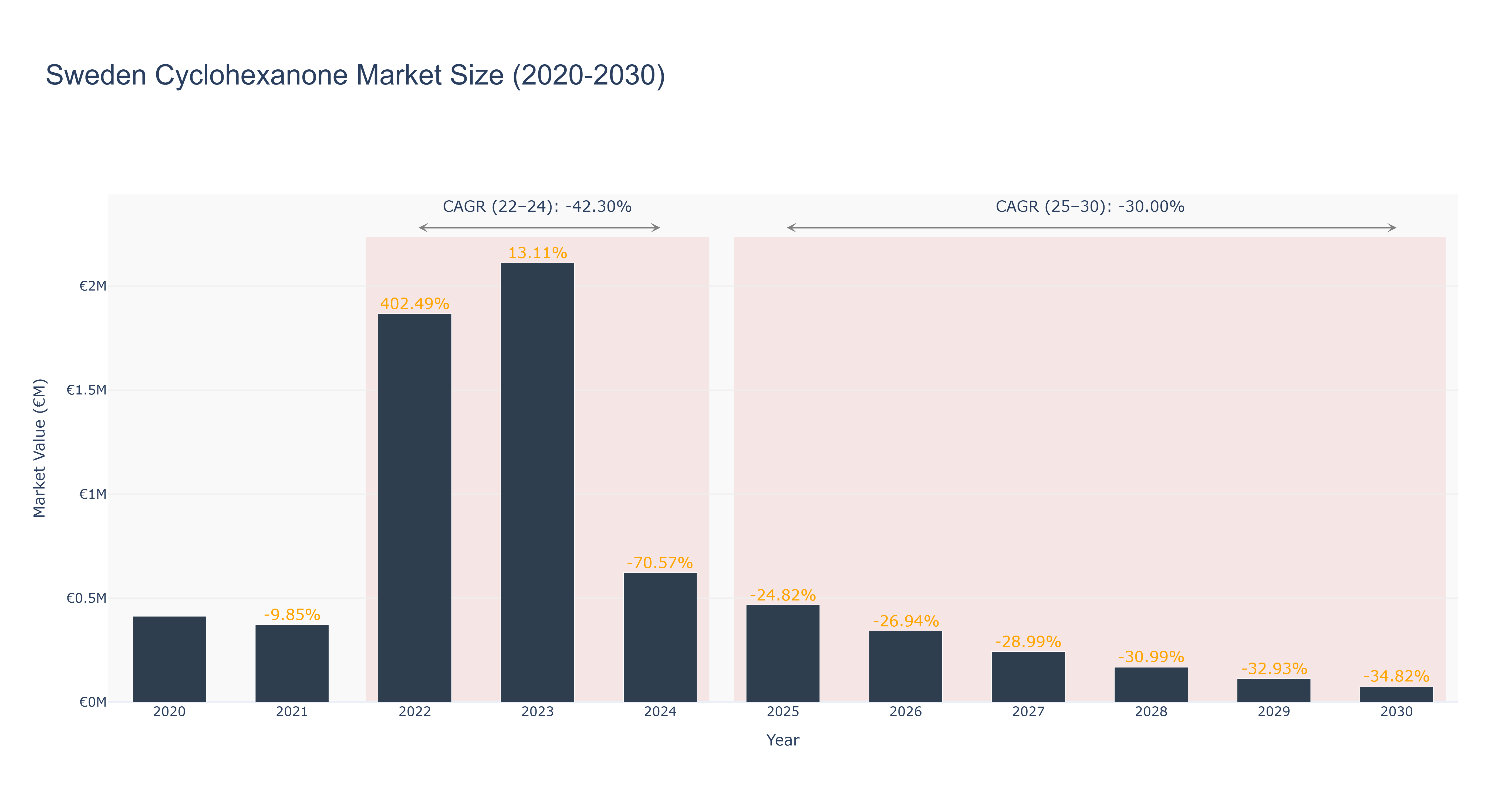
Sweden's Cyclohexanone Market experienced a peak market size of €2.11 million in 2023, followed by a significant decline to €0.62 million in 2024. The market is forecasted to continue shrinking, with an expected size of €0.07 million in 2030. The CAGR for the period 2022-24 was -42.30%, reflecting the sharp downturn, while the CAGR for 2025-30 is projected at -30.0%. This decline can be attributed to various factors such as changing consumer preferences, global economic conditions, and regulatory challenges. Despite the current downward trend, upcoming investments in sustainable production methods and the introduction of innovative technologies are expected to drive growth in the Sweden Cyclohexanone Market in the near future. Investors and stakeholders should closely monitor these developments to capitalize on emerging opportunities in the market.
Sweden Cyclohexanone Market: Production & Trade Performance (2019-2025)
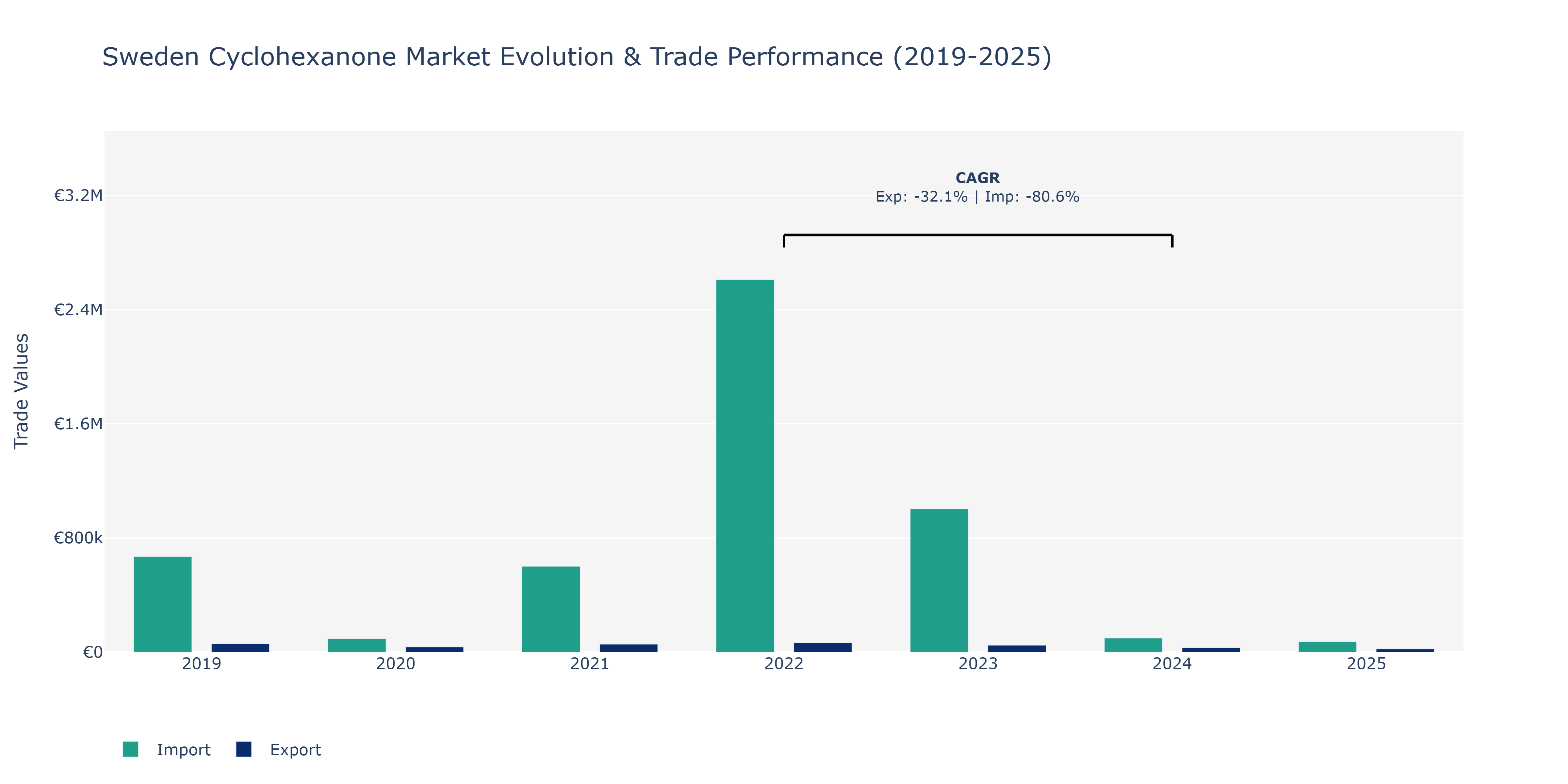
The Sweden Cyclohexanone Market witnessed varying trends in Exports and Imports over the specified years. In 2019, Imports stood notably higher than Exports, with €670.68 thousand against €57.73 thousand, indicating a substantial reliance on foreign sources. The subsequent year, 2020, saw a decline in both Exports to €35.78 thousand and Imports to €94.2 thousand, possibly attributed to global economic uncertainties affecting trade flows. However, 2021 marked a significant rebound in trade activity, particularly in Imports, which surged to €601.23 thousand, showcasing a strong recovery momentum. The peak point for Imports occurred in 2022 at €2.61 million, reflecting a substantial increase likely driven by heightened demand or supply chain disruptions elsewhere. By 2025, both Exports and Imports experienced a decline, possibly due to evolving market dynamics or regulatory changes impacting trade volumes. These fluctuations highlight the market's sensitivity to external factors and underline the importance of strategic risk management to navigate uncertainties in the cyclohexanone industry.
Sweden Cyclohexanone Market Overview
Cyclohexanone is a key solvent and intermediate chemical used extensively in the manufacture of paints, coatings, and adhesives in Sweden. The market for cyclohexanone is closely linked to the performance of the construction and automotive sectors, where demand for high-quality coatings and adhesives is rising. Environmental regulations regarding VOC emissions are prompting manufacturers to seek more sustainable production processes and alternatives, thereby influencing market dynamics. As a result, the cyclohexanone market is witnessing innovations aimed at enhancing product safety and reducing environmental impact.
Drivers of the market
The Sweden cyclohexanone market benefits from the growing demand for this solvent in the manufacturing of coatings, adhesives, and paints. Cyclohexanone serves as a key intermediate in the production of nylon and other chemical products, driving its demand in the textile and automotive sectors. Moreover, the increasing emphasis on high-performance materials in various applications is contributing to the market growth. The trend towards sustainable practices in chemical manufacturing is leading to innovations in cyclohexanone production processes, enhancing efficiency and reducing environmental impact, which also supports market expansion.
Challenges of the market
In the cyclohexanone market, challenges primarily stem from environmental regulations and market competition. The chemical industry is increasingly pressured to reduce emissions and comply with strict environmental standards, which can lead to higher operational costs for cyclohexanone manufacturers. Furthermore, the availability of substitutes that are less harmful to the environment poses a threat to market growth. Price volatility of raw materials also complicates budgeting and forecasting for producers, potentially impacting their ability to invest in technology upgrades and expansions. Additionally, the cyclical nature of end-user industries, such as automotive and textiles, can lead to unpredictable demand fluctuations.
Government Policy of the market
Government regulations in Sweden aimed at controlling chemical production, such as those enforced by the Swedish Chemicals Agency (KEMI), significantly influence the cyclohexanone market. Cyclohexanone, being a precursor to materials like nylon, falls under scrutiny due to its potential environmental impact. Policies focusing on sustainable industrial practices and adherence to EU regulations on hazardous chemicals can affect production levels and require companies to implement advanced waste management and emission control technologies.
Key Highlights of the Report:
- Sweden Cyclohexanone Market Outlook
- Market Size of Sweden Cyclohexanone Market, 2025
- Forecast of Sweden Cyclohexanone Market, 2032
- Historical Data and Forecast of Sweden Cyclohexanone Revenues & Volume for the Period 2022 - 2032
- Sweden Cyclohexanone Market Trend Evolution
- Sweden Cyclohexanone Market Drivers and Challenges
- Sweden Cyclohexanone Price Trends
- Sweden Cyclohexanone Porter`s Five Forces
- Sweden Cyclohexanone Industry Life Cycle
- Historical Data and Forecast of Sweden Cyclohexanone Market Revenues & Volume By Type for the Period 2022 - 2032
- Historical Data and Forecast of Sweden Cyclohexanone Market Revenues & Volume By Nylon 6 for the Period 2022 - 2032
- Historical Data and Forecast of Sweden Cyclohexanone Market Revenues & Volume By Nylon 66 for the Period 2022 - 2032
- Historical Data and Forecast of Sweden Cyclohexanone Market Revenues & Volume By Polyester Polyol for the Period 2022 - 2032
- Historical Data and Forecast of Sweden Cyclohexanone Market Revenues & Volume By Others for the Period 2022 - 2032
- Historical Data and Forecast of Sweden Cyclohexanone Market Revenues & Volume By End-use for the Period 2022 - 2032
- Historical Data and Forecast of Sweden Cyclohexanone Market Revenues & Volume By Construction for the Period 2022 - 2032
- Historical Data and Forecast of Sweden Cyclohexanone Market Revenues & Volume By Aerospace and Defence for the Period 2022 - 2032
- Historical Data and Forecast of Sweden Cyclohexanone Market Revenues & Volume By Textiles for the Period 2022 - 2032
- Historical Data and Forecast of Sweden Cyclohexanone Market Revenues & Volume By Automotive for the Period 2022 - 2032
- Historical Data and Forecast of Sweden Cyclohexanone Market Revenues & Volume By Electrical and Electronics for the Period 2022 - 2032
- Historical Data and Forecast of Sweden Cyclohexanone Market Revenues & Volume By Others for the Period 2022 - 2032
- Historical Data and Forecast of Sweden Cyclohexanone Market Revenues & Volume By Application for the Period 2022 - 2032
- Historical Data and Forecast of Sweden Cyclohexanone Market Revenues & Volume By Paint and Dyes for the Period 2022 - 2032
- Historical Data and Forecast of Sweden Cyclohexanone Market Revenues & Volume By Soaps for the Period 2022 - 2032
- Historical Data and Forecast of Sweden Cyclohexanone Market Revenues & Volume By Fertilizers for the Period 2022 - 2032
- Historical Data and Forecast of Sweden Cyclohexanone Market Revenues & Volume By Films for the Period 2022 - 2032
- Historical Data and Forecast of Sweden Cyclohexanone Market Revenues & Volume By Pharmaceutical for the Period 2022 - 2032
- Historical Data and Forecast of Sweden Cyclohexanone Market Revenues & Volume By Caprolactam for the Period 2022 - 2032
- Historical Data and Forecast of Sweden Cyclohexanone Market Revenues & Volume By Adipic Acid for the Period 2022 - 2032
- Historical Data and Forecast of Sweden Cyclohexanone Market Revenues & Volume By Others for the Period 2022 - 2032
- Sweden Cyclohexanone Import Export Trade Statistics
- Market Opportunity Assessment By Type
- Market Opportunity Assessment By End-use
- Market Opportunity Assessment By Application
- Sweden Cyclohexanone Top Companies Market Share
- Sweden Cyclohexanone Competitive Benchmarking By Technical and Operational Parameters
- Sweden Cyclohexanone Company Profiles
- Sweden Cyclohexanone Key Strategic Recommendations






































