Switzerland Acrylic Sheet Market Growth Rate Analysis (2025 - 2031)
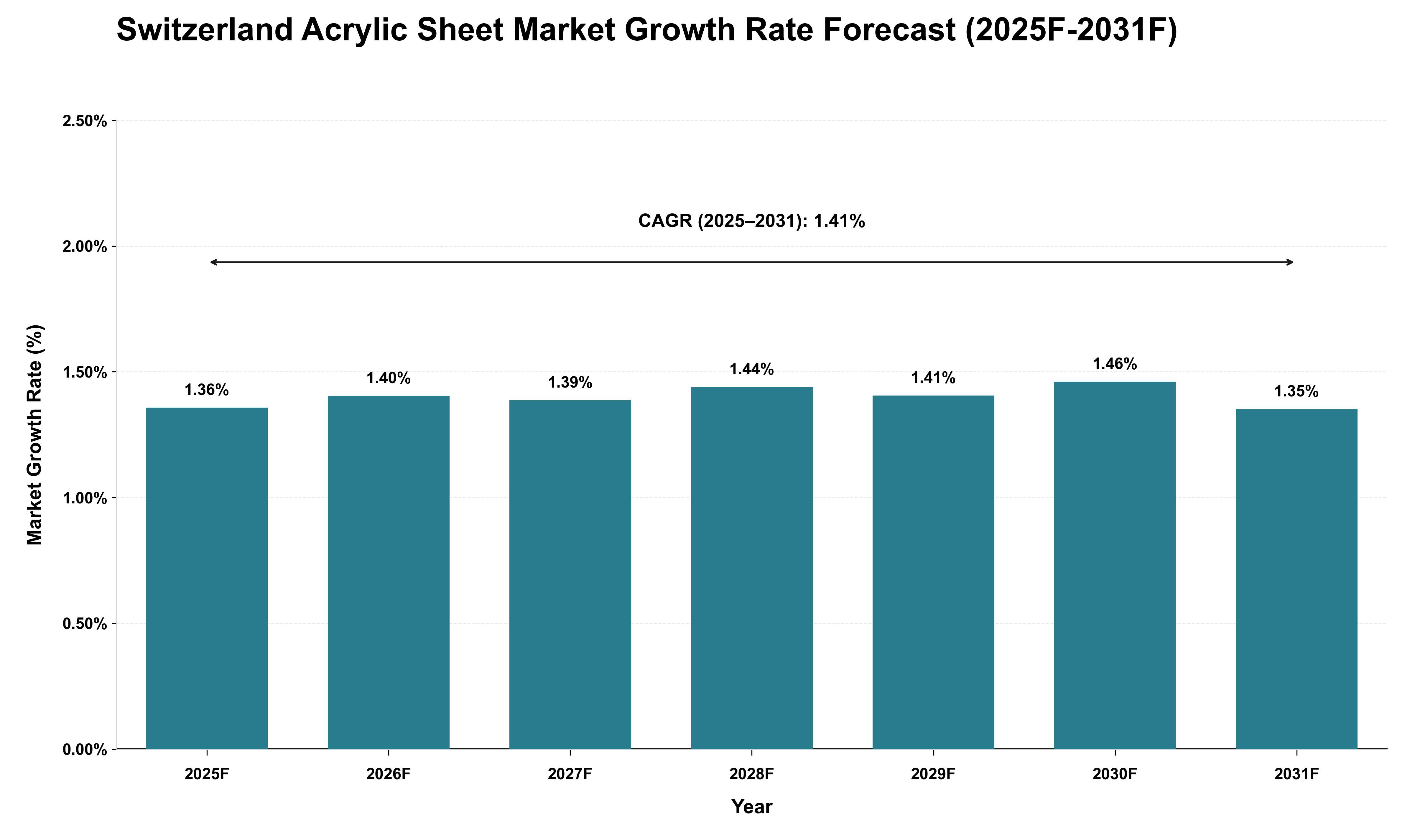
The projected growth trajectory of the Switzerland acrylic sheet market will exhibit a nuanced acceleration, as indicated by the annual growth rates peaking at 1.46% in 2030 before tapering to 1.35% in 2031. This pattern suggests an underlying resilience driven by technological advancements and product substitution dynamics, particularly as industries increasingly adopt acrylic sheets for their lightweight and versatile properties over traditional materials. The CAGR of 1.41% reflects a steady demand influenced by sectors such as construction and automotive, where acrylic's superior performance characteristics are likely to replace heavier alternatives. Additionally, import dependencies may play a role in shaping market dynamics, as fluctuations in global supply chains could impact pricing and availability, further influencing consumption patterns. Overall, the interplay between innovation and cyclical economic factors will be pivotal in determining the market's trajectory during this forecast period.
Key Highlights of the Report:
- Switzerland Acrylic Sheet Market Outlook
- Market Size of Switzerland Acrylic Sheet Market, 2024
- Forecast of Switzerland Acrylic Sheet Market, 2031
- Historical Data and Forecast of Switzerland Acrylic Sheet Revenues & Volume for the Period 2021- 2031
- Switzerland Acrylic Sheet Market Trend Evolution
- Switzerland Acrylic Sheet Market Drivers and Challenges
- Switzerland Acrylic Sheet Price Trends
- Switzerland Acrylic Sheet Porter's Five Forces
- Switzerland Acrylic Sheet Industry Life Cycle
- Historical Data and Forecast of Switzerland Acrylic Sheet Market Revenues & Volume By Technology for the Period 2021- 2031
- Historical Data and Forecast of Switzerland Acrylic Sheet Market Revenues & Volume By Cell Cast for the Period 2021- 2031
- Historical Data and Forecast of Switzerland Acrylic Sheet Market Revenues & Volume By Extruded for the Period 2021- 2031
- Historical Data and Forecast of Switzerland Acrylic Sheet Market Revenues & Volume By Continuous Cast for the Period 2021- 2031
- Historical Data and Forecast of Switzerland Acrylic Sheet Market Revenues & Volume By Application for the Period 2021- 2031
- Historical Data and Forecast of Switzerland Acrylic Sheet Market Revenues & Volume By Architecture & Construction for the Period 2021- 2031
- Historical Data and Forecast of Switzerland Acrylic Sheet Market Revenues & Volume By Furniture & Design for the Period 2021- 2031
- Historical Data and Forecast of Switzerland Acrylic Sheet Market Revenues & Volume By Automotive & Transportation for the Period 2021- 2031
- Historical Data and Forecast of Switzerland Acrylic Sheet Market Revenues & Volume By Visual Comm. & Retail for the Period 2021- 2031
- Historical Data and Forecast of Switzerland Acrylic Sheet Market Revenues & Volume By Electronics & Energy for the Period 2021- 2031
- Historical Data and Forecast of Switzerland Acrylic Sheet Market Revenues & Volume By Medical for the Period 2021- 2031
- Historical Data and Forecast of Switzerland Acrylic Sheet Market Revenues & Volume By Sanitary for the Period 2021- 2031
- Switzerland Acrylic Sheet Import Export Trade Statistics
- Market Opportunity Assessment By Technology
- Market Opportunity Assessment By Application
- Switzerland Acrylic Sheet Top Companies Market Share
- Switzerland Acrylic Sheet Competitive Benchmarking By Technical and Operational Parameters
- Switzerland Acrylic Sheet Company Profiles
- Switzerland Acrylic Sheet Key Strategic Recommendations






































