Switzerland Agricultural Machinery Market Year-wise Growth Rate (2021-2031F)
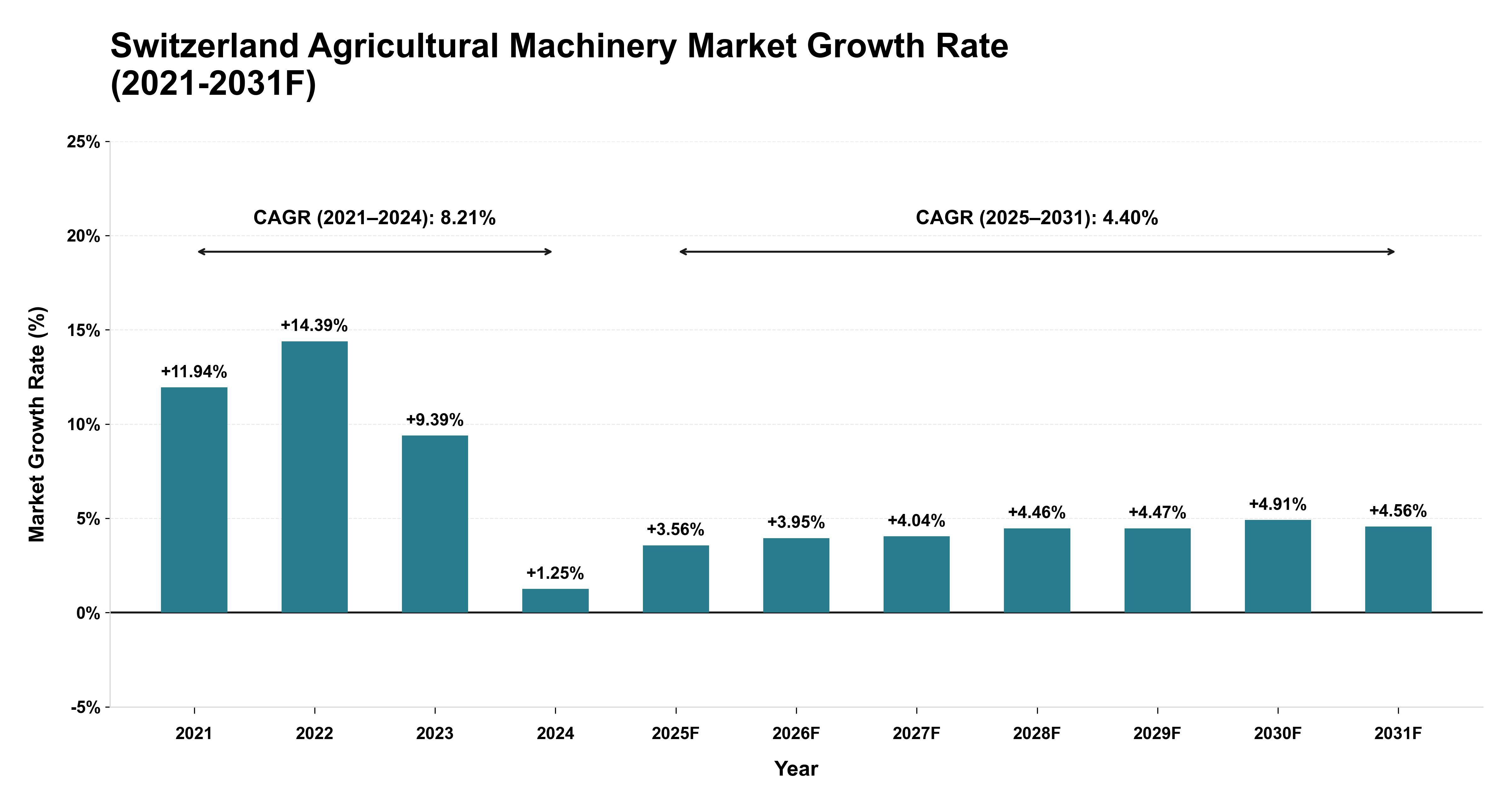
In the Switzerland Agricultural Machinery Market, from 2021 to 2024, we observed a robust historical trend with accelerating growth rates year over year, starting at 11.94% in 2021 and peaking at 14.39% in 2022 before gradually decelerating to 1.25% in 2024. This period was marked by increased investments in advanced agricultural technologies and machinery, driven by the need for efficiency and productivity in the agriculture sector. Looking ahead to the forecast period of 2025-2031, we anticipate a more moderate growth trajectory with an expected CAGR of 4.40%. This slowdown aligns with a stabilizing market after a period of rapid expansion, indicating a maturing phase where technological advancements become more incremental rather than revolutionary, reflecting a more mature stage of adoption within the sector.
Key Highlights of the Report:
- Switzerland Agricultural Machinery Market Outlook
- Market Size of Switzerland Agricultural Machinery Market, 2024
- Forecast of Switzerland Agricultural Machinery Market, 2031
- Historical Data and Forecast of Switzerland Agricultural Machinery Revenues & Volume for the Period 2021- 2031
- Switzerland Agricultural Machinery Market Trend Evolution
- Switzerland Agricultural Machinery Market Drivers and Challenges
- Switzerland Agricultural Machinery Price Trends
- Switzerland Agricultural Machinery Porter's Five Forces
- Switzerland Agricultural Machinery Industry Life Cycle
- Historical Data and Forecast of Switzerland Agricultural Machinery Market Revenues & Volume By Type for the Period 2021- 2031
- Historical Data and Forecast of Switzerland Agricultural Machinery Market Revenues & Volume By Tractors for the Period 2021- 2031
- Historical Data and Forecast of Switzerland Agricultural Machinery Market Revenues & Volume By Equipment for the Period 2021- 2031
- Historical Data and Forecast of Switzerland Agricultural Machinery Market Revenues & Volume By Irrigation Machinery for the Period 2021- 2031
- Historical Data and Forecast of Switzerland Agricultural Machinery Market Revenues & Volume By Harvesting Machinery for the Period 2021- 2031
- Historical Data and Forecast of Switzerland Agricultural Machinery Market Revenues & Volume By Haying and Forage Machinery for the Period 2021- 2031
- Switzerland Agricultural Machinery Import Export Trade Statistics
- Market Opportunity Assessment By Type
- Switzerland Agricultural Machinery Top Companies Market Share
- Switzerland Agricultural Machinery Competitive Benchmarking By Technical and Operational Parameters
- Switzerland Agricultural Machinery Company Profiles
- Switzerland Agricultural Machinery Key Strategic Recommendations






































