Switzerland Cinnamon Market Growth Rate Analysis (2025 - 2031)
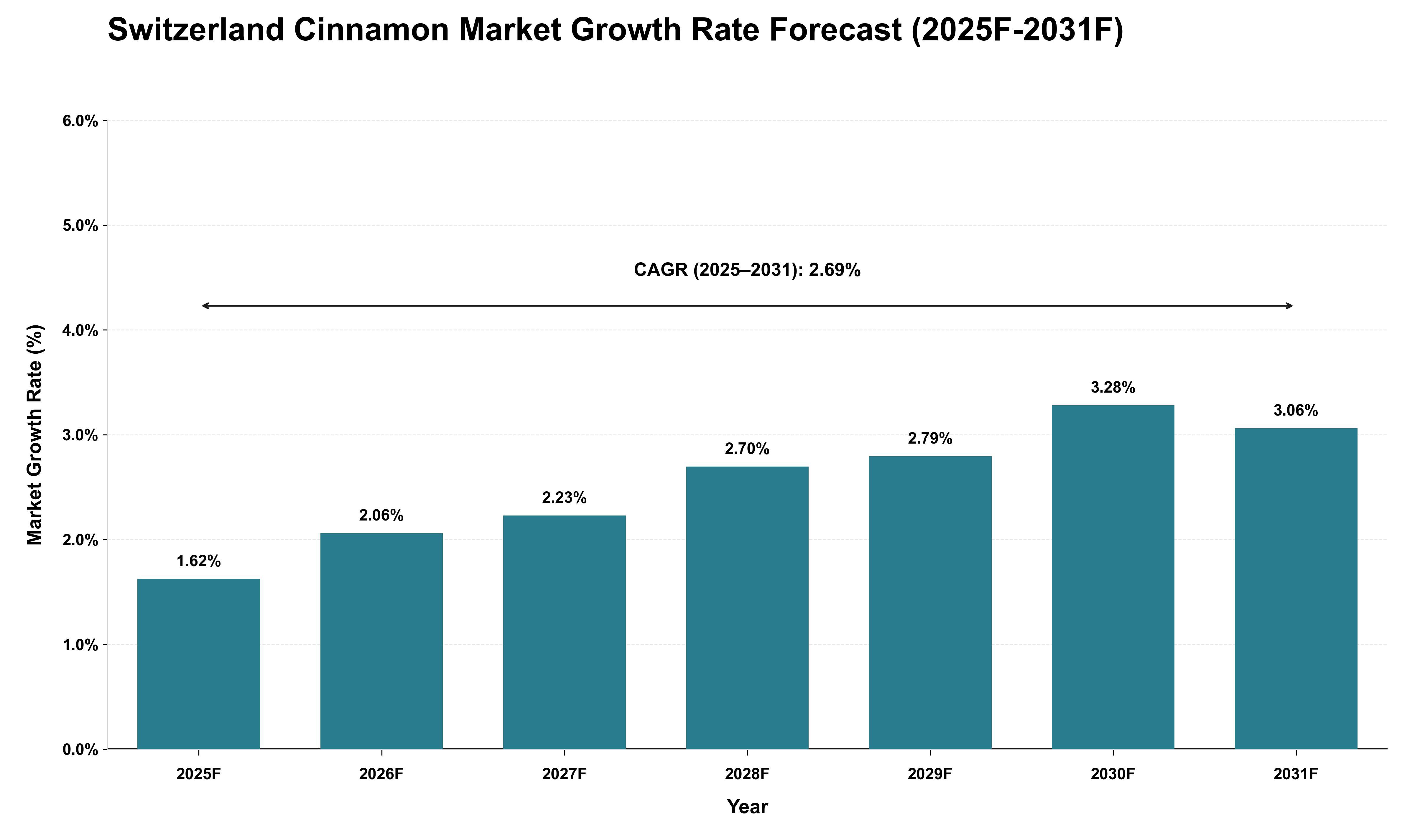
The outlook for the Swiss cinnamon market will be shaped by several macroeconomic factors, including raw material availability and pricing dynamics. As global demand for cinnamon continues to rise, driven by its applications in food, beverages, and health products, Switzerland's reliance on imports will become increasingly significant. The forecasted CAGR of 2.69% from 2025 to 2031 reflects a gradual increase in consumption patterns, with annual growth rates starting at 1.62% in 2025 and peaking at 3.28% in 2030. This trajectory suggests that supply chain efficiencies and favorable trade agreements may enhance import flows, potentially stabilizing prices despite fluctuations in global production due to climatic conditions affecting key producing regions. Consequently, the interplay between demand growth and import dependencies will likely dictate pricing trends and market dynamics throughout this period.
Key Highlights of the Report:
- Switzerland Cinnamon Market Outlook
- Market Size of Switzerland Cinnamon Market, 2024
- Forecast of Switzerland Cinnamon Market, 2031
- Historical Data and Forecast of Switzerland Cinnamon Revenues & Volume for the Period 2021-2031
- Switzerland Cinnamon Market Trend Evolution
- Switzerland Cinnamon Market Drivers and Challenges
- Switzerland Cinnamon Price Trends
- Switzerland Cinnamon Porter`s Five Forces
- Switzerland Cinnamon Industry Life Cycle
- Historical Data and Forecast of Switzerland Cinnamon Market Revenues & Volume By Product for the Period 2021-2031
- Historical Data and Forecast of Switzerland Cinnamon Market Revenues & Volume By Ceylon for the Period 2021-2031
- Historical Data and Forecast of Switzerland Cinnamon Market Revenues & Volume By Cassia for the Period 2021-2031
- Historical Data and Forecast of Switzerland Cinnamon Market Revenues & Volume By Saigon for the Period 2021-2031
- Historical Data and Forecast of Switzerland Cinnamon Market Revenues & Volume By Korintje for the Period 2021-2031
- Historical Data and Forecast of Switzerland Cinnamon Market Revenues & Volume By Application for the Period 2021-2031
- Historical Data and Forecast of Switzerland Cinnamon Market Revenues & Volume By Residential for the Period 2021-2031
- Historical Data and Forecast of Switzerland Cinnamon Market Revenues & Volume By Commercial for the Period 2021-2031
- Switzerland Cinnamon Import Export Trade Statistics
- Market Opportunity Assessment By Product
- Market Opportunity Assessment By Application
- Switzerland Cinnamon Top Companies Market Share
- Switzerland Cinnamon Competitive Benchmarking By Technical and Operational Parameters
- Switzerland Cinnamon Company Profiles
- Switzerland Cinnamon Key Strategic Recommendations






































