Switzerland Circuit Breakers Market Growth Rate Analysis (2025 - 2031)
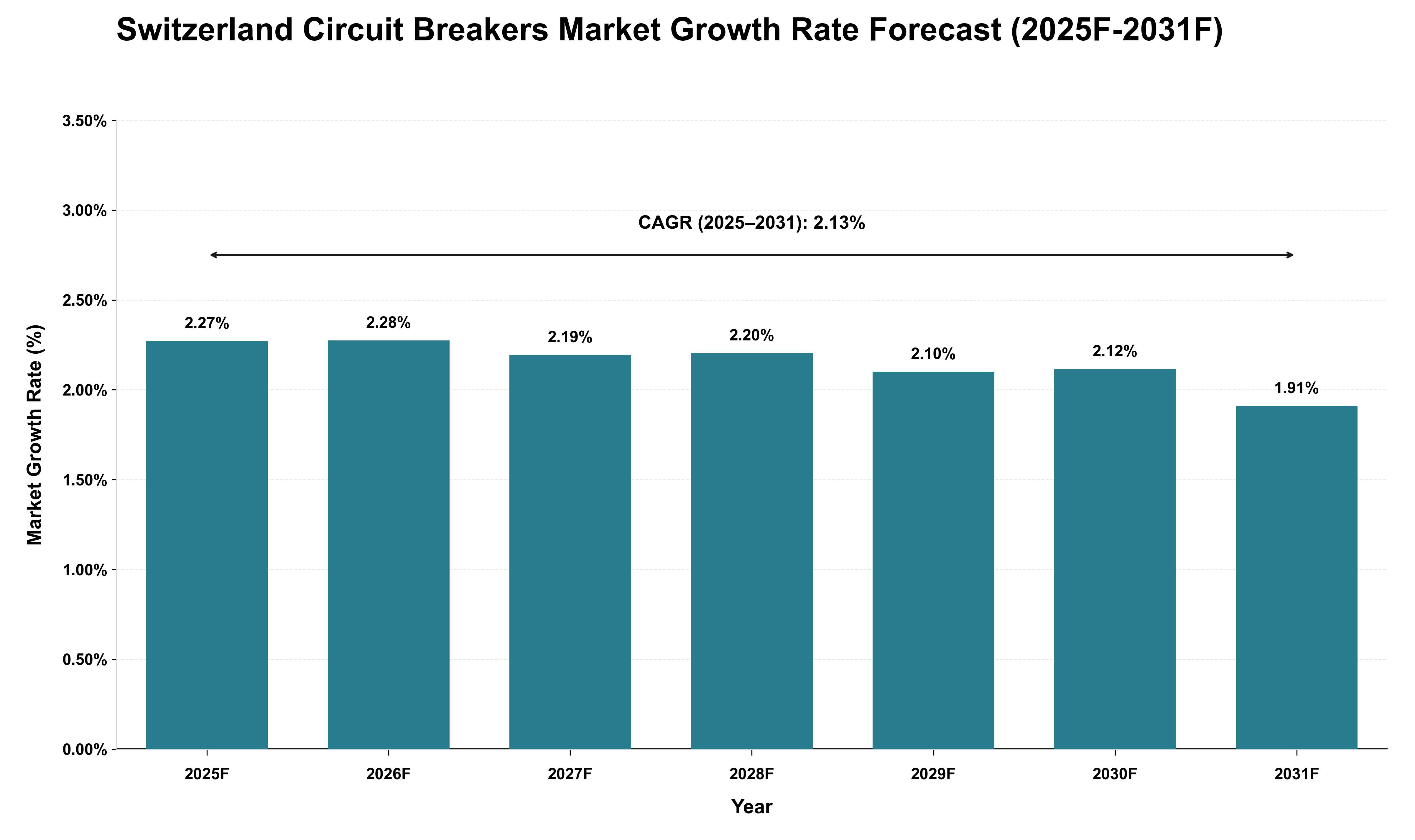
The Switzerland circuit breakers market will experience a gradual growth trajectory, driven by ongoing technological advancements and the increasing adoption of smart grid solutions. As energy efficiency becomes paramount, the demand for innovative circuit protection devices will rise, reflecting a compound annual growth rate (CAGR) of 2.13% from 2025 to 2031. The annual growth rates will exhibit slight fluctuations, peaking at 2.28% in 2026 before tapering off to 1.91% by 2031. This trend will be influenced by the cyclical nature of construction and infrastructure investments, alongside import dependencies on advanced components that enhance product functionality. Additionally, as regulatory frameworks evolve to prioritize safety and sustainability, manufacturers will likely pivot towards integrating digital technologies into their offerings, further shaping market dynamics and consumer preferences in this sector during the forecast period.
Key Highlights of the Report:
- Switzerland Circuit Breakers Market Outlook
- Market Size of Switzerland Circuit Breakers Market, 2024
- Forecast of Switzerland Circuit Breakers Market, 2031
- Historical Data and Forecast of Switzerland Circuit Breakers Revenues & Volume for the Period 2021-2031
- Switzerland Circuit Breakers Market Trend Evolution
- Switzerland Circuit Breakers Market Drivers and Challenges
- Switzerland Circuit Breakers Price Trends
- Switzerland Circuit Breakers Porter`s Five Forces
- Switzerland Circuit Breakers Industry Life Cycle
- Historical Data and Forecast of Switzerland Circuit Breakers Market Revenues & Volume By Type for the Period 2021-2031
- Historical Data and Forecast of Switzerland Circuit Breakers Market Revenues & Volume By Type B MCB for the Period 2021-2031
- Historical Data and Forecast of Switzerland Circuit Breakers Market Revenues & Volume By Type C MCB for the Period 2021-2031
- Historical Data and Forecast of Switzerland Circuit Breakers Market Revenues & Volume By Type D MCB for the Period 2021-2031
- Historical Data and Forecast of Switzerland Circuit Breakers Market Revenues & Volume By Application for the Period 2021-2031
- Historical Data and Forecast of Switzerland Circuit Breakers Market Revenues & Volume By Residential for the Period 2021-2031
- Historical Data and Forecast of Switzerland Circuit Breakers Market Revenues & Volume By Commercial for the Period 2021-2031
- Historical Data and Forecast of Switzerland Circuit Breakers Market Revenues & Volume By Industrial for the Period 2021-2031
- Switzerland Circuit Breakers Import Export Trade Statistics
- Market Opportunity Assessment By Type
- Market Opportunity Assessment By Application
- Switzerland Circuit Breakers Top Companies Market Share
- Switzerland Circuit Breakers Competitive Benchmarking By Technical and Operational Parameters
- Switzerland Circuit Breakers Company Profiles
- Switzerland Circuit Breakers Key Strategic Recommendations






































