Switzerland Dishwasher Market Year-wise Growth Rate (2021-2031F)
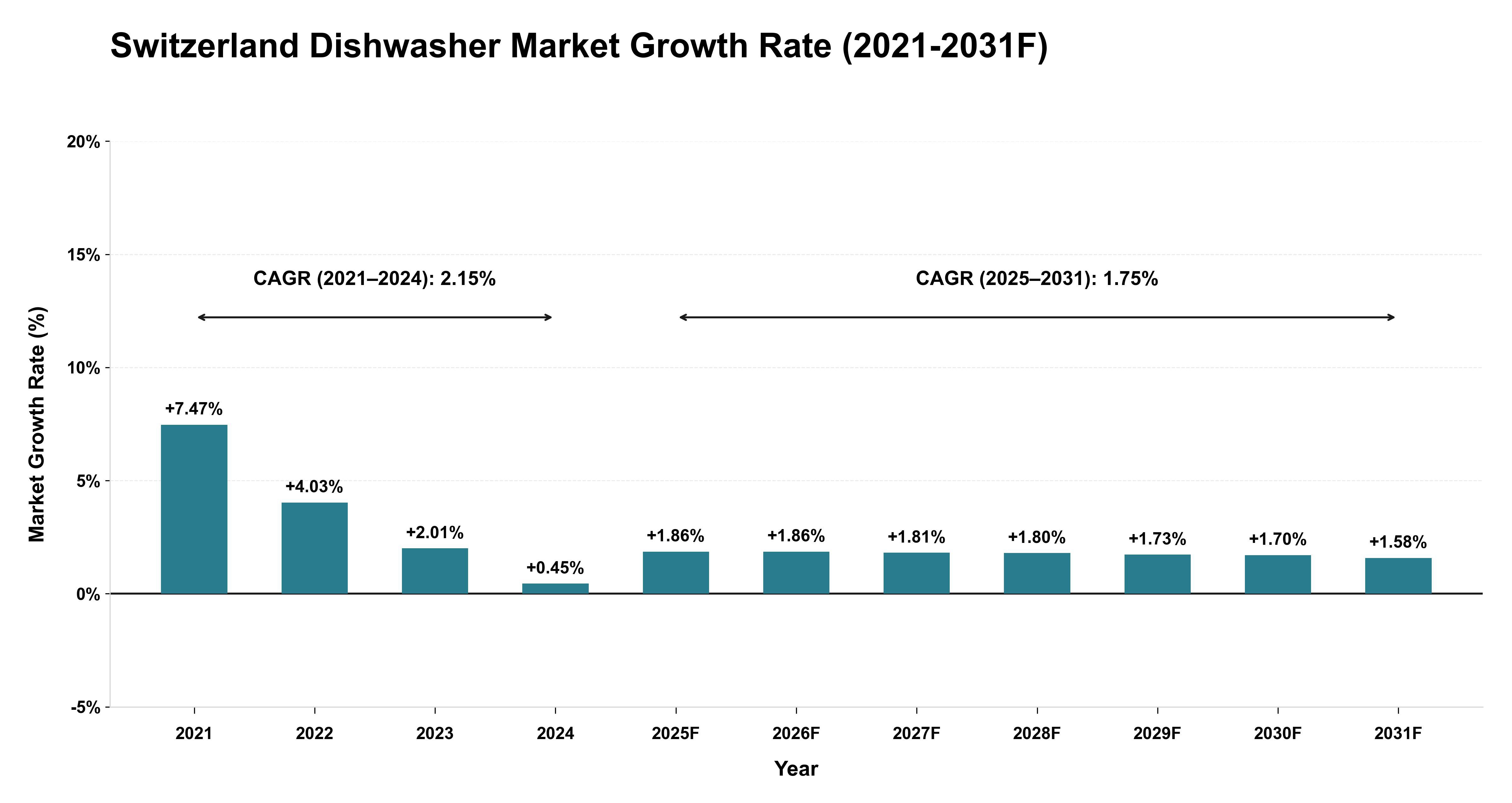
In the Switzerland Dishwasher Market, from 2021 to 2024, the sector experienced robust growth with a CAGR of 2.15%. The market witnessed significant accelerations in 2021 and 2022 at 7.47% and 4.03% respectively, driven by technological advancements and changing consumer preferences towards convenient household appliances. However, from 2023 onwards, growth started decelerating due to market saturation in urban areas and price competition among manufacturers. Looking ahead to the forecast period of 2025-2031, the CAGR is expected to decrease slightly to 1.75%. This deceleration reflects a mature market where demand stabilizes as most households already own dishwashers, leading to a more moderate growth trajectory influenced by replacement cycles and incremental innovations in energy efficiency and smart features.
Key Highlights of the Report:
- Switzerland Dishwasher Market Outlook
- Market Size of Switzerland Dishwasher Market, 2025
- Forecast of Switzerland Dishwasher Market, 2032
- Historical Data and Forecast of Switzerland Dishwasher Revenues & Volume for the Period 2022-2032F
- Switzerland Dishwasher Market Trend Evolution
- Switzerland Dishwasher Market Drivers and Challenges
- Switzerland Dishwasher Price Trends
- Switzerland Dishwasher Porter`s Five Forces
- Switzerland Dishwasher Industry Life Cycle
- Historical Data and Forecast of Switzerland Dishwasher Market Revenues & Volume By Type for the Period 2022-2032F
- Historical Data and Forecast of Switzerland Dishwasher Market Revenues & Volume By Freestanding dishwasher for the Period 2022-2032F
- Historical Data and Forecast of Switzerland Dishwasher Market Revenues & Volume By Built-in dishwasher for the Period 2022-2032F
- Historical Data and Forecast of Switzerland Dishwasher Market Revenues & Volume By Application for the Period 2022-2032F
- Historical Data and Forecast of Switzerland Dishwasher Market Revenues & Volume By Industrial for the Period 2022-2032F
- Historical Data and Forecast of Switzerland Dishwasher Market Revenues & Volume By Residential for the Period 2022-2032F
- Historical Data and Forecast of Switzerland Dishwasher Market Revenues & Volume By Distribution Channel for the Period 2022-2032F
- Historical Data and Forecast of Switzerland Dishwasher Market Revenues & Volume By Offline for the Period 2022-2032F
- Historical Data and Forecast of Switzerland Dishwasher Market Revenues & Volume By Online for the Period 2022-2032F
- Switzerland Dishwasher Import Export Trade Statistics
- Market Opportunity Assessment By Type
- Market Opportunity Assessment By Application
- Market Opportunity Assessment By Distribution Channel
- Switzerland Dishwasher Top Companies Market Share
- Switzerland Dishwasher Competitive Benchmarking By Technical and Operational Parameters
- Switzerland Dishwasher Company Profiles
- Switzerland Dishwasher Key Strategic Recommendations






































