Switzerland Encapsulated Flavours Market: Import Trend Analysis
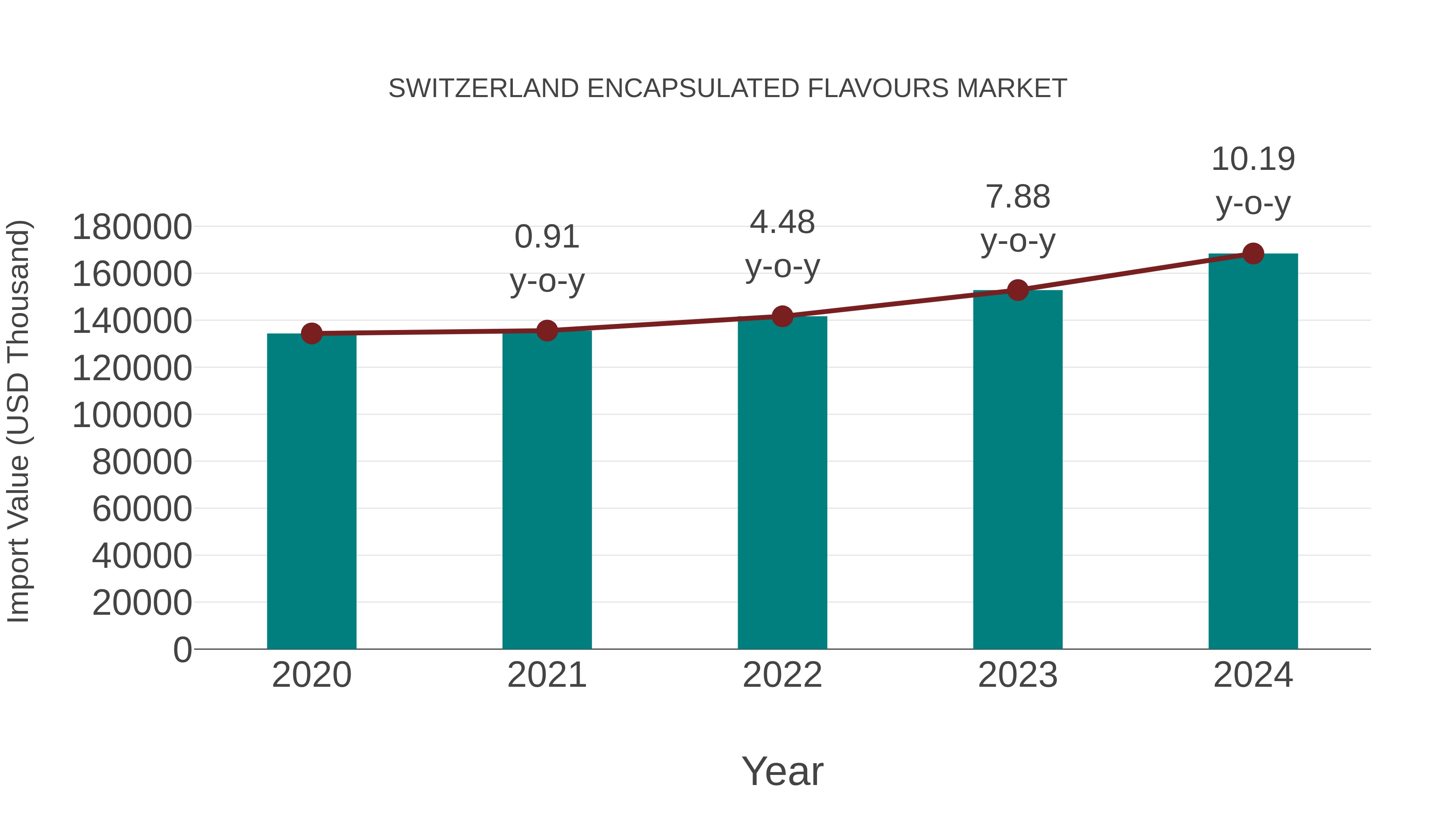
Switzerland import trend for encapsulated flavors market showed a growth rate of 10.19% from 2023 to 2024, with a compound annual growth rate (CAGR) of 5.81% from 2020 to 2024. This growth can be attributed to increasing consumer demand for unique and convenient flavoring options in various food and beverage products.
Switzerland Encapsulated Flavours Market Overview
The encapsulated flavors market in Switzerland is witnessing steady growth driven by the rising demand for innovative and convenient food products. Encapsulated flavors are widely used in a variety of food and beverage applications, including dairy products, confectionery, and beverages, to enhance taste and aroma while ensuring stability and shelf-life. Key players in the market are focusing on product innovation and launching new flavor variants to cater to evolving consumer preferences for natural and clean label products. The market is also benefiting from the growing trend of premiumization in the food and beverage industry, with consumers willing to pay more for high-quality products. Additionally, the increasing awareness about the benefits of encapsulated flavors such as improved flavor delivery and consistency is further driving market growth in Switzerland.
Switzerland Encapsulated Flavours Market Trends
The encapsulated flavors market in Switzerland is witnessing a growing demand for natural and clean label ingredients. Consumers are increasingly seeking out products with natural flavors and ingredients, driving the market towards cleaner and more transparent labeling practices. Additionally, there is a rising interest in unique and exotic flavor profiles, as well as healthier options such as organic and plant-based encapsulated flavors. The market is also experiencing innovation in technology, with advancements in encapsulation techniques to improve flavor stability and release. Manufacturers are focusing on developing customized solutions to meet the specific needs of consumers, particularly in the food and beverage industry. Overall, the encapsulated flavors market in Switzerland is evolving to cater to the changing preferences and demands of consumers for natural, healthy, and innovative flavor experiences.
Switzerland Encapsulated Flavours Market Challenges
In the Switzerland encapsulated flavors market, some key challenges include increasing competition from other flavoring technologies, such as liquid flavors, natural flavors, and essential oils. The demand for clean label and natural ingredients is also a growing trend, posing a challenge for encapsulated flavors that may contain artificial additives or preservatives. Additionally, the high costs associated with research and development of innovative encapsulation techniques to meet changing consumer preferences and regulatory requirements can be a barrier for smaller companies in the market. Furthermore, fluctuations in raw material prices and supply chain disruptions can impact the overall cost and availability of encapsulated flavors in Switzerland, creating additional challenges for market players to navigate effectively.
Switzerland Encapsulated Flavours Market Investment Opportunities
The Switzerland encapsulated flavors market offers promising investment opportunities due to the increasing demand for innovative and convenient food and beverage products. Encapsulated flavors provide a way to enhance taste, aroma, and texture in various applications such as confectionery, dairy, and beverages. The market is driven by factors such as changing consumer preferences, a growing food processing industry, and a focus on product differentiation. Investing in this market can be lucrative as companies are constantly looking to develop new flavor combinations and technologies to meet evolving consumer needs. Additionally, Switzerland`s reputation for high-quality and premium food products further enhances the attractiveness of the encapsulated flavors market for investors looking for sustainable growth opportunities in the food industry.
Switzerland Encapsulated Flavours Market Government Policy
In Switzerland, the encapsulated flavors market is subject to various government policies aimed at ensuring food safety and quality. The Swiss Federal Food Safety and Veterinary Office (FSVO) regulates the production and labeling of encapsulated flavors to ensure they comply with strict standards. Additionally, the Swiss Federal Office of Public Health (FOPH) oversees the use of encapsulated flavors in food products to protect consumer health. The Swiss government also promotes transparency in labeling and advertising of encapsulated flavors, requiring manufacturers to provide accurate information to consumers. Overall, the government policies in Switzerland create a regulatory framework that supports the growth of the encapsulated flavors market while prioritizing consumer safety and transparency.
Switzerland Encapsulated Flavours Market Future Outlook
The future outlook for the Switzerland encapsulated flavors market appears promising, with continued growth anticipated due to several factors. The increasing demand for convenience and innovative food products is driving the adoption of encapsulated flavors in various applications such as food, beverages, and pharmaceuticals. The focus on product differentiation and enhanced sensory experiences by food manufacturers is also expected to fuel the market growth. Furthermore, the rising consumer awareness regarding health and wellness, coupled with the preference for natural and clean label ingredients, is likely to drive the demand for encapsulated flavors derived from natural sources. Advancements in encapsulation technologies and research and development activities aimed at creating novel flavor profiles are expected to further boost market growth in Switzerland. Overall, the Switzerland encapsulated flavors market is poised for expansion in the coming years.
Key Highlights of the Report:
- Switzerland Encapsulated Flavours Market Outlook
- Market Size of Switzerland Encapsulated Flavours Market,2025
- Forecast of Switzerland Encapsulated Flavours Market, 2032
- Historical Data and Forecast of Switzerland Encapsulated Flavours Revenues & Volume for the Period 2022-2032F
- Switzerland Encapsulated Flavours Market Trend Evolution
- Switzerland Encapsulated Flavours Market Drivers and Challenges
- Switzerland Encapsulated Flavours Price Trends
- Switzerland Encapsulated Flavours Porter's Five Forces
- Switzerland Encapsulated Flavours Industry Life Cycle
- Historical Data and Forecast of Switzerland Encapsulated Flavours Market Revenues & Volume By Product Type for the Period 2022-2032F
- Historical Data and Forecast of Switzerland Encapsulated Flavours Market Revenues & Volume By Flavored Blends for the Period 2022-2032F
- Historical Data and Forecast of Switzerland Encapsulated Flavours Market Revenues & Volume By Fragrance Blends for the Period 2022-2032F
- Historical Data and Forecast of Switzerland Encapsulated Flavours Market Revenues & Volume By Essential Oils for the Period 2022-2032F
- Historical Data and Forecast of Switzerland Encapsulated Flavours Market Revenues & Volume By Natural Extracts for the Period 2022-2032F
- Historical Data and Forecast of Switzerland Encapsulated Flavours Market Revenues & Volume By Aroma Chemicals for the Period 2022-2032F
- Historical Data and Forecast of Switzerland Encapsulated Flavours Market Revenues & Volume By Encapsulation Process for the Period 2022-2032F
- Historical Data and Forecast of Switzerland Encapsulated Flavours Market Revenues & Volume By Physical Process for the Period 2022-2032F
- Historical Data and Forecast of Switzerland Encapsulated Flavours Market Revenues & Volume By Physiochemical Process for the Period 2022-2032F
- Historical Data and Forecast of Switzerland Encapsulated Flavours Market Revenues & Volume By Chemical Process for the Period 2022-2032F
- Historical Data and Forecast of Switzerland Encapsulated Flavours Market Revenues & Volume By Extrusiuon for the Period 2022-2032F
- Historical Data and Forecast of Switzerland Encapsulated Flavours Market Revenues & Volume By Spray Congealing and Chilling for the Period 2022-2032F
- Historical Data and Forecast of Switzerland Encapsulated Flavours Market Revenues & Volume By Sprays Drying for the Period 2022-2032F
- Historical Data and Forecast of Switzerland Encapsulated Flavours Market Revenues & Volume By Glass Encapsulation for the Period 2022-2032F
- Historical Data and Forecast of Switzerland Encapsulated Flavours Market Revenues & Volume By Others for the Period 2022-2032F
- Historical Data and Forecast of Switzerland Encapsulated Flavours Market Revenues & Volume By Flavor Type for the Period 2022-2032F
- Historical Data and Forecast of Switzerland Encapsulated Flavours Market Revenues & Volume By Fruit Flavors for the Period 2022-2032F
- Historical Data and Forecast of Switzerland Encapsulated Flavours Market Revenues & Volume By Nut Flavors for the Period 2022-2032F
- Historical Data and Forecast of Switzerland Encapsulated Flavours Market Revenues & Volume By Chocolate Flavor for the Period 2022-2032F
- Historical Data and Forecast of Switzerland Encapsulated Flavours Market Revenues & Volume By Spice Flavor for the Period 2022-2032F
- Historical Data and Forecast of Switzerland Encapsulated Flavours Market Revenues & Volume By Vanilla Flavor for the Period 2022-2032F
- Historical Data and Forecast of Switzerland Encapsulated Flavours Market Revenues & Volume By Citric Flavor for the Period 2022-2032F
- Historical Data and Forecast of Switzerland Encapsulated Flavours Market Revenues & Volume By Berry Flavor for the Period 2022-2032F
- Historical Data and Forecast of Switzerland Encapsulated Flavours Market Revenues & Volume By Others for the Period 2022-2032F
- Historical Data and Forecast of Switzerland Encapsulated Flavours Market Revenues & Volume By Application for the Period 2022-2032F
- Historical Data and Forecast of Switzerland Encapsulated Flavours Market Revenues & Volume By Pharmaceutical and Personal Care for the Period 2022-2032F
- Historical Data and Forecast of Switzerland Encapsulated Flavours Market Revenues & Volume By Toiletries and Cleaners for the Period 2022-2032F
- Historical Data and Forecast of Switzerland Encapsulated Flavours Market Revenues & Volume By Beverages and Instant drinks for the Period 2022-2032F
- Historical Data and Forecast of Switzerland Encapsulated Flavours Market Revenues & Volume By Dairy Products for the Period 2022-2032F
- Historical Data and Forecast of Switzerland Encapsulated Flavours Market Revenues & Volume By Frozen Food for the Period 2022-2032F
- Historical Data and Forecast of Switzerland Encapsulated Flavours Market Revenues & Volume By Snacks for the Period 2022-2032F
- Historical Data and Forecast of Switzerland Encapsulated Flavours Market Revenues & Volume By Cereal and Oatmeal for the Period 2022-2032F
- Historical Data and Forecast of Switzerland Encapsulated Flavours Market Revenues & Volume By Bakery and Confectionery for the Period 2022-2032F
- Switzerland Encapsulated Flavours Import Export Trade Statistics
- Market Opportunity Assessment By Product Type
- Market Opportunity Assessment By Encapsulation Process
- Market Opportunity Assessment By Flavor Type
- Market Opportunity Assessment By Application
- Switzerland Encapsulated Flavours Top Companies Market Share
- Switzerland Encapsulated Flavours Competitive Benchmarking By Technical and Operational Parameters
- Switzerland Encapsulated Flavours Company Profiles
- Switzerland Encapsulated Flavours Key Strategic Recommendations






































