Switzerland Food Products Machinery Market Year-wise Growth Rate (2021-2031F)
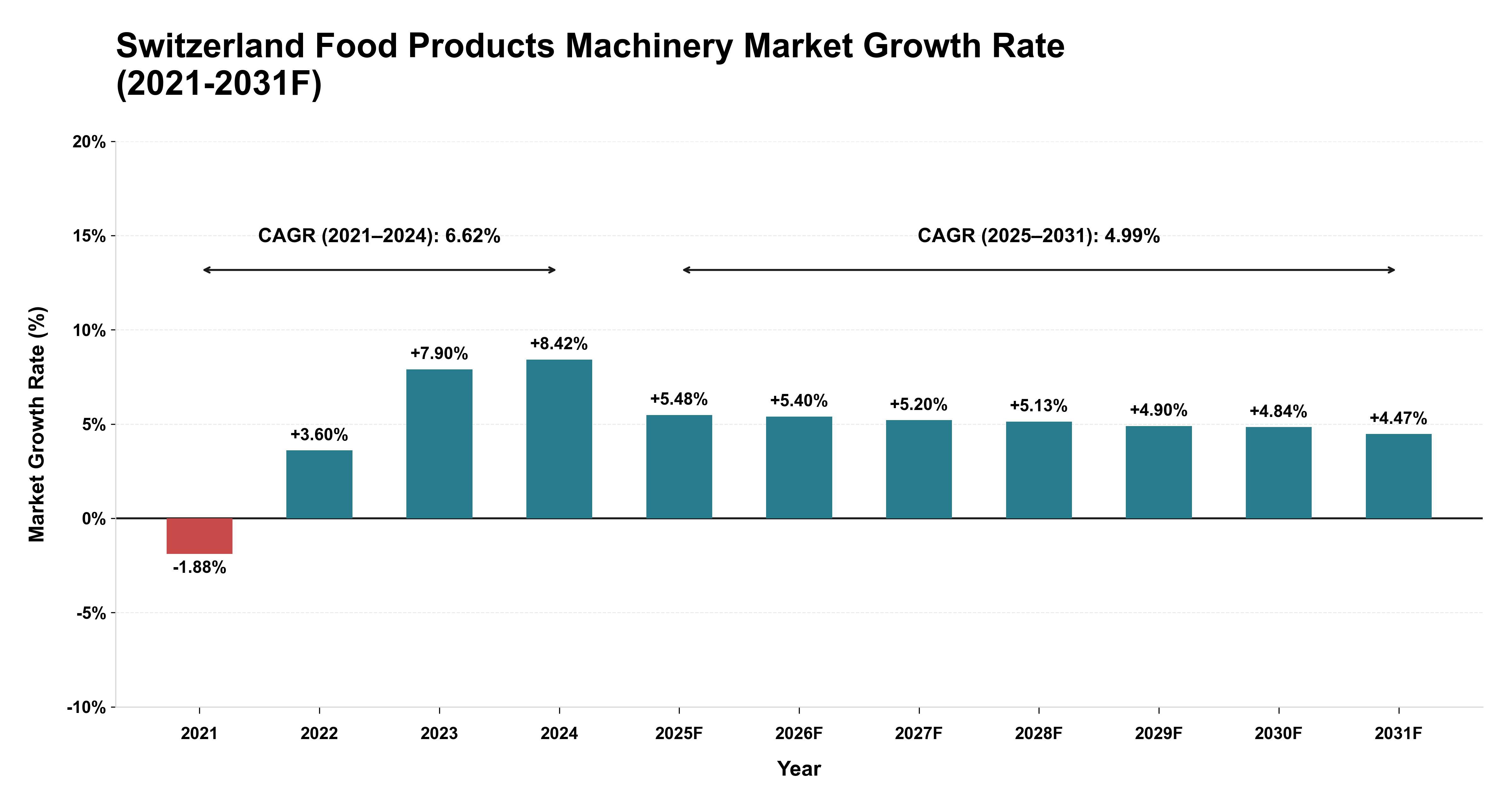
The Switzerland Food Products Machinery Market witnessed a tumultuous period from 2021 to 2024, experiencing a contraction in 2021 followed by a significant rebound in subsequent years with growth rates of 3.60%, 7.90%, and 8.42% respectively. These fluctuations can be attributed to evolving consumer preferences, technological advancements, and regulatory changes shaping the demand for food processing equipment. Looking ahead to the forecast period from 2025 to 2031, the market is expected to stabilize with a more moderate annual growth trajectory ranging from 4.47% to 5.48%. This deceleration aligns with a maturing market landscape, where established players focus on optimizing production efficiencies and meeting sustainability standards to sustain growth in the long term.
Key Highlights of the Report:
- Switzerland Food products machinery Market Outlook
- Market Size of Switzerland Food products machinery Market, 2024
- Forecast of Switzerland Food products machinery Market, 2031
- Historical Data and Forecast of Switzerland Food products machinery Revenues & Volume for the Period 2021-2031
- Switzerland Food products machinery Market Trend Evolution
- Switzerland Food products machinery Market Drivers and Challenges
- Switzerland Food products machinery Price Trends
- Switzerland Food products machinery Porter`s Five Forces
- Switzerland Food products machinery Industry Life Cycle
- Historical Data and Forecast of Switzerland Food products machinery Market Revenues & Volume By Type for the Period 2021-2031
- Historical Data and Forecast of Switzerland Food products machinery Market Revenues & Volume By Dairy Product Plant Machinery and Equipment for the Period 2021-2031
- Historical Data and Forecast of Switzerland Food products machinery Market Revenues & Volume By Bakery Machinery and Equipment for the Period 2021-2031
- Historical Data and Forecast of Switzerland Food products machinery Market Revenues & Volume By Meat and Poultry Processing And Preparation Machinery for the Period 2021-2031
- Historical Data and Forecast of Switzerland Food products machinery Market Revenues & Volume By Other Commercial Food Products Machinery for the Period 2021-2031
- Historical Data and Forecast of Switzerland Food products machinery Market Revenues & Volume By Applications for the Period 2021-2031
- Historical Data and Forecast of Switzerland Food products machinery Market Revenues & Volume By Bakery & Confectionery for the Period 2021-2031
- Historical Data and Forecast of Switzerland Food products machinery Market Revenues & Volume By Meat, Poultry, and Seafood for the Period 2021-2031
- Historical Data and Forecast of Switzerland Food products machinery Market Revenues & Volume By Dairy for the Period 2021-2031
- Historical Data and Forecast of Switzerland Food products machinery Market Revenues & Volume By Beverages for the Period 2021-2031
- Historical Data and Forecast of Switzerland Food products machinery Market Revenues & Volume By Others for the Period 2021-2031
- Switzerland Food products machinery Import Export Trade Statistics
- Market Opportunity Assessment By Type
- Market Opportunity Assessment By Applications
- Switzerland Food products machinery Top Companies Market Share
- Switzerland Food products machinery Competitive Benchmarking By Technical and Operational Parameters
- Switzerland Food products machinery Company Profiles
- Switzerland Food products machinery Key Strategic Recommendations






































