Switzerland Healthcare It Market: Import Trend Analysis
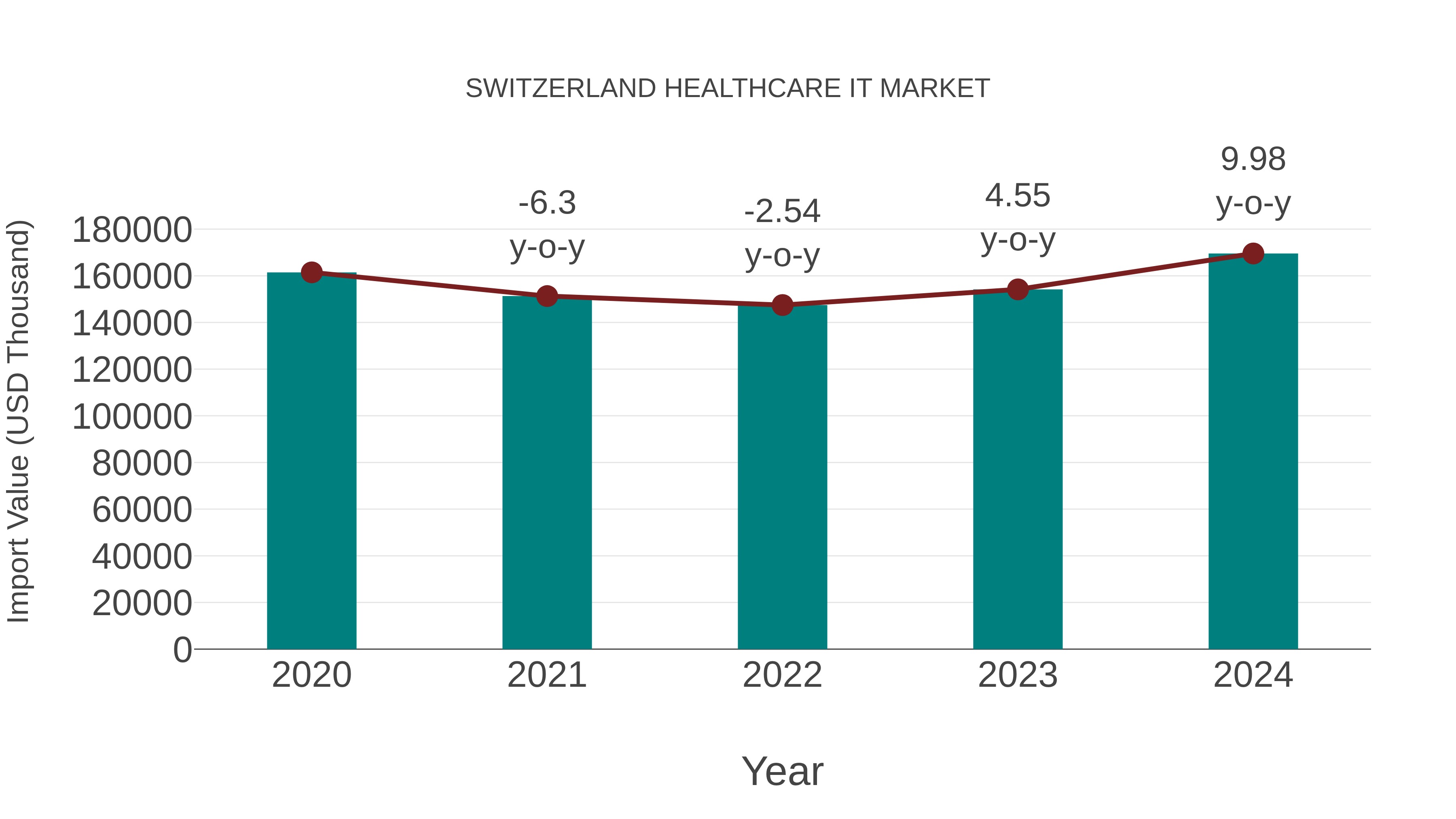
Switzerland import trend for the healthcare IT market showed a growth rate of 9.98% from 2023 to 2024, with a CAGR of 1.23% from 2020 to 2024. This growth can be attributed to increasing demand for advanced healthcare technologies and digital solutions in the market.
Switzerland Healthcare IT Market Overview
The Switzerland Healthcare IT Market is characterized by advanced technology adoption, stringent data privacy regulations, and a strong focus on patient-centric care delivery. The market is driven by factors such as the increasing demand for efficient healthcare services, rising healthcare costs, and the need for interoperable systems to facilitate seamless data exchange among healthcare providers. Key trends in the Swiss Healthcare IT Market include the implementation of electronic health records (EHRs), telemedicine solutions, and mobile health applications. Market players are investing in innovative technologies like AI, blockchain, and IoT to enhance healthcare delivery and improve patient outcomes. The Swiss government`s initiatives to promote digital health solutions and its commitment to data security further contribute to the growth of the Healthcare IT Market in Switzerland.
Switzerland Healthcare IT Market Trends
The Switzerland Healthcare IT Market is experiencing a significant growth trajectory driven by the increasing adoption of digital health solutions and the emphasis on improving healthcare efficiency and patient outcomes. Key trends include the integration of electronic health records (EHR) systems to enhance data sharing among healthcare providers, the rise of telemedicine services for remote patient consultations, and the implementation of healthcare analytics tools for data-driven decision-making. Additionally, there is a growing focus on cybersecurity measures to protect sensitive patient information and comply with data privacy regulations. The market is also witnessing a shift towards mobile health applications and wearable devices to empower patients in managing their health and wellness. Overall, the Switzerland Healthcare IT Market is evolving rapidly to meet the demands of a modern healthcare system.
Switzerland Healthcare IT Market Challenges
In the Switzerland Healthcare IT market, several challenges are faced, including data privacy and security concerns due to the sensitive nature of patient information. The complex regulatory environment in Switzerland also poses challenges for healthcare IT providers, requiring them to navigate multiple compliance requirements. Additionally, interoperability issues between different healthcare systems and software solutions hinder seamless data exchange and communication among healthcare providers. Limited funding and resources for implementing advanced IT systems further constrain the adoption of innovative technologies in the Swiss healthcare sector. Addressing these challenges will be crucial for driving digital transformation in healthcare and improving patient care outcomes in Switzerland.
Switzerland Healthcare IT Market Investment Opportunities
The Switzerland Healthcare IT market presents promising investment opportunities in areas such as electronic health records (EHR), telemedicine, and data analytics. With a strong emphasis on healthcare quality and efficiency, Swiss healthcare providers are increasingly adopting digital solutions to streamline processes and improve patient care. EHR systems offer significant growth potential as they help healthcare professionals access and share patient information securely. Telemedicine services are also gaining traction, especially in remote areas, providing convenient access to healthcare services. Furthermore, the demand for advanced data analytics tools to derive insights from healthcare data is on the rise, presenting opportunities for companies offering innovative solutions in this space. Overall, investing in the Switzerland Healthcare IT market can be lucrative due to the country`s strong healthcare infrastructure and commitment to digital transformation.
Switzerland Healthcare IT Market Government Policy
In Switzerland, government policies related to the Healthcare IT Market focus on promoting the adoption of digital technologies to improve healthcare delivery and patient outcomes. The Swiss government has implemented initiatives such as the eHealth Strategy 2.0 and the Electronic Health Record (EHR) Act, which aim to standardize health data exchange, enhance interoperability among healthcare systems, and ensure the secure storage and sharing of patient information. Additionally, the government provides incentives for healthcare providers to invest in electronic health records and telemedicine services. Overall, the Swiss government emphasizes the importance of leveraging technology to modernize the healthcare sector, streamline processes, and ultimately enhance the quality of care for its citizens.
Switzerland Healthcare IT Market Future Outlook
The Switzerland Healthcare IT Market is poised for substantial growth in the coming years as the country continues to prioritize digital transformation in its healthcare system. Factors such as increasing adoption of electronic health records, rising demand for telemedicine services, and emphasis on interoperability and data analytics are driving the market expansion. The COVID-19 pandemic has also accelerated the adoption of digital health solutions in Switzerland, leading to a surge in investments in healthcare IT infrastructure. Moreover, the government`s support for innovation and technology in healthcare is expected to further propel market growth. As a result, the Switzerland Healthcare IT Market is anticipated to experience significant advancements in areas such as telehealth, health information exchange, and patient engagement tools, offering new opportunities for market players and stakeholders.
Key Highlights of the Report:
- Switzerland Healthcare IT Market Outlook
- Market Size of Switzerland Healthcare IT Market, 2025
- Forecast of Switzerland Healthcare IT Market, 2032
- Historical Data and Forecast of Switzerland Healthcare IT Revenues & Volume for the Period 2022 - 2032F
- Switzerland Healthcare IT Market Trend Evolution
- Switzerland Healthcare IT Market Drivers and Challenges
- Switzerland Healthcare IT Price Trends
- Switzerland Healthcare IT Porter's Five Forces
- Switzerland Healthcare IT Industry Life Cycle
- Historical Data and Forecast of Switzerland Healthcare IT Market Revenues & Volume By Product for the Period 2022 - 2032F
- Historical Data and Forecast of Switzerland Healthcare IT Market Revenues & Volume By Healthcare Provider Solutions for the Period 2022 - 2032F
- Historical Data and Forecast of Switzerland Healthcare IT Market Revenues & Volume By Non-clinical Solutions for the Period 2022 - 2032F
- Historical Data and Forecast of Switzerland Healthcare IT Market Revenues & Volume By Healthcare Payer Solutions for the Period 2022 - 2032F
- Historical Data and Forecast of Switzerland Healthcare IT Market Revenues & Volume By HCIT Outsourcing Services for the Period 2022 - 2032F
- Historical Data and Forecast of Switzerland Healthcare IT Market Revenues & Volume By Payer HCIT Outsourcing Services for the Period 2022 - 2032F
- Historical Data and Forecast of Switzerland Healthcare IT Market Revenues & Volume By Operational HCIT Outsourcing Services for the Period 2022 - 2032F
- Historical Data and Forecast of Switzerland Healthcare IT Market Revenues & Volume By IT Infrastructure Management Services for the Period 2022 - 2032F
- Historical Data and Forecast of Switzerland Healthcare IT Market Revenues & Volume By End User for the Period 2022 - 2032F
- Historical Data and Forecast of Switzerland Healthcare IT Market Revenues & Volume By Healthcare Providers for the Period 2022 - 2032F
- Historical Data and Forecast of Switzerland Healthcare IT Market Revenues & Volume By Healthcare Payers for the Period 2022 - 2032F
- Switzerland Healthcare IT Import Export Trade Statistics
- Market Opportunity Assessment By Product
- Market Opportunity Assessment By End User
- Switzerland Healthcare IT Top Companies Market Share
- Switzerland Healthcare IT Competitive Benchmarking By Technical and Operational Parameters
- Switzerland Healthcare IT Company Profiles
- Switzerland Healthcare IT Key Strategic Recommendations






































