Switzerland Lithium Hydroxide Market: Import Trend Analysis
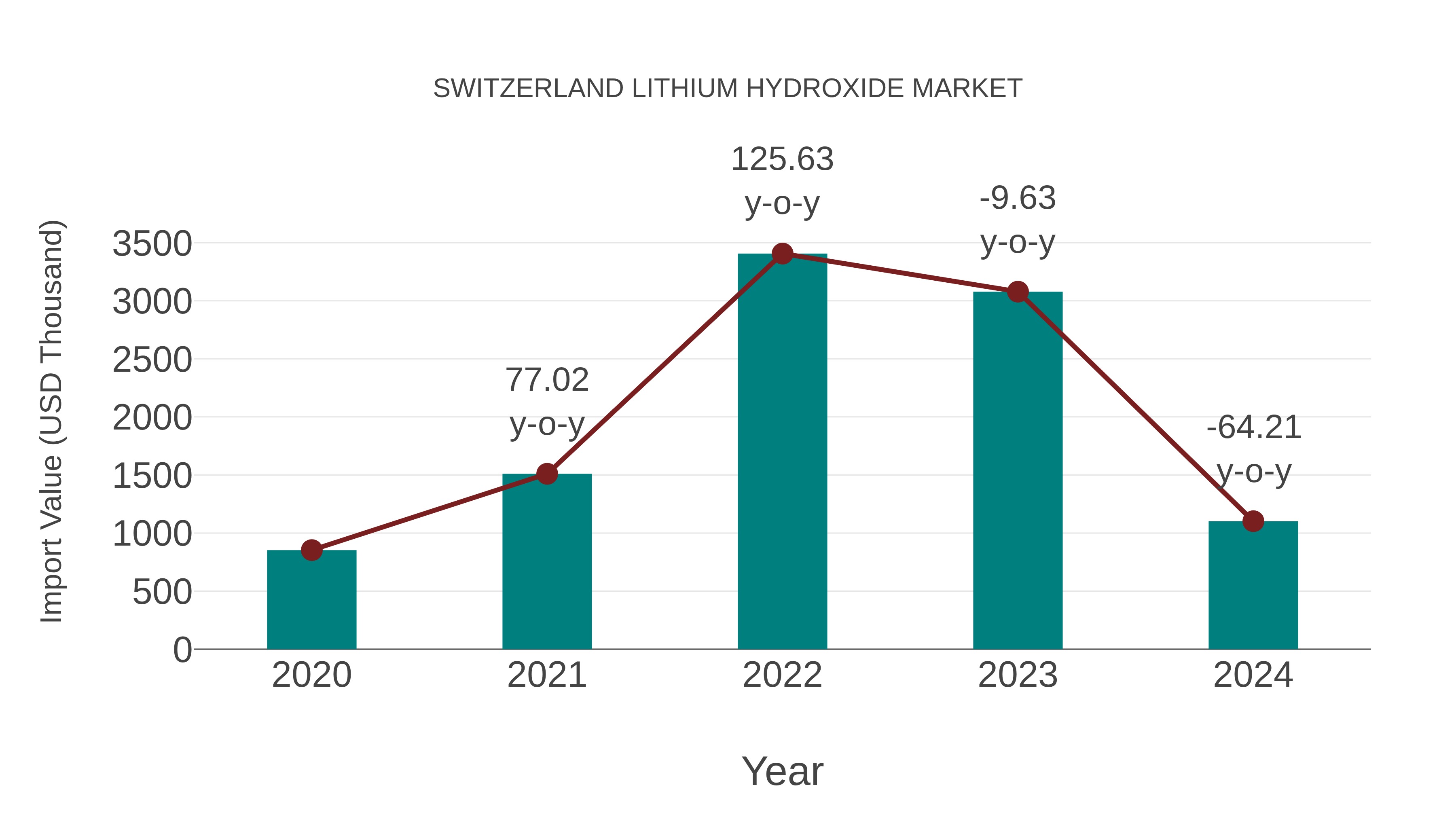
Switzerland import trend for lithium hydroxide in 2023-2024 experienced a decline of -64.21%, with a 6.61% CAGR from 2020-2024. This significant drop in imports could be attributed to shifts in demand or changes in trade policies impacting the market.
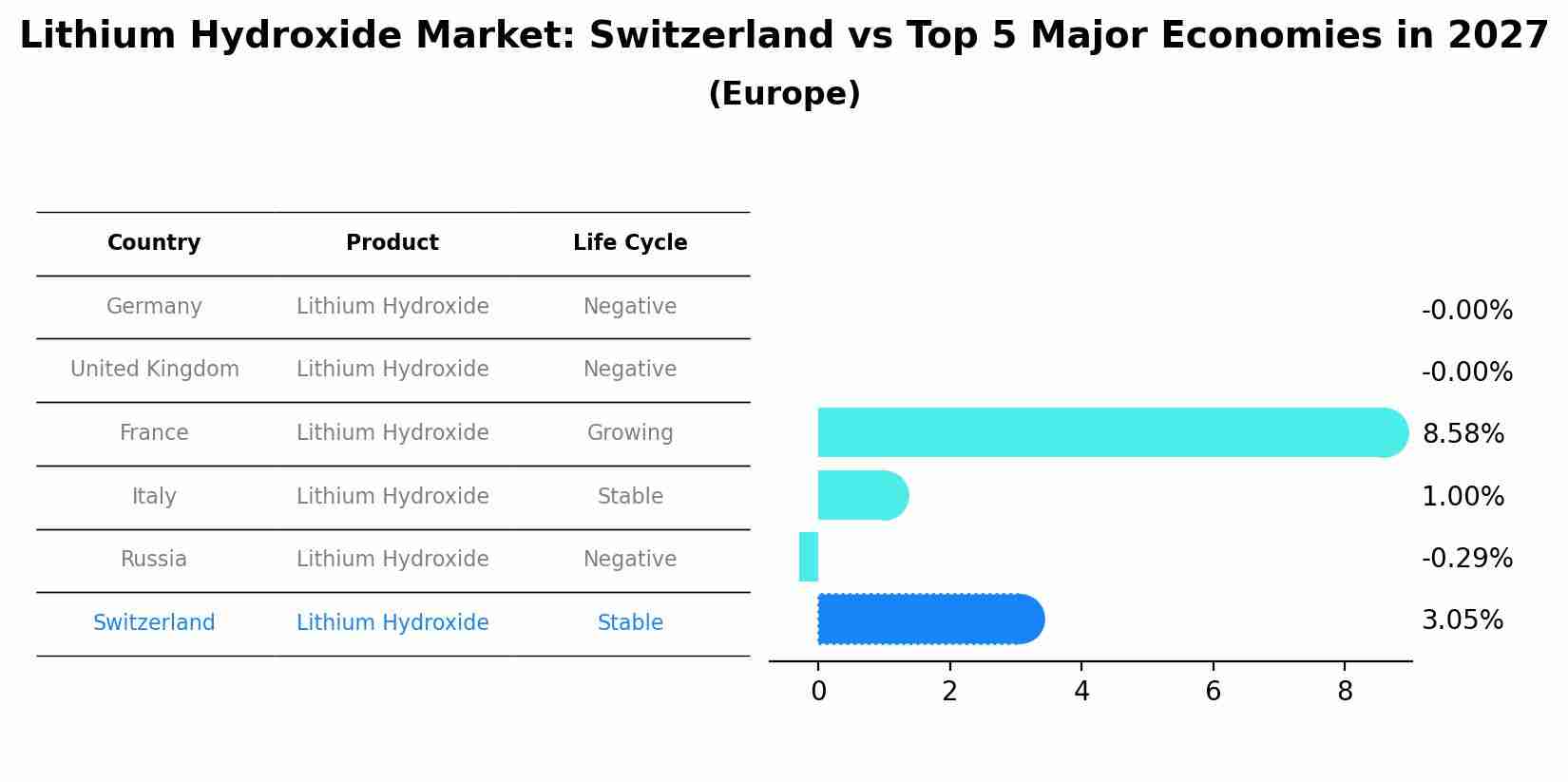
Lithium Hydroxide Market: Switzerland vs Top 5 Major Economies in 2027 (Europe)
In the Europe region, the Lithium Hydroxide market in Switzerland is projected to expand at a stable growth rate of 3.05% by 2027. The largest economy is Germany, followed by United Kingdom, France, Italy and Russia.
Switzerland Lithium Hydroxide Market Overview
The lithium hydroxide market in Switzerland is expanding as it is a preferred component in the production of high-performance lithium-ion batteries, particularly those used in EVs. The market benefits from advancements in battery technology that require materials with high energy density and stability. As the demand for cleaner and more efficient energy solutions rises, the market for lithium hydroxide continues to grow, supported by efforts to enhance the supply chain sustainability.
Drivers of the market
The lithium hydroxide market in Switzerland is influenced by the increasing need for high-performance lithium-ion batteries in the electric vehicle market. As manufacturers seek to improve battery efficiency and longevity, the demand for lithium hydroxide rises. The focus on reducing carbon emissions and transitioning to electric mobility further drives the market`s growth.
Challenges of the market
In the lithium hydroxide market, companies encounter challenges related to increasing competition and fluctuating demand from various sectors, particularly electric vehicle (EV) manufacturers. As the shift towards electrification accelerates, the demand for lithium hydroxide, essential for high-performance batteries, surges. However, this rapid growth can lead to supply shortages and increased prices. Moreover, manufacturers must ensure that their production processes are efficient and environmentally compliant, which often requires significant investment in technology and infrastructure.
Government Policy of the market
In the lithium hydroxide market, Swiss government policies emphasize the importance of high-quality production processes and environmental sustainability. Incentives are provided for companies that adopt green technologies in the production of lithium hydroxide, particularly for applications in batteries. The government actively promotes the development of local supply chains to reduce dependency on imports, supporting domestic manufacturers in their efforts to meet growing global demand. Regulatory frameworks ensure compliance with safety and environmental standards, fostering trust among consumers and businesses alike.
Key Highlights of the Report:
- Switzerland Lithium Hydroxide Market Outlook
- Market Size of Switzerland Lithium Hydroxide Market, 2025
- Forecast of Switzerland Lithium Hydroxide Market, 2032
- Historical Data and Forecast of Switzerland Lithium Hydroxide Revenues & Volume for the Period 2022-2032F
- Switzerland Lithium Hydroxide Market Trend Evolution
- Switzerland Lithium Hydroxide Market Drivers and Challenges
- Switzerland Lithium Hydroxide Price Trends
- Switzerland Lithium Hydroxide Porter`s Five Forces
- Switzerland Lithium Hydroxide Industry Life Cycle
- Historical Data and Forecast of Switzerland Lithium Hydroxide Market Revenues & Volume By Application for the Period 2022-2032F
- Historical Data and Forecast of Switzerland Lithium Hydroxide Market Revenues & Volume By Batteries for the Period 2022-2032F
- Historical Data and Forecast of Switzerland Lithium Hydroxide Market Revenues & Volume By Lubricating Greases for the Period 2022-2032F
- Historical Data and Forecast of Switzerland Lithium Hydroxide Market Revenues & Volume By Purification for the Period 2022-2032F
- Historical Data and Forecast of Switzerland Lithium Hydroxide Market Revenues & Volume By Others for the Period 2022-2032F
- Switzerland Lithium Hydroxide Import Export Trade Statistics
- Market Opportunity Assessment By Application
- Switzerland Lithium Hydroxide Top Companies Market Share
- Switzerland Lithium Hydroxide Competitive Benchmarking By Technical and Operational Parameters
- Switzerland Lithium Hydroxide Company Profiles
- Switzerland Lithium Hydroxide Key Strategic Recommendations






































