Switzerland Magnetic Field Sensors Market: Import Trend Analysis
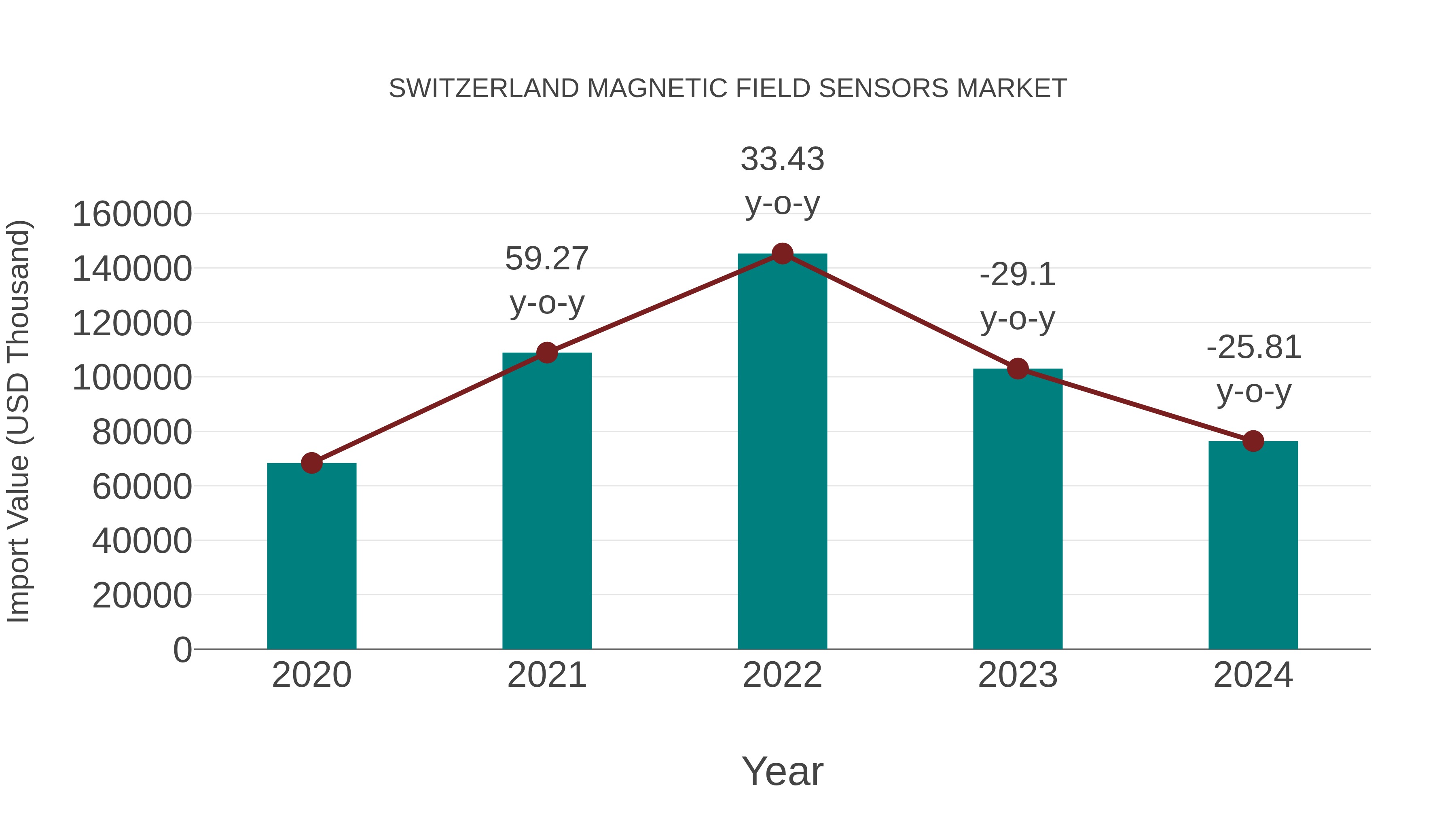
Switzerland import trend for magnetic field sensors from 2023 to 2024 experienced a decline of -25.81%. The compound annual growth rate (CAGR) for 2020-2024 stood at 2.82%. This decrease in imports could be attributed to shifts in demand or changes in market dynamics.
Switzerland Magnetic Field Sensors Market Overview
The Switzerland magnetic field sensors market is experiencing steady growth due to increasing demand across various industries such as automotive, healthcare, consumer electronics, and industrial automation. The market is driven by a rising need for precise and reliable sensing technologies for applications like position sensing, proximity detection, and current sensing. Key players in the Swiss market include companies like Sensirion AG, Infineon Technologies AG, and TDK Corporation, offering a wide range of magnetic field sensor products with advanced features and capabilities. The growing adoption of Internet of Things (IoT) devices and increasing focus on automation and robotics are further fueling the demand for magnetic field sensors in Switzerland. Additionally, advancements in sensor technologies, such as the development of smaller and more energy-efficient sensors, are expected to drive the market growth in the coming years.
Switzerland Magnetic Field Sensors Market Trends
The Switzerland magnetic field sensors market is experiencing steady growth driven by the increasing demand for these sensors in various industries such as automotive, consumer electronics, and healthcare. Key trends in the market include the rising adoption of Hall effect sensors for automotive applications, the development of high-precision magnetoresistive sensors for industrial automation, and the integration of magnetic sensors in wearable devices for health monitoring. Additionally, advancements in magnetic sensor technology, such as the miniaturization of sensors and the enhancement of sensitivity and accuracy, are further fueling market growth. The market is also witnessing a shift towards the use of magnetometer sensors for applications like navigation systems and virtual reality. Overall, the Switzerland magnetic field sensors market is poised for continued expansion driven by ongoing technological innovations and increasing integration of sensors in various end-use industries.
Switzerland Magnetic Field Sensors Market Challenges
In the Switzerland magnetic field sensors market, the main challenges include increasing competition from global players offering advanced technologies at lower costs, constant need for innovation to stay ahead in the market, and the impact of economic uncertainties on investment in new sensor technologies. Additionally, the market faces challenges related to stringent regulations and standards governing the use of magnetic field sensors in various industries, requiring companies to ensure compliance while maintaining competitive pricing. Furthermore, the evolving needs of end-users and rapid technological advancements pose challenges in terms of developing sensors that meet changing requirements and offer improved performance. Overall, navigating these challenges requires companies in the Switzerland magnetic field sensors market to focus on differentiation through innovation, cost-efficiency, and strategic partnerships to sustain growth and competitive advantage.
Switzerland Magnetic Field Sensors Market Investment Opportunities
In the Switzerland magnetic field sensors market, there are several promising investment opportunities for both established companies and new entrants. With the increasing demand for magnetic field sensors in various industries such as automotive, consumer electronics, healthcare, and industrial automation, there is a growing need for innovative and high-performance sensor technologies. Investing in research and development to create advanced sensors with higher sensitivity, accuracy, and efficiency can provide a competitive edge in the market. Additionally, collaborations with key industry players, universities, and research institutions in Switzerland can help in accessing cutting-edge technologies and expanding market reach. Furthermore, targeting niche applications such as IoT devices, robotics, and smart grids can open up new avenues for growth and profitability in the Switzerland magnetic field sensors market.
Switzerland Magnetic Field Sensors Market Government Policy
Government policies in Switzerland related to the magnetic field sensors market are focused on regulating the use and manufacturing of these sensors to ensure safety and compliance with environmental standards. The Swiss government has stringent regulations in place to monitor electromagnetic radiation levels emitted by these sensors to protect public health and the environment. Additionally, there are policies promoting research and development in the field of magnetic field sensors to drive innovation and competitiveness in the market. The government also provides support for companies in the sector through funding opportunities and incentives to encourage growth and sustainability. Overall, Switzerland`s government policies aim to create a conducive environment for the magnetic field sensors market to thrive while ensuring adherence to regulatory standards and promoting technological advancements.
Switzerland Magnetic Field Sensors Market Future Outlook
The Switzerland magnetic field sensors market is expected to witness steady growth in the coming years, driven by the increasing demand for these sensors across various industries such as automotive, consumer electronics, and healthcare. The market is likely to benefit from advancements in technology, particularly in the development of more accurate and reliable sensors. Additionally, the growing trend of automation and IoT applications is anticipated to further boost the adoption of magnetic field sensors in Switzerland. Factors such as the rise in smart devices and the need for precise positioning and navigation solutions are also expected to contribute to the market`s growth. Overall, the Switzerland magnetic field sensors market is poised for expansion, offering opportunities for companies to innovate and diversify their product offerings to meet evolving industry requirements.
Key Highlights of the Report:
- Switzerland Magnetic Field Sensors Market Outlook
- Market Size of Switzerland Magnetic Field Sensors Market,2025
- Forecast of Switzerland Magnetic Field Sensors Market, 2032
- Historical Data and Forecast of Switzerland Magnetic Field Sensors Revenues & Volume for the Period 2022-2032F
- Switzerland Magnetic Field Sensors Market Trend Evolution
- Switzerland Magnetic Field Sensors Market Drivers and Challenges
- Switzerland Magnetic Field Sensors Price Trends
- Switzerland Magnetic Field Sensors Porter's Five Forces
- Switzerland Magnetic Field Sensors Industry Life Cycle
- Historical Data and Forecast of Switzerland Magnetic Field Sensors Market Revenues & Volume By Type for the Period 2022-2032F
- Historical Data and Forecast of Switzerland Magnetic Field Sensors Market Revenues & Volume By Hall Effect for the Period 2022-2032F
- Historical Data and Forecast of Switzerland Magnetic Field Sensors Market Revenues & Volume By AMR for the Period 2022-2032F
- Historical Data and Forecast of Switzerland Magnetic Field Sensors Market Revenues & Volume By GMR for the Period 2022-2032F
- Historical Data and Forecast of Switzerland Magnetic Field Sensors Market Revenues & Volume By Technology for the Period 2022-2032F
- Historical Data and Forecast of Switzerland Magnetic Field Sensors Market Revenues & Volume By Semiconductor for the Period 2022-2032F
- Historical Data and Forecast of Switzerland Magnetic Field Sensors Market Revenues & Volume By Industrial for the Period 2022-2032F
- Historical Data and Forecast of Switzerland Magnetic Field Sensors Market Revenues & Volume By Precision Electronics for the Period 2022-2032F
- Historical Data and Forecast of Switzerland Magnetic Field Sensors Market Revenues & Volume By Application for the Period 2022-2032F
- Historical Data and Forecast of Switzerland Magnetic Field Sensors Market Revenues & Volume By Automotive Sensors for the Period 2022-2032F
- Historical Data and Forecast of Switzerland Magnetic Field Sensors Market Revenues & Volume By Robotics for the Period 2022-2032F
- Historical Data and Forecast of Switzerland Magnetic Field Sensors Market Revenues & Volume By Consumer Electronics for the Period 2022-2032F
- Historical Data and Forecast of Switzerland Magnetic Field Sensors Market Revenues & Volume By End User for the Period 2022-2032F
- Historical Data and Forecast of Switzerland Magnetic Field Sensors Market Revenues & Volume By Automotive for the Period 2022-2032F
- Historical Data and Forecast of Switzerland Magnetic Field Sensors Market Revenues & Volume By Manufacturing for the Period 2022-2032F
- Historical Data and Forecast of Switzerland Magnetic Field Sensors Market Revenues & Volume By Electronics for the Period 2022-2032F
- Historical Data and Forecast of Switzerland Magnetic Field Sensors Market Revenues & Volume By Sales Channel for the Period 2022-2032F
- Historical Data and Forecast of Switzerland Magnetic Field Sensors Market Revenues & Volume By Direct Sales for the Period 2022-2032F
- Historical Data and Forecast of Switzerland Magnetic Field Sensors Market Revenues & Volume By Distributors for the Period 2022-2032F
- Historical Data and Forecast of Switzerland Magnetic Field Sensors Market Revenues & Volume By Online Sales for the Period 2022-2032F
- Switzerland Magnetic Field Sensors Import Export Trade Statistics
- Market Opportunity Assessment By Type
- Market Opportunity Assessment By Technology
- Market Opportunity Assessment By Application
- Market Opportunity Assessment By End User
- Market Opportunity Assessment By Sales Channel
- Switzerland Magnetic Field Sensors Top Companies Market Share
- Switzerland Magnetic Field Sensors Competitive Benchmarking By Technical and Operational Parameters
- Switzerland Magnetic Field Sensors Company Profiles
- Switzerland Magnetic Field Sensors Key Strategic Recommendations






































