Switzerland Marine Hvac Market: Import Trend Analysis
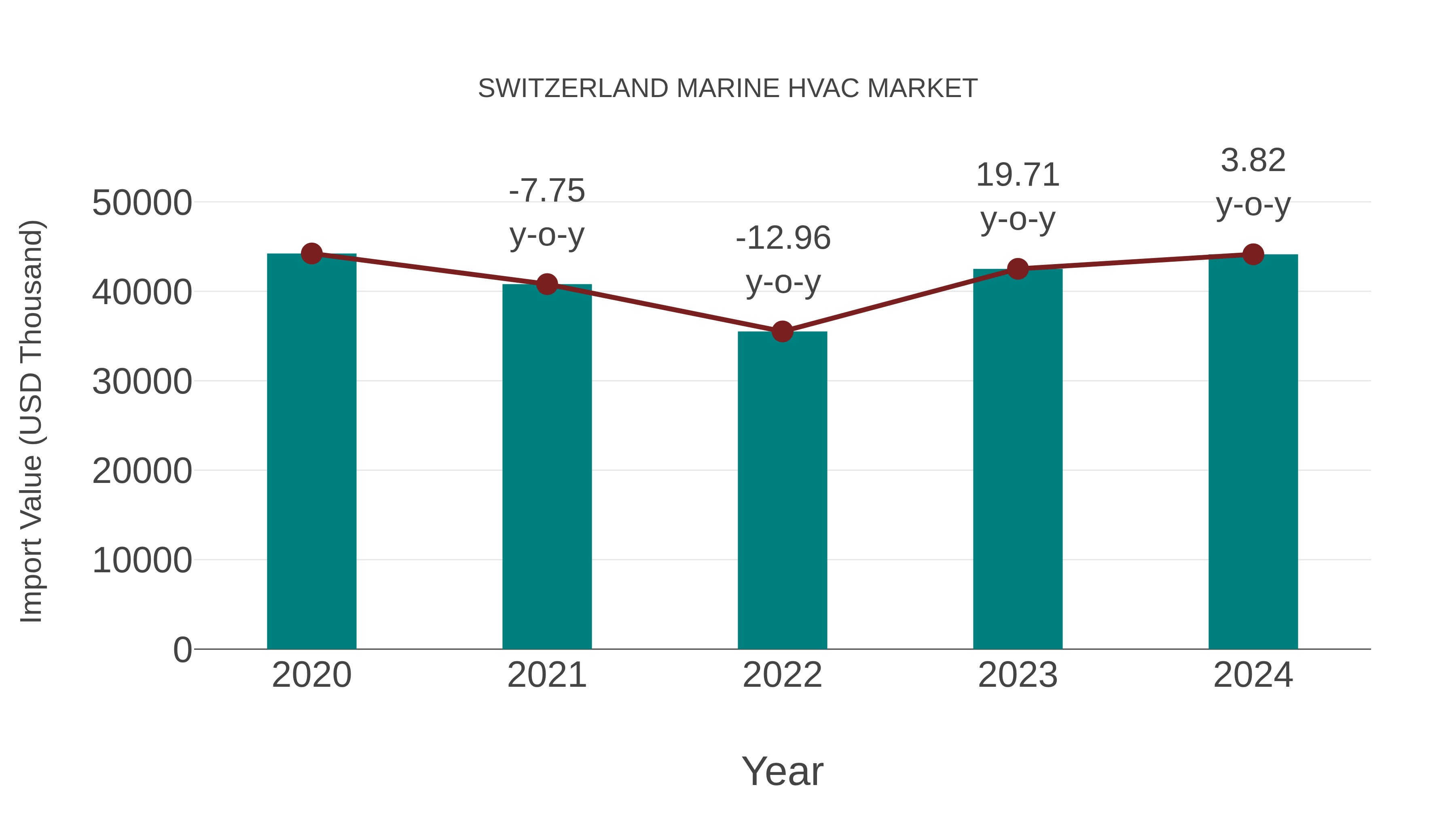
Switzerland import trend for the marine HVAC market showed a growth rate of 3.82% from 2023 to 2024, with a CAGR of -0.05% from 2020 to 2024. This fluctuation could be attributed to evolving environmental regulations impacting demand for energy-efficient HVAC systems.
Switzerland Marine HVAC Market Overview
The Switzerland Marine HVAC market is driven by factors such as the increasing demand for energy-efficient HVAC systems in marine vessels, stringent regulations regarding emissions and fuel efficiency, and the growing trend of luxury yachts equipped with advanced HVAC technologies. Key players in the market are focusing on developing innovative HVAC solutions that are environmentally friendly and provide optimal comfort onboard ships. The market is witnessing a shift towards the adoption of advanced HVAC systems that offer better control, automation, and energy savings. Factors like the rise in maritime tourism and the expansion of the shipping industry are expected to further fuel the growth of the Marine HVAC market in Switzerland. Overall, the market is poised for steady growth, with a focus on sustainability and technological advancements driving innovation in the sector.
Switzerland Marine HVAC Market Trends
Currently, the Switzerland Marine HVAC market is experiencing a shift towards more energy-efficient and environmentally friendly solutions. There is a growing demand for HVAC systems that comply with strict regulations on emissions and energy consumption. Additionally, there is an increased focus on integrating smart technologies into marine HVAC systems to enhance performance and optimize energy usage. The market is also seeing a rise in the adoption of variable refrigerant flow (VRF) systems for their flexibility and energy-saving benefits. Furthermore, there is a growing trend towards customization and modular designs to meet the specific needs of different types of vessels. Overall, the Switzerland Marine HVAC market is evolving to meet the demands for sustainable, efficient, and technologically advanced solutions in the maritime industry.
Switzerland Marine HVAC Market Challenges
In the Switzerland Marine HVAC market, challenges primarily revolve around stringent environmental regulations and sustainability requirements. These regulations often require marine HVAC systems to be energy-efficient, environmentally friendly, and compliant with specific emission standards. Additionally, the unique operating conditions of marine vessels, such as exposure to saltwater, fluctuating temperatures, and limited space for HVAC equipment installation, pose technical challenges for manufacturers and operators. The competitive landscape and the need to constantly innovate to meet evolving customer demands also present challenges in the Switzerland Marine HVAC market. Overall, navigating these regulatory, technical, and competitive challenges is essential for companies operating in this sector to thrive and maintain a competitive edge.
Switzerland Marine HVAC Market Investment Opportunities
The Switzerland Marine HVAC market presents lucrative investment opportunities driven by the country`s strong maritime industry, strict environmental regulations, and the growing demand for energy-efficient HVAC systems on ships. Key areas for investment include the development of advanced HVAC technologies tailored for marine applications, such as compact and lightweight systems that offer superior performance while reducing energy consumption. Additionally, there is a rising trend towards sustainable solutions in the maritime sector, creating opportunities for investments in eco-friendly HVAC solutions like seawater-cooled systems or hybrid HVAC systems that integrate renewable energy sources. Investing in research and development to innovate new products that meet the evolving needs of the Switzerland Marine HVAC market can position investors for long-term growth and success in this dynamic industry.
Switzerland Marine HVAC Market Government Policy
In Switzerland, government policies related to the Marine HVAC market primarily focus on environmental regulations and energy efficiency standards. The Swiss government has implemented strict emissions standards and regulations to reduce the environmental impact of marine HVAC systems, encouraging the use of eco-friendly refrigerants and energy-efficient technologies. Additionally, there are guidelines in place to ensure that marine HVAC systems comply with safety and quality standards to protect both the environment and public health. The government also provides incentives and subsidies for companies that invest in sustainable HVAC solutions for marine applications, promoting innovation and the adoption of clean technologies in the maritime sector. Overall, Switzerland`s policies aim to drive the transition towards a more sustainable and energy-efficient Marine HVAC market.
Switzerland Marine HVAC Market Future Outlook
The Switzerland Marine HVAC market is expected to witness steady growth in the coming years due to the increasing demand for energy-efficient and environmentally friendly HVAC systems in the marine industry. The implementation of stringent regulations regarding emissions and energy efficiency in Switzerland is driving the adoption of advanced HVAC technologies on ships and vessels. Additionally, the growing focus on enhancing passenger comfort and crew safety onboard marine vessels is fueling the demand for high-quality HVAC systems. With advancements in technology and the introduction of smart HVAC solutions, the Switzerland Marine HVAC market is projected to expand further, offering opportunities for market players to innovate and cater to the evolving needs of the maritime sector.
Key Highlights of the Report:
- Switzerland Marine HVAC Market Outlook
- Market Size of Switzerland Marine HVAC Market, 2025
- Forecast of Switzerland Marine HVAC Market, 2032
- Historical Data and Forecast of Switzerland Marine HVAC Revenues & Volume for the Period 2022 - 2032F
- Switzerland Marine HVAC Market Trend Evolution
- Switzerland Marine HVAC Market Drivers and Challenges
- Switzerland Marine HVAC Price Trends
- Switzerland Marine HVAC Porter's Five Forces
- Switzerland Marine HVAC Industry Life Cycle
- Historical Data and Forecast of Switzerland Marine HVAC Market Revenues & Volume By Vessel Type for the Period 2022 - 2032F
- Historical Data and Forecast of Switzerland Marine HVAC Market Revenues & Volume By Passenger Vessels for the Period 2022 - 2032F
- Historical Data and Forecast of Switzerland Marine HVAC Market Revenues & Volume By Cargo Carriers for the Period 2022 - 2032F
- Historical Data and Forecast of Switzerland Marine HVAC Market Revenues & Volume By Fishing Vessels for the Period 2022 - 2032F
- Historical Data and Forecast of Switzerland Marine HVAC Market Revenues & Volume By Technology Type for the Period 2022 - 2032F
- Historical Data and Forecast of Switzerland Marine HVAC Market Revenues & Volume By Marine Ventilation Systems for the Period 2022 - 2032F
- Historical Data and Forecast of Switzerland Marine HVAC Market Revenues & Volume By Marine Air Conditioning for the Period 2022 - 2032F
- Historical Data and Forecast of Switzerland Marine HVAC Market Revenues & Volume By Marine Heating Systems for the Period 2022 - 2032F
- Historical Data and Forecast of Switzerland Marine HVAC Market Revenues & Volume By Marine Refrigeration Systems for the Period 2022 - 2032F
- Historical Data and Forecast of Switzerland Marine HVAC Market Revenues & Volume By Capacity for the Period 2022 - 2032F
- Historical Data and Forecast of Switzerland Marine HVAC Market Revenues & Volume By Less than 20 RT for the Period 2022 - 2032F
- Historical Data and Forecast of Switzerland Marine HVAC Market Revenues & Volume By 20 - 90 RT for the Period 2022 - 2032F
- Historical Data and Forecast of Switzerland Marine HVAC Market Revenues & Volume By Above 90 RT for the Period 2022 - 2032F
- Historical Data and Forecast of Switzerland Marine HVAC Market Revenues & Volume By Application for the Period 2022 - 2032F
- Historical Data and Forecast of Switzerland Marine HVAC Market Revenues & Volume By Engine Room for the Period 2022 - 2032F
- Historical Data and Forecast of Switzerland Marine HVAC Market Revenues & Volume By Cargo Hold for the Period 2022 - 2032F
- Historical Data and Forecast of Switzerland Marine HVAC Market Revenues & Volume By Deck for the Period 2022 - 2032F
- Historical Data and Forecast of Switzerland Marine HVAC Market Revenues & Volume By Tender Garage for the Period 2022 - 2032F
- Switzerland Marine HVAC Import Export Trade Statistics
- Market Opportunity Assessment By Vessel Type
- Market Opportunity Assessment By Technology Type
- Market Opportunity Assessment By Capacity
- Market Opportunity Assessment By Application
- Switzerland Marine HVAC Top Companies Market Share
- Switzerland Marine HVAC Competitive Benchmarking By Technical and Operational Parameters
- Switzerland Marine HVAC Company Profiles
- Switzerland Marine HVAC Key Strategic Recommendations






































