Switzerland Medical Gases Market: Import Trend Analysis
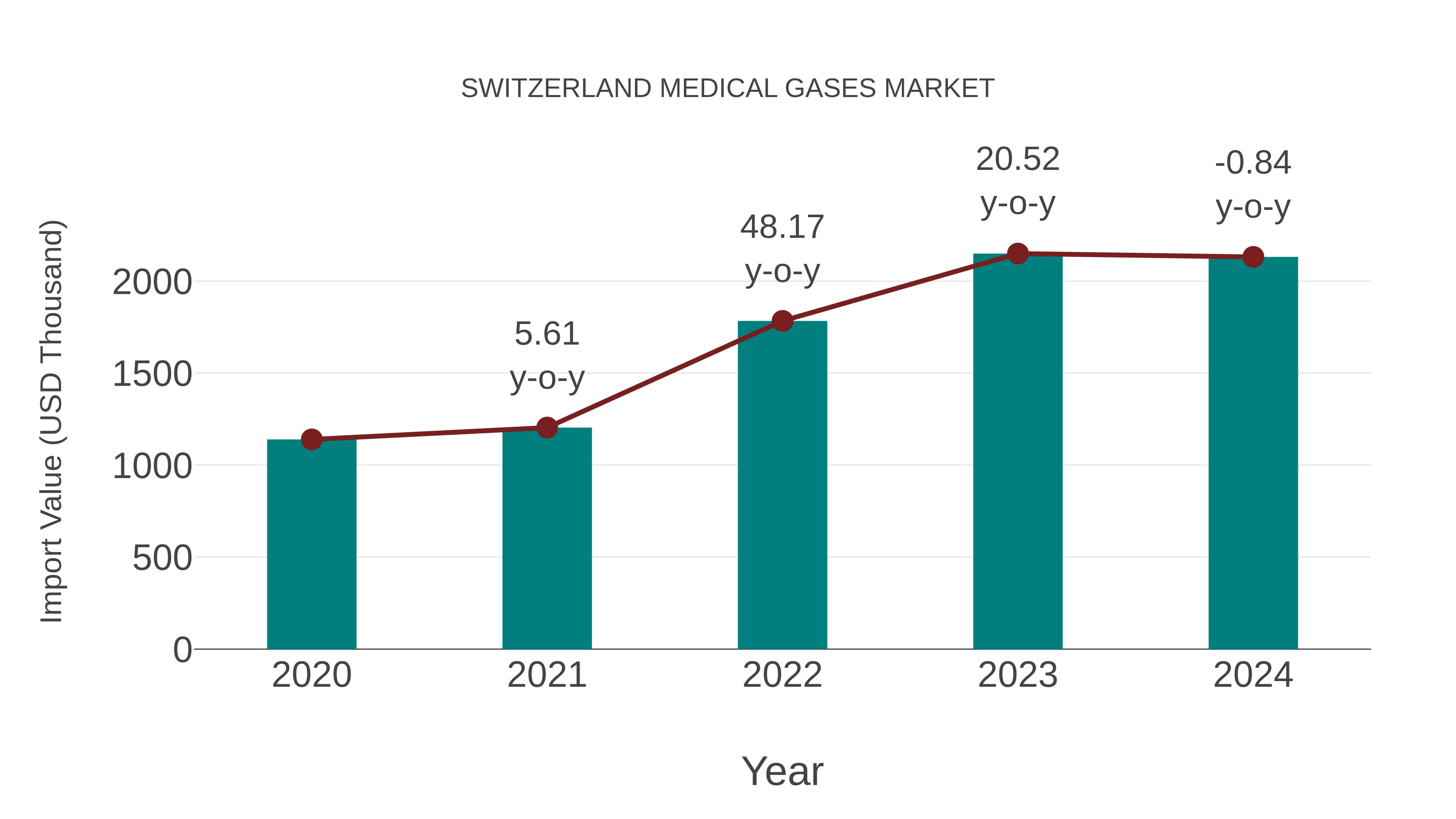
Switzerland import trend for the medical gases market showed a decline with a growth rate of -0.84% from 2023 to 2024. However, the compound annual growth rate (CAGR) from 2020 to 2024 was 16.94%. This fluctuation could be attributed to shifts in demand dynamics or changes in trade policies impacting imports.
Switzerland Medical Gases Market Overview
The Switzerland medical gases market is experiencing steady growth driven by factors such as the increasing prevalence of chronic diseases, advancements in healthcare infrastructure, and the rising demand for home healthcare services. The market is predominantly dominated by oxygen, nitrogen, nitrous oxide, carbon dioxide, and helium gases, which are essential for various medical applications such as anesthesia, respiratory therapy, and surgical procedures. Key players in the Switzerland medical gases market include Air Liquide, Linde Group, and Praxair, among others. The market is characterized by stringent regulations ensuring the quality and safety of medical gases, as well as a growing trend towards outsourcing medical gas supply and distribution services to specialized companies. Overall, the Switzerland medical gases market is poised for further expansion, driven by the increasing healthcare needs of an aging population and ongoing technological advancements in the healthcare sector.
Switzerland Medical Gases Market Trends
The Switzerland medical gases market is experiencing steady growth driven by an increasing prevalence of chronic diseases, rising geriatric population, and advancements in healthcare infrastructure. The demand for medical gases such as oxygen, nitrogen, carbon dioxide, and nitrous oxide is on the rise due to their critical role in various medical procedures and therapies. Additionally, the ongoing COVID-19 pandemic has further highlighted the importance of medical gases in providing respiratory support to patients. Market players are focusing on developing innovative products, expanding their distribution networks, and enhancing safety standards to meet the growing demand. Regulatory initiatives aimed at ensuring the quality and safety of medical gases are also influencing market dynamics, with a growing emphasis on compliance with stringent standards and regulations.
Switzerland Medical Gases Market Challenges
In the Switzerland medical gases market, challenges include stringent regulatory requirements for production and distribution, which can increase operational costs and limit market entry for new players. Additionally, maintaining consistent quality standards and ensuring the safe handling and storage of medical gases are key challenges faced by industry players. The market is also characterized by intense competition among established suppliers, leading to price pressures and the need for continuous innovation to differentiate products and services. Moreover, the increasing demand for medical gases driven by the growing healthcare sector puts pressure on suppliers to scale up production capacities while maintaining a reliable supply chain. Overall, navigating these challenges requires a deep understanding of regulatory frameworks, investment in technology, and a customer-centric approach to stay competitive in the Switzerland medical gases market.
Switzerland Medical Gases Market Investment Opportunities
The Switzerland medical gases market offers promising investment opportunities due to the increasing emphasis on healthcare infrastructure development and the rising demand for medical gases in various healthcare settings. With the growing prevalence of chronic diseases and the need for advanced medical treatments, the demand for medical gases such as oxygen, nitrogen, and carbon dioxide is expected to rise. Investing in companies that manufacture or supply medical gases, as well as those involved in gas delivery systems and equipment, could be lucrative. Additionally, advancements in medical gas technology, such as portable oxygen concentrators and high-pressure gas cylinders, present opportunities for innovation and growth in the Switzerland medical gases market. Overall, the market`s stability, coupled with the increasing healthcare expenditure in the country, makes it an attractive sector for investors seeking long-term growth potential.
Switzerland Medical Gases Market Government Policy
In Switzerland, the medical gases market is regulated by the Swiss Agency for Therapeutic Products (Swissmedic). Swissmedic oversees the authorization, manufacturing, import, and distribution of medical gases to ensure safety, quality, and efficacy. The agency requires compliance with Good Manufacturing Practices (GMP) and Good Distribution Practices (GDP) for medical gases. Additionally, the Federal Office of Public Health (FOPH) sets guidelines for the use of medical gases in healthcare settings to promote patient safety and quality of care. Moreover, the Swiss healthcare system operates under a universal health insurance model, which provides coverage for medical gases prescribed by healthcare professionals. Overall, government policies in Switzerland aim to maintain high standards in the production, distribution, and use of medical gases to safeguard public health and ensure access to quality healthcare services.
Switzerland Medical Gases Market Future Outlook
The Switzerland medical gases market is poised for steady growth in the coming years, driven by factors such as the increasing prevalence of chronic diseases, rising geriatric population, and advancements in healthcare infrastructure. The demand for medical gases, including oxygen, nitrogen, carbon dioxide, and nitrous oxide, is expected to rise as these gases play a crucial role in various medical procedures and treatments. Additionally, the growing focus on home healthcare services and the expanding healthcare sector in Switzerland are anticipated to fuel the market further. With a strong regulatory framework ensuring quality standards and safety measures, the Switzerland medical gases market is likely to witness sustained growth, presenting opportunities for market players to innovate and expand their product offerings to meet the evolving healthcare needs of the population.
Key Highlights of the Report:
- Switzerland Medical Gases Market Outlook
- Market Size of Switzerland Medical Gases Market,2025
- Forecast of Switzerland Medical Gases Market, 2032
- Historical Data and Forecast of Switzerland Medical Gases Revenues & Volume for the Period 2022-2032F
- Switzerland Medical Gases Market Trend Evolution
- Switzerland Medical Gases Market Drivers and Challenges
- Switzerland Medical Gases Price Trends
- Switzerland Medical Gases Porter's Five Forces
- Switzerland Medical Gases Industry Life Cycle
- Historical Data and Forecast of Switzerland Medical Gases Market Revenues & Volume By Technology Type for the Period 2022-2032F
- Historical Data and Forecast of Switzerland Medical Gases Market Revenues & Volume By Fractional Distillation for the Period 2022-2032F
- Historical Data and Forecast of Switzerland Medical Gases Market Revenues & Volume By Molecular Sieve for the Period 2022-2032F
- Historical Data and Forecast of Switzerland Medical Gases Market Revenues & Volume By Semipermeable Membrane for the Period 2022-2032F
- Historical Data and Forecast of Switzerland Medical Gases Market Revenues & Volume By Physical Separators for the Period 2022-2032F
- Historical Data and Forecast of Switzerland Medical Gases Market Revenues & Volume By Application Area for the Period 2022-2032F
- Historical Data and Forecast of Switzerland Medical Gases Market Revenues & Volume By Therapeutic Applications for the Period 2022-2032F
- Historical Data and Forecast of Switzerland Medical Gases Market Revenues & Volume By Pharmaceutical Manufacturing for the Period 2022-2032F
- Historical Data and Forecast of Switzerland Medical Gases Market Revenues & Volume By Diagnostic Applications for the Period 2022-2032F
- Historical Data and Forecast of Switzerland Medical Gases Market Revenues & Volume By Drug Discovery for the Period 2022-2032F
- Historical Data and Forecast of Switzerland Medical Gases Market Revenues & Volume By Quality Control for the Period 2022-2032F
- Historical Data and Forecast of Switzerland Medical Gases Market Revenues & Volume By End User for the Period 2022-2032F
- Historical Data and Forecast of Switzerland Medical Gases Market Revenues & Volume By Hospitals for the Period 2022-2032F
- Historical Data and Forecast of Switzerland Medical Gases Market Revenues & Volume By Home Healthcare for the Period 2022-2032F
- Historical Data and Forecast of Switzerland Medical Gases Market Revenues & Volume By Pharmaceutical Companies for the Period 2022-2032F
- Historical Data and Forecast of Switzerland Medical Gases Market Revenues & Volume By Academic Institutions for the Period 2022-2032F
- Historical Data and Forecast of Switzerland Medical Gases Market Revenues & Volume By Emergency Service Providers for the Period 2022-2032F
- Historical Data and Forecast of Switzerland Medical Gases Market Revenues & Volume By Product Type for the Period 2022-2032F
- Historical Data and Forecast of Switzerland Medical Gases Market Revenues & Volume By Oxygen Gases for the Period 2022-2032F
- Historical Data and Forecast of Switzerland Medical Gases Market Revenues & Volume By Carbon Dioxide Gases for the Period 2022-2032F
- Historical Data and Forecast of Switzerland Medical Gases Market Revenues & Volume By Nitrogen Gases for the Period 2022-2032F
- Historical Data and Forecast of Switzerland Medical Gases Market Revenues & Volume By Helium Gases for the Period 2022-2032F
- Historical Data and Forecast of Switzerland Medical Gases Market Revenues & Volume By Gas Mixtures for the Period 2022-2032F
- Switzerland Medical Gases Import Export Trade Statistics
- Market Opportunity Assessment By Technology Type
- Market Opportunity Assessment By Application Area
- Market Opportunity Assessment By End User
- Market Opportunity Assessment By Product Type
- Switzerland Medical Gases Top Companies Market Share
- Switzerland Medical Gases Competitive Benchmarking By Technical and Operational Parameters
- Switzerland Medical Gases Company Profiles
- Switzerland Medical Gases Key Strategic Recommendations






































