Switzerland Passenger Car Motor Oil Market: Import Trend Analysis
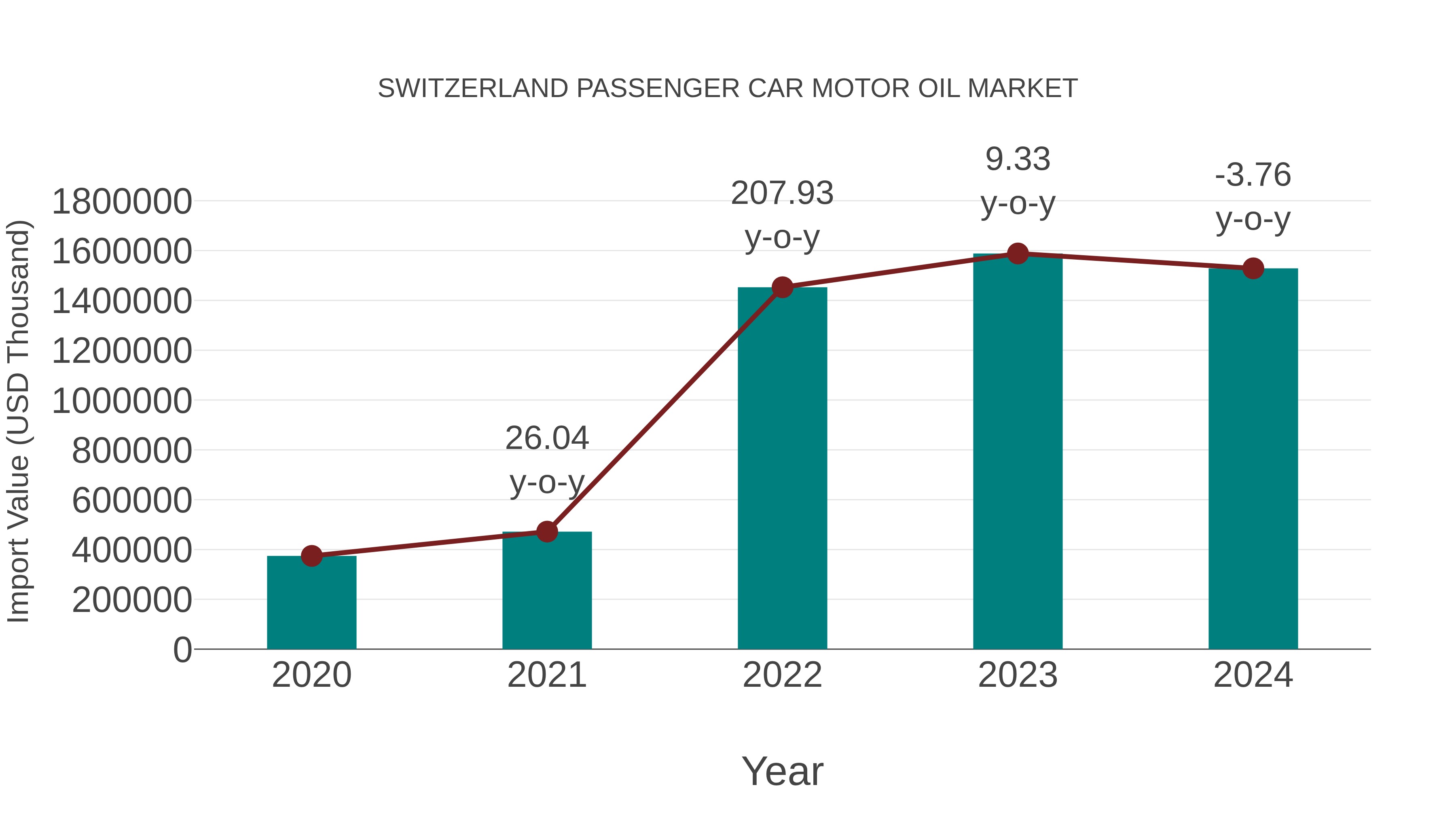
Switzerland import trend for passenger car motor oil experienced a -3.76% decline from 2023 to 2024, with a compound annual growth rate (CAGR) of 42.15% from 2020 to 2024. This decrease may be attributed to shifting consumer preferences or changes in automotive industry regulations.
Switzerland Passenger Car Motor Oil Market Overview
The Switzerland passenger car motor oil market is characterized by a high level of competition among both domestic and international brands. With a strong emphasis on quality and performance, consumers in Switzerland are increasingly opting for synthetic and premium motor oils to ensure optimal engine protection and performance. The market is also witnessing a growing trend towards environmentally friendly and energy-efficient lubricants, driven by stricter regulations and increasing awareness of sustainability issues. Key players in the market include major oil companies, independent lubricant manufacturers, and automotive retailers. The market is expected to continue growing steadily, fueled by the increasing vehicle parc in the country and the shift towards higher quality motor oils to meet the evolving needs of consumers and comply with industry standards.
Switzerland Passenger Car Motor Oil Market Trends
In the Switzerland passenger car motor oil market, there is a growing demand for synthetic and high-performance oils due to their ability to provide better engine protection and improved fuel efficiency. Consumers are also increasingly conscious of environmental concerns, leading to a rise in the adoption of eco-friendly and sustainable motor oil options. Additionally, there is a trend towards extended oil change intervals driven by advancements in oil technology and engine design, reducing the frequency of oil changes. The market is also witnessing an increase in the availability of online retail channels for purchasing motor oil, offering convenience and competitive pricing to consumers. Overall, the Switzerland passenger car motor oil market is evolving towards more advanced, sustainable, and convenient solutions to meet the changing needs and preferences of consumers.
Switzerland Passenger Car Motor Oil Market Challenges
In the Switzerland passenger car motor oil market, one of the main challenges faced is the increasing demand for environmentally-friendly and sustainable products. Consumers are becoming more conscious about the impact of their choices on the environment and are looking for motor oils that are eco-friendly and comply with stricter regulations. This is putting pressure on manufacturers to develop and market products that are not only effective in terms of performance but also sustainable in terms of their production and disposal. Additionally, the market is highly competitive with a wide range of brands and products available, making it challenging for companies to differentiate themselves and attract customers. Overall, companies in the Switzerland passenger car motor oil market need to innovate and adapt to changing consumer preferences and regulatory requirements to stay competitive.
Switzerland Passenger Car Motor Oil Market Investment Opportunities
In the Switzerland passenger car motor oil market, there are opportunities for investment in the growing demand for synthetic motor oils due to their superior performance and environmental benefits. With increasing awareness about the importance of engine efficiency and maintenance, consumers are seeking higher quality lubricants that offer extended engine life and improved fuel economy. Additionally, the shift towards electric vehicles presents an opportunity for investment in specialized lubricants tailored for these vehicles. Investing in research and development to innovate new formulations, expanding distribution networks, and strategic partnerships with automotive manufacturers can position companies well to capitalize on the evolving trends in the Switzerland passenger car motor oil market.
Switzerland Passenger Car Motor Oil Market Government Policy
In Switzerland, government policies related to the passenger car motor oil market focus on environmental protection and consumer safety. The Swiss government mandates that motor oil products meet strict quality and performance standards to ensure they are safe for use in vehicles and do not harm the environment. Additionally, there are regulations in place to encourage the recycling and proper disposal of used motor oil to minimize environmental impact. The government also promotes the use of sustainable and environmentally friendly motor oil products to reduce emissions and promote energy efficiency in the transportation sector. Overall, Switzerland`s policies aim to balance the needs of consumers, the automotive industry, and environmental sustainability in the passenger car motor oil market.
Switzerland Passenger Car Motor Oil Market Future Outlook
The Switzerland passenger car motor oil market is anticipated to witness steady growth in the coming years. Factors such as the increasing number of vehicles on the road, rising consumer awareness about the importance of regular maintenance, and the trend towards higher performance synthetic oils are expected to drive market growth. Additionally, the growing focus on sustainability and environmentally friendly products is likely to fuel demand for eco-friendly motor oil alternatives. Technological advancements in the automotive industry, such as the development of electric vehicles and hybrid cars, will also impact the market dynamics, leading to a shift in the types of motor oils being used. Overall, the Switzerland passenger car motor oil market is poised for growth, with opportunities for innovation and product development to meet evolving consumer needs and preferences.
Key Highlights of the Report:
- Switzerland Passenger Car Motor Oil Market Outlook
- Market Size of Switzerland Passenger Car Motor Oil Market,2025
- Forecast of Switzerland Passenger Car Motor Oil Market, 2032
- Historical Data and Forecast of Switzerland Passenger Car Motor Oil Revenues & Volume for the Period 2022-2032F
- Switzerland Passenger Car Motor Oil Market Trend Evolution
- Switzerland Passenger Car Motor Oil Market Drivers and Challenges
- Switzerland Passenger Car Motor Oil Price Trends
- Switzerland Passenger Car Motor Oil Porter's Five Forces
- Switzerland Passenger Car Motor Oil Industry Life Cycle
- Historical Data and Forecast of Switzerland Passenger Car Motor Oil Market Revenues & Volume By Type for the Period 2022-2032F
- Historical Data and Forecast of Switzerland Passenger Car Motor Oil Market Revenues & Volume By Synthetic for the Period 2022-2032F
- Historical Data and Forecast of Switzerland Passenger Car Motor Oil Market Revenues & Volume By Conventional for the Period 2022-2032F
- Historical Data and Forecast of Switzerland Passenger Car Motor Oil Market Revenues & Volume By Semi-Synthetic for the Period 2022-2032F
- Historical Data and Forecast of Switzerland Passenger Car Motor Oil Market Revenues & Volume By High-Mileage for the Period 2022-2032F
- Historical Data and Forecast of Switzerland Passenger Car Motor Oil Market Revenues & Volume By Viscosity Grade for the Period 2022-2032F
- Historical Data and Forecast of Switzerland Passenger Car Motor Oil Market Revenues & Volume By 5W-30 for the Period 2022-2032F
- Historical Data and Forecast of Switzerland Passenger Car Motor Oil Market Revenues & Volume By 10W-40 for the Period 2022-2032F
- Historical Data and Forecast of Switzerland Passenger Car Motor Oil Market Revenues & Volume By 15W-50 for the Period 2022-2032F
- Historical Data and Forecast of Switzerland Passenger Car Motor Oil Market Revenues & Volume By 0W-20 for the Period 2022-2032F
- Historical Data and Forecast of Switzerland Passenger Car Motor Oil Market Revenues & Volume By Application for the Period 2022-2032F
- Historical Data and Forecast of Switzerland Passenger Car Motor Oil Market Revenues & Volume By High Performance for the Period 2022-2032F
- Historical Data and Forecast of Switzerland Passenger Car Motor Oil Market Revenues & Volume By Standard Driving for the Period 2022-2032F
- Historical Data and Forecast of Switzerland Passenger Car Motor Oil Market Revenues & Volume By Long Mileage for the Period 2022-2032F
- Historical Data and Forecast of Switzerland Passenger Car Motor Oil Market Revenues & Volume By Fuel Efficiency for the Period 2022-2032F
- Historical Data and Forecast of Switzerland Passenger Car Motor Oil Market Revenues & Volume By End Use for the Period 2022-2032F
- Historical Data and Forecast of Switzerland Passenger Car Motor Oil Market Revenues & Volume By Car Owners for the Period 2022-2032F
- Historical Data and Forecast of Switzerland Passenger Car Motor Oil Market Revenues & Volume By Dealerships for the Period 2022-2032F
- Historical Data and Forecast of Switzerland Passenger Car Motor Oil Market Revenues & Volume By Service Centers for the Period 2022-2032F
- Historical Data and Forecast of Switzerland Passenger Car Motor Oil Market Revenues & Volume By Automotive for the Period 2022-2032F
- Switzerland Passenger Car Motor Oil Import Export Trade Statistics
- Market Opportunity Assessment By Type
- Market Opportunity Assessment By Viscosity Grade
- Market Opportunity Assessment By Application
- Market Opportunity Assessment By End Use
- Switzerland Passenger Car Motor Oil Top Companies Market Share
- Switzerland Passenger Car Motor Oil Competitive Benchmarking By Technical and Operational Parameters
- Switzerland Passenger Car Motor Oil Company Profiles
- Switzerland Passenger Car Motor Oil Key Strategic Recommendations






































