Switzerland Pneumatic Conveying Systems Market Growth Rate Analysis (2025 - 2031)
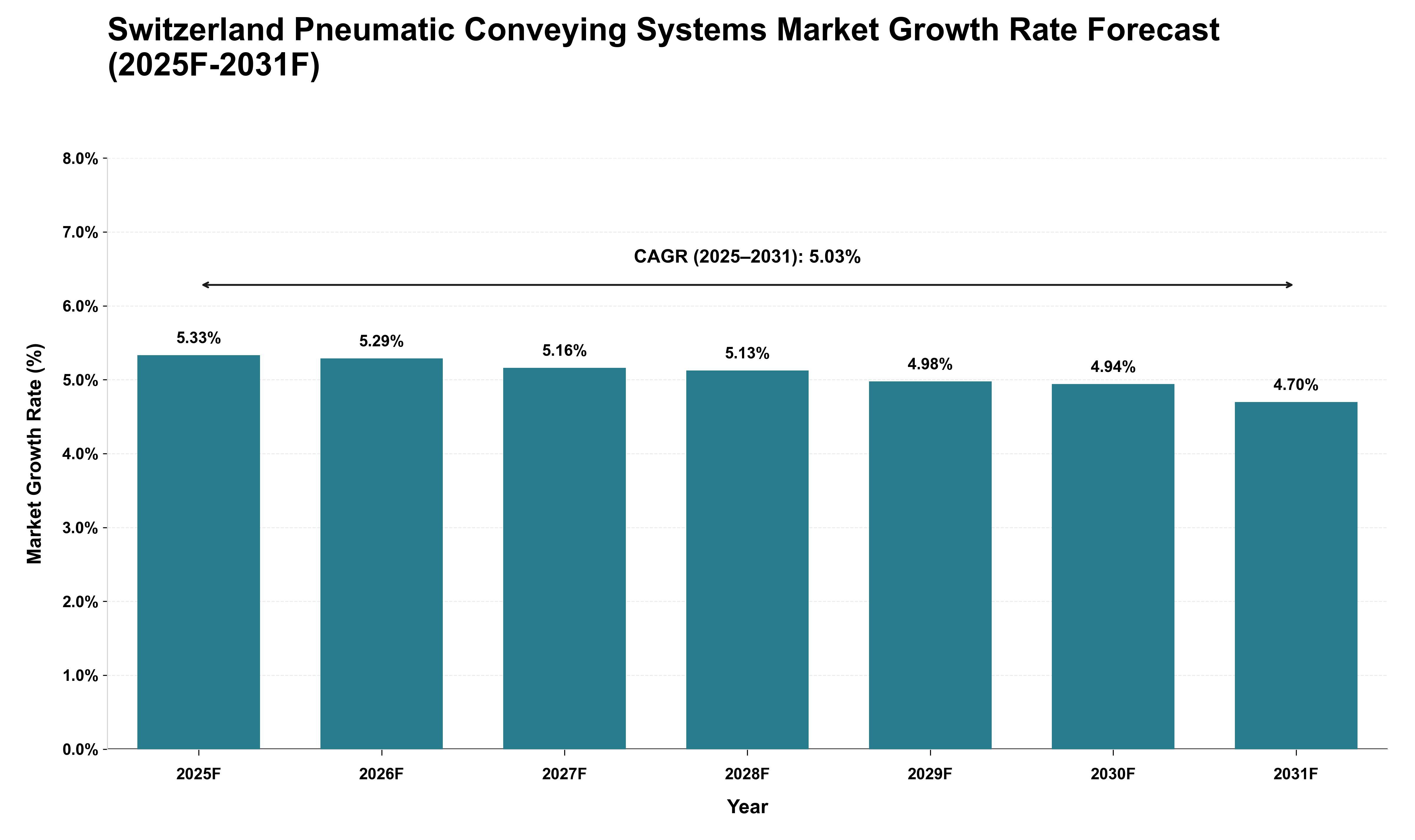
The projected deceleration in growth rates for the Switzerland pneumatic conveying systems market, from 5.33% in 2025 to 4.70% by 2031, indicates a gradual cooling of demand dynamics influenced by evolving supply chain conditions and input costs. As global supply chains continue to adapt post-pandemic, fluctuations in raw material availability and transportation costs will likely impact pricing structures and operational efficiencies within this sector. The anticipated CAGR of 5.03% suggests that while growth remains robust, it will be tempered by increasing competition and potential shifts in import dependencies as manufacturers seek cost-effective sourcing strategies. Additionally, cyclical trends may emerge as industries reliant on pneumatic systems adjust their capital expenditures based on broader economic conditions, further influencing demand patterns throughout the forecast period. This interplay between supply chain resilience and input cost management will be critical in shaping market trajectories moving forward.
Key Highlights of the Report:
- Switzerland Pneumatic Conveying Systems Market Outlook
- Market Size of Switzerland Pneumatic Conveying Systems Market, 2024
- Forecast of Switzerland Pneumatic Conveying Systems Market, 2031
- Historical Data and Forecast of Switzerland Pneumatic Conveying Systems Revenues & Volume for the Period 2021-2031
- Switzerland Pneumatic Conveying Systems Market Trend Evolution
- Switzerland Pneumatic Conveying Systems Market Drivers and Challenges
- Switzerland Pneumatic Conveying Systems Price Trends
- Switzerland Pneumatic Conveying Systems Porter`s Five Forces
- Switzerland Pneumatic Conveying Systems Industry Life Cycle
- Historical Data and Forecast of Switzerland Pneumatic Conveying Systems Market Revenues & Volume By Type for the Period 2021-2031
- Historical Data and Forecast of Switzerland Pneumatic Conveying Systems Market Revenues & Volume By Positive Pressure Conveying for the Period 2021-2031
- Historical Data and Forecast of Switzerland Pneumatic Conveying Systems Market Revenues & Volume By Vacuum Pressure Conveying for the Period 2021-2031
- Historical Data and Forecast of Switzerland Pneumatic Conveying Systems Market Revenues & Volume By Combined Conveying for the Period 2021-2031
- Historical Data and Forecast of Switzerland Pneumatic Conveying Systems Market Revenues & Volume By Operation for the Period 2021-2031
- Historical Data and Forecast of Switzerland Pneumatic Conveying Systems Market Revenues & Volume By Dense-phase conveying for the Period 2021-2031
- Historical Data and Forecast of Switzerland Pneumatic Conveying Systems Market Revenues & Volume By Dilute-phase conveying for the Period 2021-2031
- Switzerland Pneumatic Conveying Systems Import Export Trade Statistics
- Market Opportunity Assessment By Type
- Market Opportunity Assessment By Operation
- Switzerland Pneumatic Conveying Systems Top Companies Market Share
- Switzerland Pneumatic Conveying Systems Competitive Benchmarking By Technical and Operational Parameters
- Switzerland Pneumatic Conveying Systems Company Profiles
- Switzerland Pneumatic Conveying Systems Key Strategic Recommendations






































