Switzerland Potato Starch Market Size Growth Rate
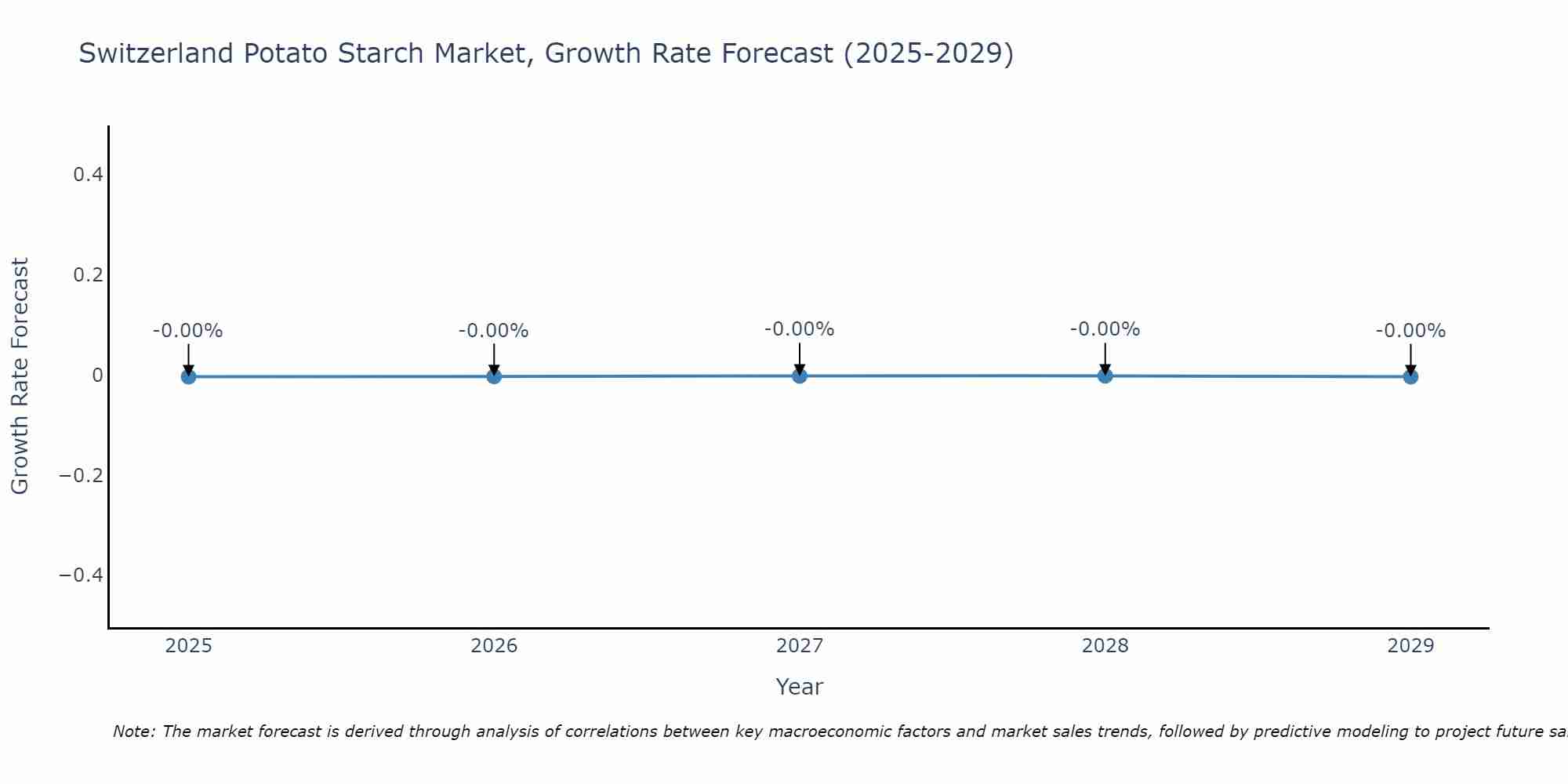
The Switzerland Potato Starch Market is projected to witness mixed growth rate patterns during 2025 to 2029. Growth accelerates to -0.00% in 2028, following an initial rate of -0.00%, before easing to -0.00% at the end of the period.
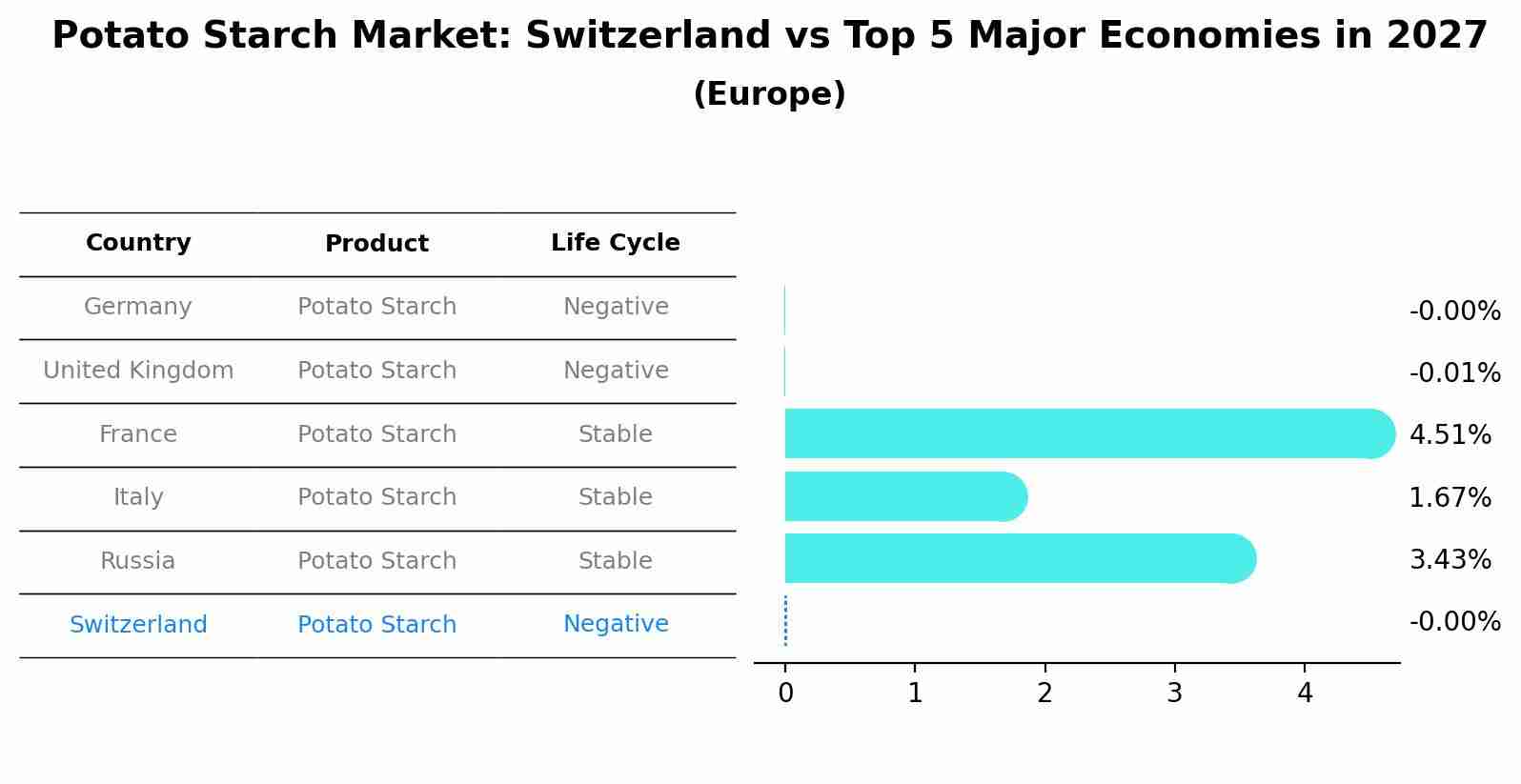
Potato Starch Market: Switzerland vs Top 5 Major Economies in 2027 (Europe)
Switzerland's Potato Starch market is anticipated to experience a negative growth rate of -0.00% by 2027, reflecting trends observed in the largest economy Germany, followed by United Kingdom, France, Italy and Russia.
Switzerland Potato Starch Market Overview
The Switzerland Potato Starch Market is growing as potato starch is widely used in food, pharmaceuticals, and paper industries. It acts as a thickener, stabilizer, and binding agent, making it essential in food processing and manufacturing.
Drivers of the market
The Switzerland potato starch market is driven by its extensive applications in the food, pharmaceutical, and textile industries. The increasing demand for gluten-free food products and clean-label ingredients is a major factor pushing the use of potato starch in food manufacturing. Additionally, potato starchs use as a thickening, binding, and gelling agent in various industries contributes to its growing market. The Swiss focus on sustainable and organic ingredients further boosts its demand in food production.
Challenges of the market
The potato starch market faces challenges related to sourcing and regulatory compliance. Fluctuations in potato supply can impact the availability and cost of raw materials, complicating production processes for manufacturers. Additionally, increasing regulations concerning food safety and labeling necessitate strict compliance, which can increase operational complexity. This dynamic landscape requires effective risk management and innovation to maintain competitiveness in the market while navigating supply chain challenges.
Government Policy of the market
In the potato starch market, Swiss regulations focus on food safety and environmental compliance. The government promotes research into innovative applications for potato starch in food, pharmaceuticals, and industrial processes. Policies support sustainable agricultural practices and encourage responsible sourcing of potatoes to enhance sustainability.
Key Highlights of the Report:
- Switzerland Potato Starch Market Outlook
- Market Size of Switzerland Potato Starch Market, 2024
- Forecast of Switzerland Potato Starch Market, 2031
- Historical Data and Forecast of Switzerland Potato Starch Revenues & Volume for the Period 2021-2031
- Switzerland Potato Starch Market Trend Evolution
- Switzerland Potato Starch Market Drivers and Challenges
- Switzerland Potato Starch Price Trends
- Switzerland Potato Starch Porter`s Five Forces
- Switzerland Potato Starch Industry Life Cycle
- Historical Data and Forecast of Switzerland Potato Starch Market Revenues & Volume By Nature for the Period 2021-2031
- Historical Data and Forecast of Switzerland Potato Starch Market Revenues & Volume By Organic for the Period 2021-2031
- Historical Data and Forecast of Switzerland Potato Starch Market Revenues & Volume By Conventional for the Period 2021-2031
- Historical Data and Forecast of Switzerland Potato Starch Market Revenues & Volume By End-users for the Period 2021-2031
- Historical Data and Forecast of Switzerland Potato Starch Market Revenues & Volume By Textile & Paper for the Period 2021-2031
- Historical Data and Forecast of Switzerland Potato Starch Market Revenues & Volume By Food & Beverages for the Period 2021-2031
- Historical Data and Forecast of Switzerland Potato Starch Market Revenues & Volume By Pharmaceuticals for the Period 2021-2031
- Switzerland Potato Starch Import Export Trade Statistics
- Market Opportunity Assessment By Nature
- Market Opportunity Assessment By End-users
- Switzerland Potato Starch Top Companies Market Share
- Switzerland Potato Starch Competitive Benchmarking By Technical and Operational Parameters
- Switzerland Potato Starch Company Profiles
- Switzerland Potato Starch Key Strategic Recommendations






































