Switzerland Programmable Oscillator Market: Import Trend Analysis
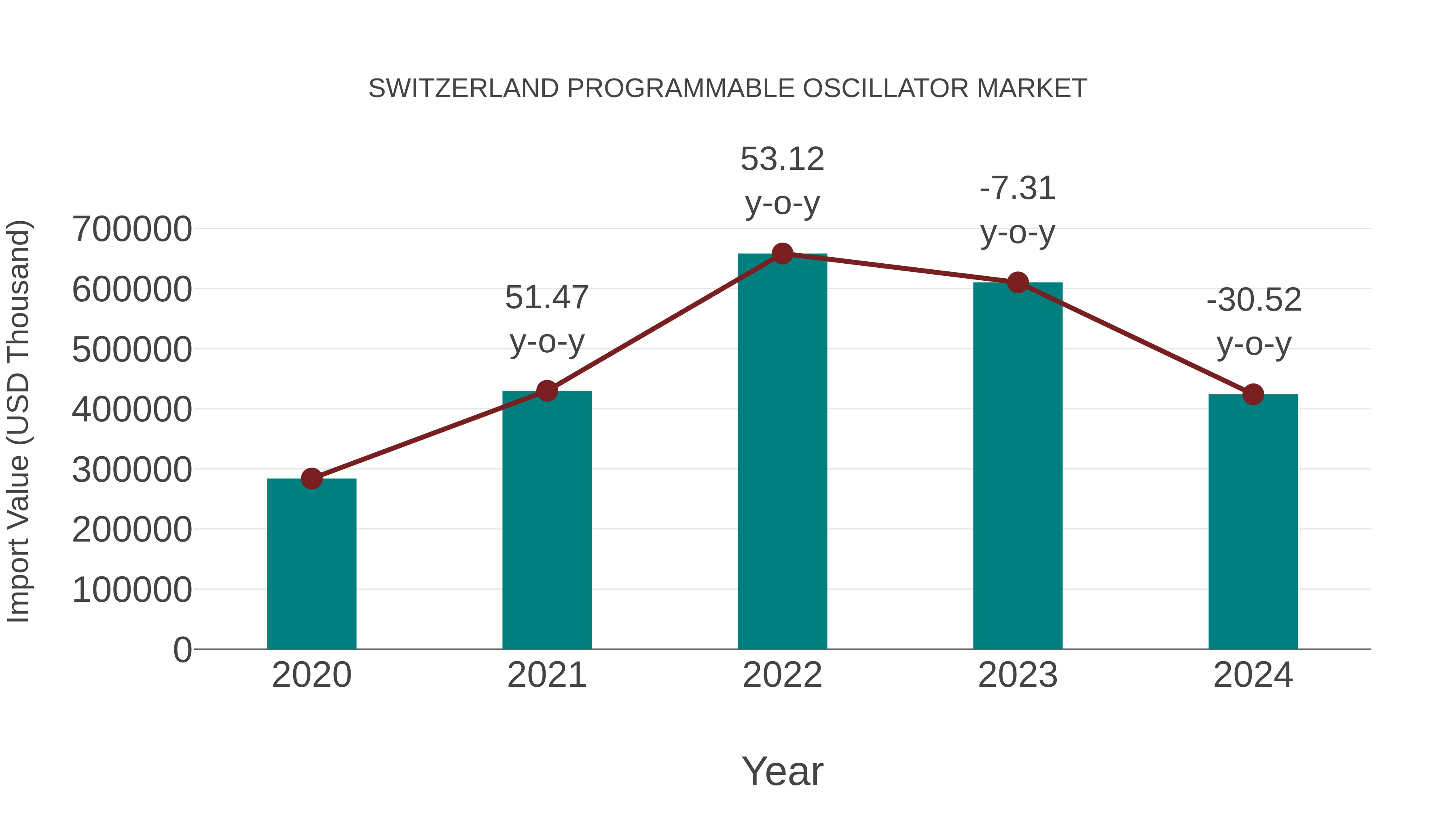
Switzerland import trend for programmable oscillators saw a decline of -30.52% from 2023 to 2024, with a compound annual growth rate (CAGR) of 10.55% from 2020 to 2024. This decrease could be attributed to shifts in demand patterns or market saturation.
Switzerland Programmable Oscillator Market Overview
The Switzerland programmable oscillator market is characterized by a growing demand for high-precision timing solutions in various industries such as telecommunications, aerospace, and automotive. Programmable oscillators offer flexibility and customization options, making them suitable for a wide range of applications. Key players in the market are focusing on developing advanced technologies to meet the increasing requirements for frequency stability, low jitter, and fast delivery times. Additionally, the adoption of programmable oscillators in emerging technologies like 5G networks and Internet of Things (IoT) devices is driving market growth. Switzerland`s strong reputation for quality and precision engineering further enhances the country`s position as a key player in the programmable oscillator market. Overall, the market is expected to continue its growth trajectory fueled by technological advancements and expanding applications across industries.
Switzerland Programmable Oscillator Market Trends
The programmable oscillator market in Switzerland is experiencing a growing demand for high-frequency and low phase noise oscillators, driven by the increasing adoption of advanced communication systems, radar technologies, and high-performance electronic devices. There is a notable shift towards compact and energy-efficient programmable oscillators to meet the requirements of portable and wearable electronics, IoT devices, and automotive applications. Furthermore, the market is witnessing a trend towards the integration of programmable oscillators with additional features such as frequency synchronization, programmable output levels, and temperature compensation. Key players in the Switzerland programmable oscillator market are focusing on product innovation, strategic partnerships, and mergers to gain a competitive edge and expand their market presence in this evolving landscape.
Switzerland Programmable Oscillator Market Challenges
In the Switzerland programmable oscillator market, one of the key challenges faced is the increasing competition from global players offering similar products at lower prices. This price pressure can impact the profit margins of local companies and make it difficult for them to compete effectively. Additionally, technological advancements and the need for constant innovation pose challenges for Swiss companies to stay ahead in the market. Adapting to rapidly changing customer requirements and maintaining a high level of product quality while keeping costs competitive are ongoing challenges for players in the programmable oscillator market in Switzerland. Furthermore, navigating complex regulatory requirements and ensuring compliance with industry standards add another layer of difficulty for companies operating in this market.
Switzerland Programmable Oscillator Market Investment Opportunities
The Switzerland programmable oscillator market presents attractive investment opportunities due to the increasing demand for precise timing solutions across various industries such as telecommunications, automotive, and consumer electronics. With the growing need for advanced technologies that require accurate clock signals, programmable oscillators offer flexibility and customization options to meet specific requirements. Investing in companies specializing in programmable oscillator development and manufacturing in Switzerland can be promising, as the country is known for its strong innovation ecosystem and high-quality precision engineering capabilities. Additionally, the market is expected to experience steady growth driven by the adoption of 5G technology, IoT devices, and autonomous vehicles, creating a favorable environment for potential investors looking to capitalize on the expanding programmable oscillator market in Switzerland.
Switzerland Programmable Oscillator Market Government Policy
The Swiss government has implemented various policies to support the programmable oscillator market, including providing research grants and tax incentives for companies involved in the development and production of such technologies. Additionally, the government has established partnerships with industry stakeholders to promote innovation and collaboration in this sector. These policies aim to strengthen Switzerland`s position as a leading hub for programmable oscillator technology, driving economic growth and technological advancement in the country. Furthermore, the government has prioritized investments in education and skills development to ensure a qualified workforce capable of driving innovation and competitiveness in the programmable oscillator market.
Switzerland Programmable Oscillator Market Future Outlook
The future outlook for the Switzerland programmable oscillator market appears to be promising, driven by factors such as increasing demand for advanced electronic devices, the growing adoption of IoT and connected devices, and the expanding automotive and industrial sectors. The programmable oscillator market is expected to witness steady growth due to the need for precise timing solutions in various applications. Additionally, the focus on miniaturization and energy efficiency in electronic devices is projected to fuel the demand for programmable oscillators in Switzerland. The market is likely to see advancements in terms of technology and product offerings, with key players investing in research and development to meet evolving customer requirements. Overall, the Switzerland programmable oscillator market is anticipated to experience positive growth prospects in the coming years.
Key Highlights of the Report:
- Switzerland Programmable Oscillator Market Outlook
- Market Size of Switzerland Programmable Oscillator Market,2025
- Forecast of Switzerland Programmable Oscillator Market, 2032
- Historical Data and Forecast of Switzerland Programmable Oscillator Revenues & Volume for the Period 2022-2032F
- Switzerland Programmable Oscillator Market Trend Evolution
- Switzerland Programmable Oscillator Market Drivers and Challenges
- Switzerland Programmable Oscillator Price Trends
- Switzerland Programmable Oscillator Porter's Five Forces
- Switzerland Programmable Oscillator Industry Life Cycle
- Historical Data and Forecast of Switzerland Programmable Oscillator Market Revenues & Volume By Type for the Period 2022-2032F
- Historical Data and Forecast of Switzerland Programmable Oscillator Market Revenues & Volume By Voltage Controlled for the Period 2022-2032F
- Historical Data and Forecast of Switzerland Programmable Oscillator Market Revenues & Volume By Temperature Compensated for the Period 2022-2032F
- Historical Data and Forecast of Switzerland Programmable Oscillator Market Revenues & Volume By MEMS-based for the Period 2022-2032F
- Historical Data and Forecast of Switzerland Programmable Oscillator Market Revenues & Volume By Crystal Oscillator for the Period 2022-2032F
- Historical Data and Forecast of Switzerland Programmable Oscillator Market Revenues & Volume By Frequency Range for the Period 2022-2032F
- Historical Data and Forecast of Switzerland Programmable Oscillator Market Revenues & Volume By <10 MHz for the Period 2022-2032F
- Historical Data and Forecast of Switzerland Programmable Oscillator Market Revenues & Volume By 10-100 MHz for the Period 2022-2032F
- Historical Data and Forecast of Switzerland Programmable Oscillator Market Revenues & Volume By >100 MHz for the Period 2022-2032F
- Historical Data and Forecast of Switzerland Programmable Oscillator Market Revenues & Volume By Adjustable for the Period 2022-2032F
- Historical Data and Forecast of Switzerland Programmable Oscillator Market Revenues & Volume By Application for the Period 2022-2032F
- Historical Data and Forecast of Switzerland Programmable Oscillator Market Revenues & Volume By Communication for the Period 2022-2032F
- Historical Data and Forecast of Switzerland Programmable Oscillator Market Revenues & Volume By Signal Processing for the Period 2022-2032F
- Historical Data and Forecast of Switzerland Programmable Oscillator Market Revenues & Volume By Embedded Systems for the Period 2022-2032F
- Historical Data and Forecast of Switzerland Programmable Oscillator Market Revenues & Volume By IoT Devices for the Period 2022-2032F
- Historical Data and Forecast of Switzerland Programmable Oscillator Market Revenues & Volume By Features for the Period 2022-2032F
- Historical Data and Forecast of Switzerland Programmable Oscillator Market Revenues & Volume By Low Jitter for the Period 2022-2032F
- Historical Data and Forecast of Switzerland Programmable Oscillator Market Revenues & Volume By High Stability for the Period 2022-2032F
- Historical Data and Forecast of Switzerland Programmable Oscillator Market Revenues & Volume By Miniaturized for the Period 2022-2032F
- Historical Data and Forecast of Switzerland Programmable Oscillator Market Revenues & Volume By Low Power for the Period 2022-2032F
- Historical Data and Forecast of Switzerland Programmable Oscillator Market Revenues & Volume By End Use for the Period 2022-2032F
- Historical Data and Forecast of Switzerland Programmable Oscillator Market Revenues & Volume By Telecommunication for the Period 2022-2032F
- Historical Data and Forecast of Switzerland Programmable Oscillator Market Revenues & Volume By Aerospace for the Period 2022-2032F
- Historical Data and Forecast of Switzerland Programmable Oscillator Market Revenues & Volume By Consumer Electronics for the Period 2022-2032F
- Historical Data and Forecast of Switzerland Programmable Oscillator Market Revenues & Volume By Automotive for the Period 2022-2032F
- Switzerland Programmable Oscillator Import Export Trade Statistics
- Market Opportunity Assessment By Type
- Market Opportunity Assessment By Frequency Range
- Market Opportunity Assessment By Application
- Market Opportunity Assessment By Features
- Market Opportunity Assessment By End Use
- Switzerland Programmable Oscillator Top Companies Market Share
- Switzerland Programmable Oscillator Competitive Benchmarking By Technical and Operational Parameters
- Switzerland Programmable Oscillator Company Profiles
- Switzerland Programmable Oscillator Key Strategic Recommendations






































