Switzerland Table Olives Market Year-wise Growth Rate (2021-2031F)
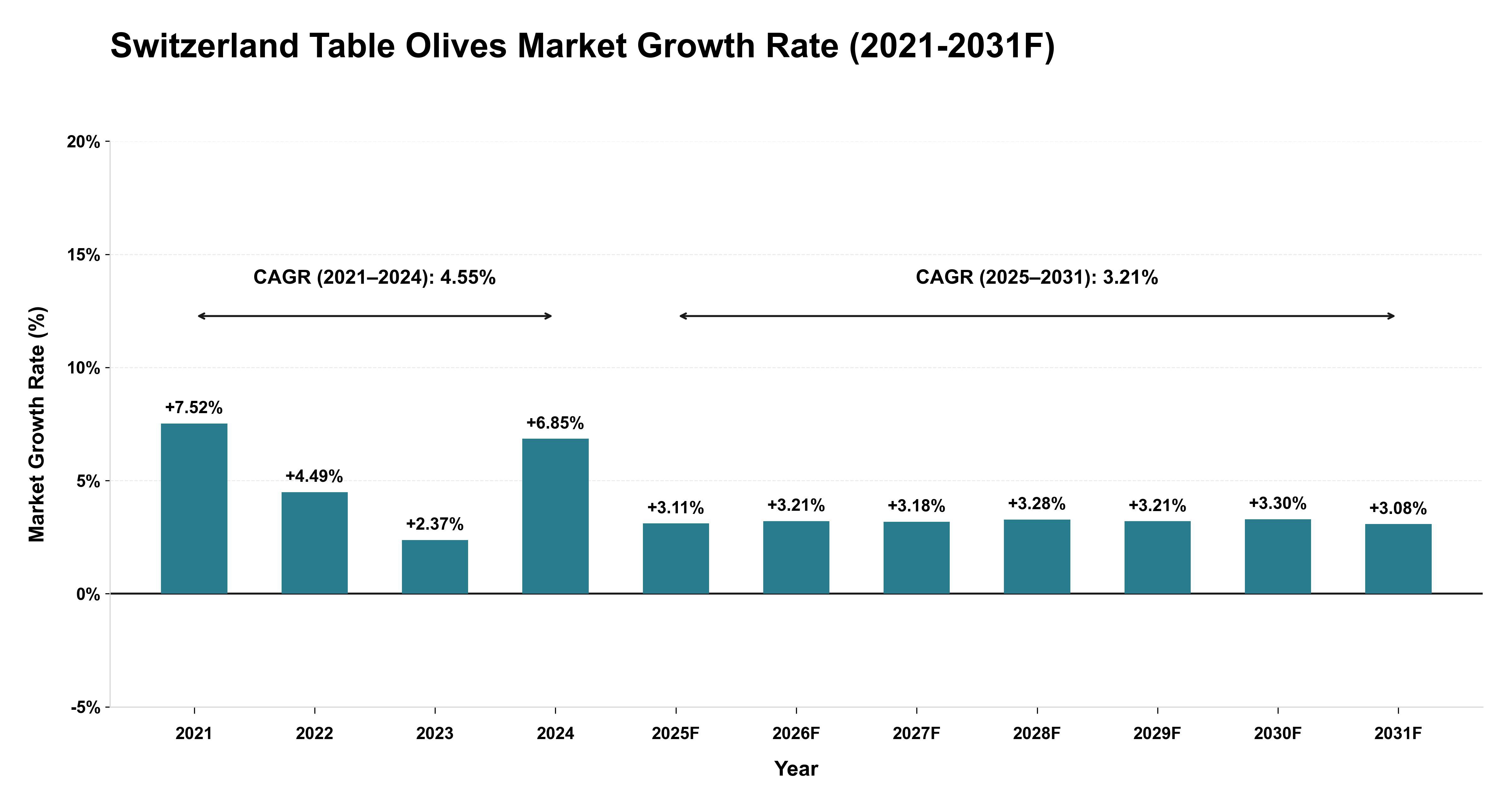
In the period 2021-2024, the Switzerland Table Olives Market exhibited a robust growth trajectory, with varying annual growth rates reflecting changing consumer preferences and economic conditions. The market saw accelerated growth in 2021 at 7.52%, driven by increasing health consciousness and culinary trends. Subsequently, growth decelerated in 2023 to 2.37% due to supply chain disruptions impacting production. However, a rebound in 2024 at 6.85% indicated resilience and adaptability within the market. Looking ahead to 2025-2031, the forecast CAGR of 3.21% suggests a more moderate but stable growth path, influenced by steady demand from the food industry and evolving consumer taste preferences towards healthier options. This forecasted trajectory reflects a matured market adapting to changing dynamics while maintaining steady expansion.
Switzerland Table Olives Market Synopsis
The Switzerland Table Olives Market is characterized by a growing demand for high-quality, premium olives among consumers. The market is driven by factors such as increasing health consciousness, a preference for Mediterranean cuisine, and a rising trend towards snacking on healthy foods. Swiss consumers are particularly interested in olives that are organic, locally sourced, and sustainably produced. The market offers a variety of olive types, including green, black, and stuffed olives, catering to different taste preferences. Key players in the Switzerland Table Olives Market focus on product innovation, packaging, and marketing strategies to differentiate themselves in a competitive landscape. Overall, the market presents opportunities for growth, especially for suppliers that can meet the evolving preferences of Swiss consumers for high-quality, flavorful olives.
Switzerland Table Olives Market Trends
The Switzerland Table Olives Market is experiencing a growing demand for high-quality, organic, and locally sourced products. Consumers are increasingly interested in healthier food options, leading to a rise in the consumption of table olives as a nutritious and versatile snack or ingredient. There is also a trend towards unique and innovative flavors and packaging formats to cater to the evolving preferences of the Swiss consumers. Opportunities lie in expanding product offerings to include a variety of olive types and flavors, as well as exploring sustainable and environmentally friendly production practices to appeal to the growing segment of eco-conscious consumers. Partnering with local farmers and producers to ensure traceability and authenticity can also help differentiate brands in the competitive market landscape.
Switzerland Table Olives Market Challenges
The Switzerland table olives market faces challenges such as high competition from imported olives, limited domestic production, and varying consumer preferences. Imported olives from countries like Spain, Italy, and Greece often dominate the market due to their established reputations and competitive pricing. The relatively small-scale domestic production of olives in Switzerland struggles to meet the demand, leading to a heavy reliance on imports. Additionally, consumer preferences for certain olive varieties, such as Kalamata or Manzanilla, present challenges for local producers who may not cultivate these specific types. Adapting to changing consumer tastes, improving marketing strategies, and enhancing product quality are key factors that companies in the Switzerland table olives market need to address to remain competitive and sustain growth.
Switzerland Table Olives Market Investment Opportunities
The Switzerland Table Olives Market is primarily driven by factors such as increasing consumer awareness about the health benefits of olives, including their high content of antioxidants and healthy fats. The growing trend of healthy eating habits and the rising demand for natural and organic food products are also significant drivers of the market. Additionally, the popularity of Mediterranean cuisine and the versatility of olives in various culinary applications are boosting the demand for table olives in Switzerland. Furthermore, the expanding retail sector and the availability of a wide range of flavored and stuffed olive products are contributing to the market growth. Overall, factors such as health consciousness, culinary trends, and product innovation are key drivers shaping the Switzerland Table Olives Market.
Switzerland Table Olives Market Government Polices
The Switzerland Table Olives Market is primarily governed by the Federal Office for Agriculture (FOAG), which oversees agricultural policies and regulations in the country. The production and marketing of table olives are subject to various regulations and quality standards enforced by the FOAG to ensure consumer safety and fair trade practices. Additionally, Switzerland follows the guidelines set by the European Union for the import and export of agricultural products, including table olives. The government provides subsidies and support programs to promote sustainable agriculture practices and boost the competitiveness of the Swiss table olive industry. Overall, government policies aim to maintain high-quality standards, promote domestic production, and ensure a fair and transparent market for table olives in Switzerland.
Switzerland Table Olives Market Future Outlook
The Switzerland Table Olives Market is expected to witness steady growth in the coming years. Increasing consumer awareness about the health benefits of olives, such as being rich in antioxidants and healthy fats, is driving the demand for table olives in the country. Additionally, the growing popularity of Mediterranean cuisine and the rising trend of healthy snacking are further boosting the market. The increasing focus on sustainable agriculture and organic farming practices is also likely to influence consumer preferences towards organic and locally sourced table olives. With a strong economy and high purchasing power, Switzerland presents a lucrative market opportunity for table olive producers. However, competition from other snack options and fluctuating olive prices due to factors like climate change and supply chain disruptions may pose challenges to market growth. Overall, the Switzerland Table Olives Market is poised for gradual expansion with a focus on quality, sustainability, and innovation.
Key Highlights of the Report:
- Switzerland Table Olives Market Outlook
- Market Size of Switzerland Table Olives Market, 2025
- Forecast of Switzerland Table Olives Market, 2032
- Historical Data and Forecast of Switzerland Table Olives Revenues & Volume for the Period 2022 - 2032F
- Switzerland Table Olives Market Trend Evolution
- Switzerland Table Olives Market Drivers and Challenges
- Switzerland Table Olives Price Trends
- Switzerland Table Olives Porter's Five Forces
- Switzerland Table Olives Industry Life Cycle
- Historical Data and Forecast of Switzerland Table Olives Market Revenues & Volume By Type for the Period 2022 - 2032F
- Historical Data and Forecast of Switzerland Table Olives Market Revenues & Volume By Black Olive for the Period 2022 - 2032F
- Historical Data and Forecast of Switzerland Table Olives Market Revenues & Volume By Green Olive for the Period 2022 - 2032F
- Historical Data and Forecast of Switzerland Table Olives Market Revenues & Volume By Application for the Period 2022 - 2032F
- Historical Data and Forecast of Switzerland Table Olives Market Revenues & Volume By Online Store for the Period 2022 - 2032F
- Historical Data and Forecast of Switzerland Table Olives Market Revenues & Volume By Supermarket for the Period 2022 - 2032F
- Historical Data and Forecast of Switzerland Table Olives Market Revenues & Volume By Convenience Store for the Period 2022 - 2032F
- Historical Data and Forecast of Switzerland Table Olives Market Revenues & Volume By Other for the Period 2022 - 2032F
- Switzerland Table Olives Import Export Trade Statistics
- Market Opportunity Assessment By Type
- Market Opportunity Assessment By Application
- Switzerland Table Olives Top Companies Market Share
- Switzerland Table Olives Competitive Benchmarking By Technical and Operational Parameters
- Switzerland Table Olives Company Profiles
- Switzerland Table Olives Key Strategic Recommendations






































