Denmark Table Olives Market Top 5 Importing Countries and Market Competition (HHI) Analysis
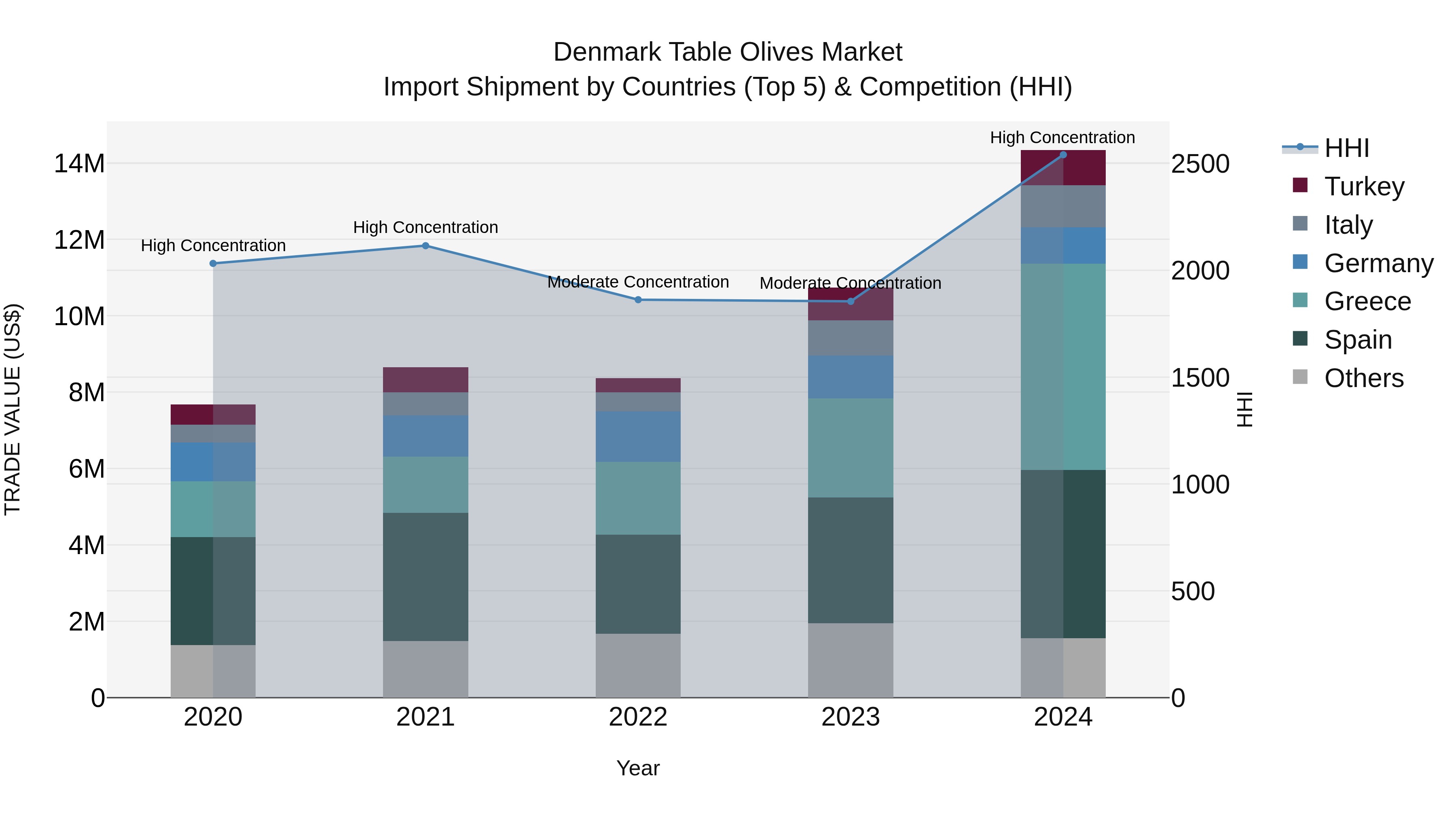
Denmark table olives import market witnessed a significant shift in concentration levels from moderate to high in 2024, with top exporting countries being Greece, Spain, Italy, Germany, and Turkey. The impressive CAGR of 16.89% from 2020 to 2024 indicates a thriving market, further reinforced by a notable growth rate of 33.56% in 2024. This suggests a growing preference for imported table olives in Denmark, with key suppliers from Mediterranean countries dominating the market. Stakeholders should closely monitor these trends for strategic insights and opportunities in the burgeoning Danish table olives import sector.
Denmark Table Olives Market Synopsis
The Denmark Table Olives Market is experiencing steady growth, driven by increasing consumer awareness of the health benefits associated with olives. Danish consumers are increasingly adopting Mediterranean diets, leading to a higher demand for table olives as a healthy snack or ingredient in various dishes. The market is characterized by a wide variety of olive types, including green, black, Kalamata, and stuffed olives, catering to diverse consumer preferences. The convenience of ready-to-eat table olives and the rising popularity of Mediterranean cuisine in Denmark are further fueling market growth. Producers are focusing on introducing innovative flavors and packaging formats to attract consumers. As the trend towards healthier eating continues, the Denmark Table Olives Market is expected to witness sustained growth in the coming years.
Denmark Table Olives Market Trends
In the Denmark table olives market, there is a growing trend towards healthier eating habits and an increasing demand for Mediterranean cuisine, driving the consumption of table olives. Consumers are seeking natural, organic, and high-quality products, presenting opportunities for premium and specialty table olive varieties. Additionally, there is a rising interest in sustainable and environmentally friendly food products, creating a niche market for producers focusing on eco-friendly practices. With the increasing popularity of plant-based diets, table olives are being recognized as a versatile and nutritious ingredient, opening avenues for product innovation and diversification. Collaborations with retailers and online platforms can further expand market reach, while promoting the unique flavors and health benefits of table olives to attract a wider consumer base in Denmark.
Denmark Table Olives Market Challenges
In the Denmark Table Olives Market, some challenges that are commonly faced include limited domestic production leading to high dependency on imports, fluctuating global olive prices impacting product costs, and competition from other snack options. Additionally, consumer preferences and awareness of table olives may vary, requiring effective marketing strategies to promote consumption. Ensuring consistent quality and taste preferences to meet customer expectations can also be a challenge, along with maintaining sustainable sourcing practices in line with increasing demand for ethical and environmentally friendly products. Overall, navigating these challenges requires market players to stay innovative, maintain quality standards, and adapt to changing consumer trends to remain competitive in the Denmark Table Olives Market.
Denmark Table Olives Market Investment Opportunities
The Denmark Table Olives Market is primarily driven by increasing consumer awareness of the health benefits associated with olives, such as being rich in antioxidants and healthy fats. The growing trend of adopting Mediterranean diets, which often include olives as a staple ingredient, is also fueling the demand for table olives in Denmark. Furthermore, the rising popularity of Mediterranean cuisine and the increasing availability of a variety of flavored olives in the market are attracting consumers towards incorporating olives into their meals. Additionally, the convenience of ready-to-eat table olives and the expanding retail distribution channels are making it easier for consumers to purchase and consume olives, further boosting the market growth in Denmark.
Denmark Table Olives Market Government Polices
The Denmark Table Olives market is primarily governed by the European Union`s Common Agricultural Policy (CAP), which sets standards for production, trade, and quality of agricultural products. Denmark follows these regulations in terms of import and export of table olives. Additionally, the Danish Veterinary and Food Administration (DVFA) enforces food safety and labeling requirements to ensure consumer protection. The Danish government also supports sustainable agriculture practices through various subsidies and incentives, encouraging producers to adopt environmentally friendly methods. Overall, government policies in Denmark aim to uphold quality standards, promote fair trade practices, and prioritize food safety in the Table Olives market.
Denmark Table Olives Market Future Outlook
The future outlook for the Denmark Table Olives Market appears promising, with steady growth anticipated in the coming years. Factors such as increasing consumer awareness about the health benefits of olives, rising demand for Mediterranean cuisine, and a growing trend towards healthier eating habits are expected to drive market growth. Additionally, the introduction of new product varieties, innovative packaging solutions, and expanding distribution channels are likely to further boost market expansion. With a focus on quality, sustainability, and product differentiation, market players have the opportunity to capitalize on the growing demand for table olives in Denmark. Overall, the Denmark Table Olives Market is forecasted to experience sustained growth and offer opportunities for new entrants and existing players to thrive in the market.
Key Highlights of the Report:
- Denmark Table Olives Market Outlook
- Market Size of Denmark Table Olives Market, 2024
- Forecast of Denmark Table Olives Market, 2031
- Historical Data and Forecast of Denmark Table Olives Revenues & Volume for the Period 2021- 2031
- Denmark Table Olives Market Trend Evolution
- Denmark Table Olives Market Drivers and Challenges
- Denmark Table Olives Price Trends
- Denmark Table Olives Porter's Five Forces
- Denmark Table Olives Industry Life Cycle
- Historical Data and Forecast of Denmark Table Olives Market Revenues & Volume By Type for the Period 2021- 2031
- Historical Data and Forecast of Denmark Table Olives Market Revenues & Volume By Black Olive for the Period 2021- 2031
- Historical Data and Forecast of Denmark Table Olives Market Revenues & Volume By Green Olive for the Period 2021- 2031
- Historical Data and Forecast of Denmark Table Olives Market Revenues & Volume By Application for the Period 2021- 2031
- Historical Data and Forecast of Denmark Table Olives Market Revenues & Volume By Online Store for the Period 2021- 2031
- Historical Data and Forecast of Denmark Table Olives Market Revenues & Volume By Supermarket for the Period 2021- 2031
- Historical Data and Forecast of Denmark Table Olives Market Revenues & Volume By Convenience Store for the Period 2021- 2031
- Historical Data and Forecast of Denmark Table Olives Market Revenues & Volume By Other for the Period 2021- 2031
- Denmark Table Olives Import Export Trade Statistics
- Market Opportunity Assessment By Type
- Market Opportunity Assessment By Application
- Denmark Table Olives Top Companies Market Share
- Denmark Table Olives Competitive Benchmarking By Technical and Operational Parameters
- Denmark Table Olives Company Profiles
- Denmark Table Olives Key Strategic Recommendations






































