Switzerland Vegetable Oil Market Growth Rate Analysis (2025 - 2031)
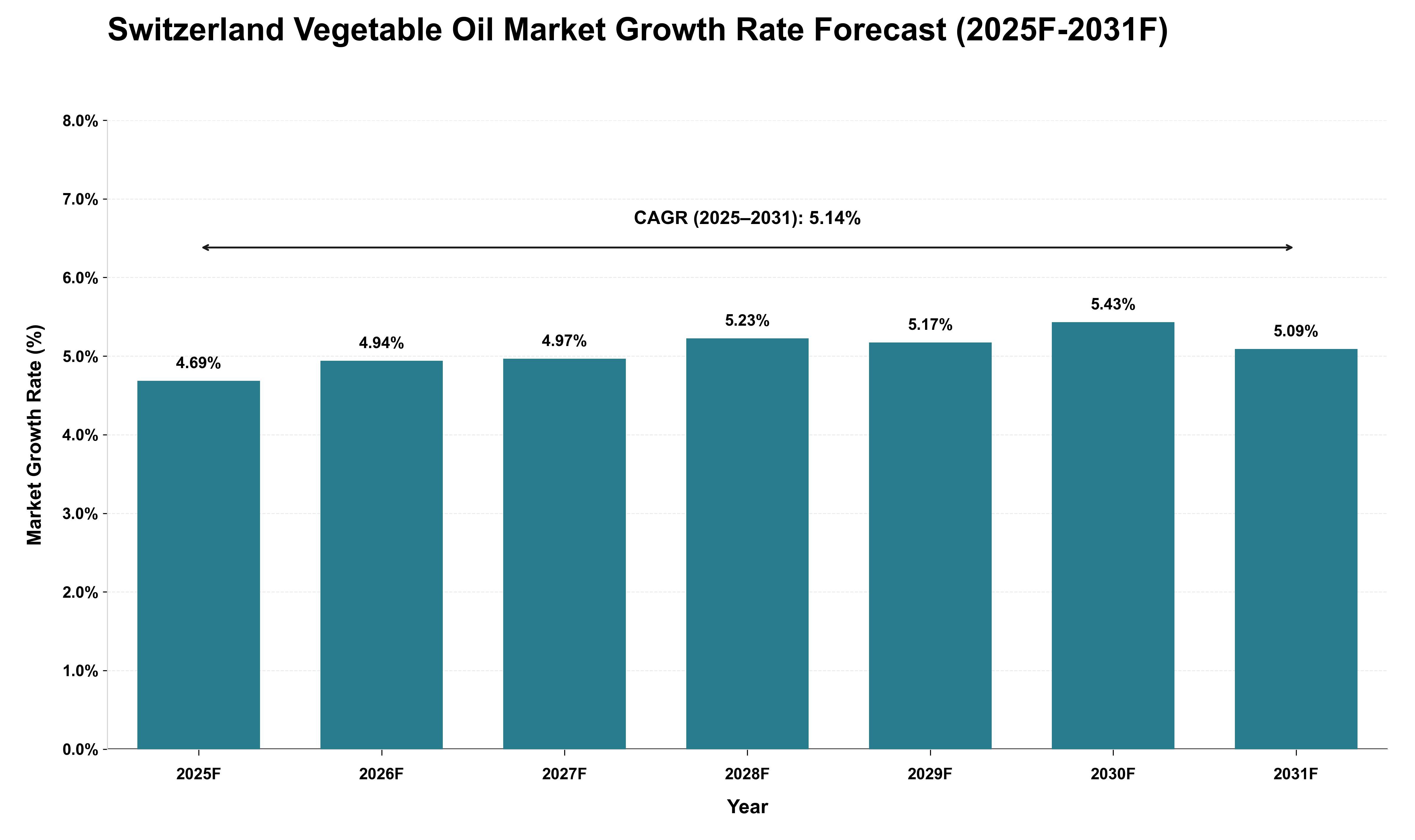
The Switzerland vegetable oil market will experience a robust growth trajectory driven by increasing health consciousness among consumers and a shift towards plant-based diets, which will enhance demand for vegetable oils. The forecasted CAGR of 5.14% from 2025 to 2031 reflects this trend, with annual growth rates gradually increasing, peaking at 5.43% in 2030. This upward momentum will be supported by anticipated changes in import dependencies as Switzerland seeks to diversify its supply sources amid global agricultural fluctuations. Additionally, cyclical trends in food consumption patterns will likely favor vegetable oils over animal fats, further bolstering market expansion. As producers adapt to these dynamics, competitive pressures will intensify, prompting innovations in product offerings and sustainability practices that align with consumer preferences for healthier options. Overall, the combination of these macroeconomic factors will shape a favorable environment for sustained growth in the vegetable oil sector during this period.
Key Highlights of the Report:
- Switzerland Vegetable Oil Market Outlook
- Market Size of Switzerland Vegetable Oil Market, 2025
- Forecast of Switzerland Vegetable Oil Market, 2032
- Historical Data and Forecast of Switzerland Vegetable Oil Revenues & Volume for the Period 2022-2032F
- Switzerland Vegetable Oil Market Trend Evolution
- Switzerland Vegetable Oil Market Drivers and Challenges
- Switzerland Vegetable Oil Price Trends
- Switzerland Vegetable Oil Porter's Five Forces
- Switzerland Vegetable Oil Industry Life Cycle
- Historical Data and Forecast of Switzerland Vegetable Oil Market Revenues & Volume By Type for the Period 2022-2032F
- Historical Data and Forecast of Switzerland Vegetable Oil Market Revenues & Volume By Sunflower Oil for the Period 2022-2032F
- Historical Data and Forecast of Switzerland Vegetable Oil Market Revenues & Volume By Rapeseed (Canola) Oil for the Period 2022-2032F
- Historical Data and Forecast of Switzerland Vegetable Oil Market Revenues & Volume By Soybean Oil for the Period 2022-2032F
- Historical Data and Forecast of Switzerland Vegetable Oil Market Revenues & Volume By Application for the Period 2022-2032F
- Historical Data and Forecast of Switzerland Vegetable Oil Market Revenues & Volume By Food for the Period 2022-2032F
- Historical Data and Forecast of Switzerland Vegetable Oil Market Revenues & Volume By Feed for the Period 2022-2032F
- Historical Data and Forecast of Switzerland Vegetable Oil Market Revenues & Volume By Industrial for the Period 2022-2032F
- Switzerland Vegetable Oil Import Export Trade Statistics
- Market Opportunity Assessment By Type
- Market Opportunity Assessment By Application
- Switzerland Vegetable Oil Top Companies Market Share
- Switzerland Vegetable Oil Competitive Benchmarking By Technical and Operational Parameters
- Switzerland Vegetable Oil Company Profiles
- Switzerland Vegetable Oil Key Strategic Recommendations






































