Switzerland Writing and Marking Instrument Market Year-wise Growth Rate (2021-2031F)
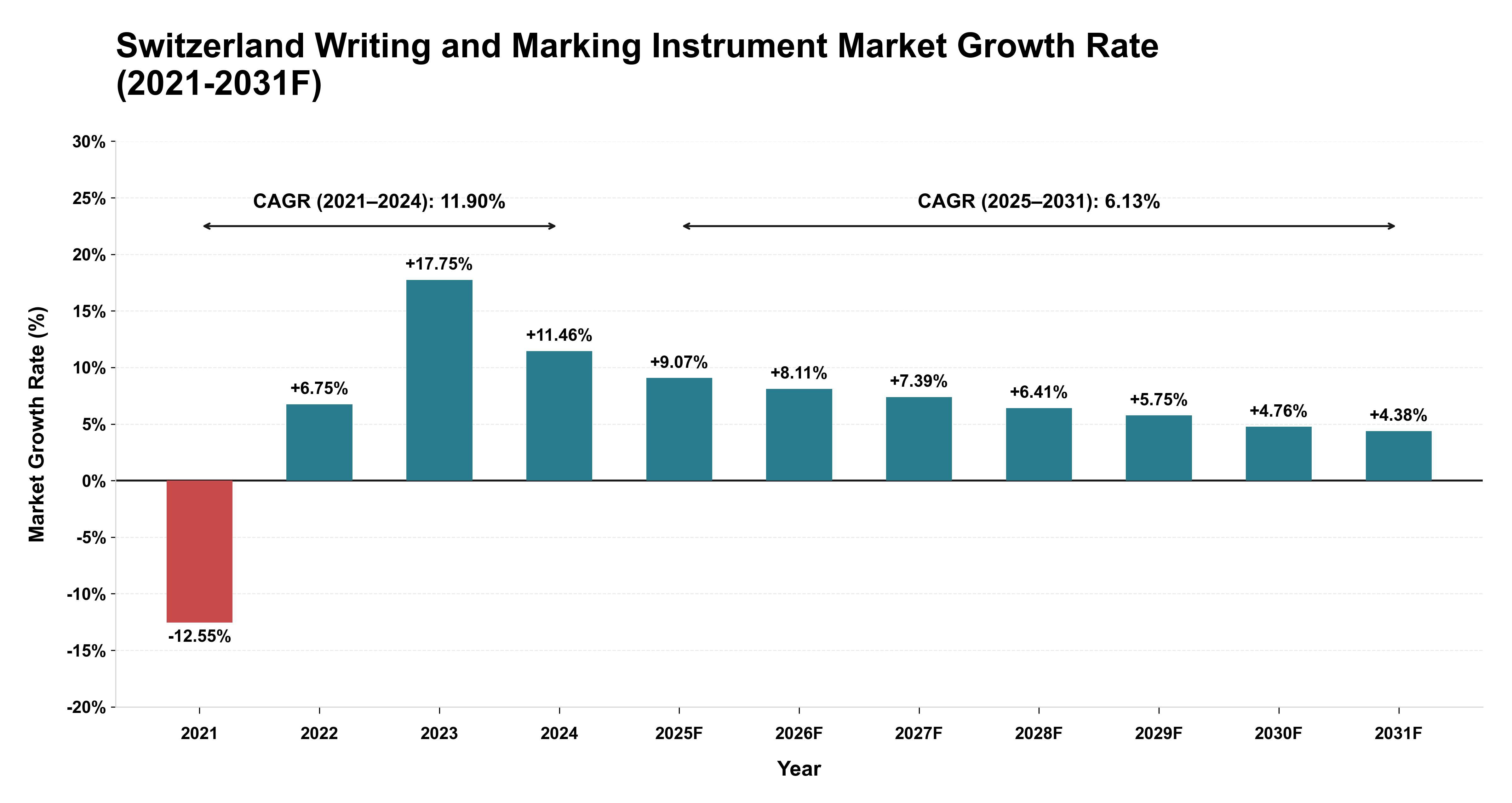
The Switzerland Writing and Marking Instrument Market experienced a turbulent period from 2021 to 2024, marked by a significant contraction in 2021 followed by a rebound in subsequent years with growth rates fluctuating but overall showing a positive trajectory. The market witnessed a robust historical CAGR of 11.90%, driven by technological advancements and evolving consumer preferences for premium writing instruments. Looking ahead to the forecast period of 2025-2031, the growth is expected to moderate with a forecasted CAGR of 6.13%, reflecting a gradual stabilization in demand and market maturity. Factors such as increasing digitalization impacting traditional writing practices and sustainability trends influencing material choices are anticipated to shape the market landscape, leading to more moderate but sustainable growth rates over the forecast horizon.
Key Highlights of the Report:
- Switzerland Writing and Marking Instrument Market Outlook
- Market Size of Switzerland Writing and Marking Instrument Market, 2024
- Forecast of Switzerland Writing and Marking Instrument Market, 2031
- Historical Data and Forecast of Switzerland Writing and Marking Instrument Revenues & Volume for the Period 2021-2031
- Switzerland Writing and Marking Instrument Market Trend Evolution
- Switzerland Writing and Marking Instrument Market Drivers and Challenges
- Switzerland Writing and Marking Instrument Price Trends
- Switzerland Writing and Marking Instrument Porter`s Five Forces
- Switzerland Writing and Marking Instrument Industry Life Cycle
- Historical Data and Forecast of Switzerland Writing and Marking Instrument Market Revenues & Volume By Type for the Period 2021-2031
- Historical Data and Forecast of Switzerland Writing and Marking Instrument Market Revenues & Volume By Pen for the Period 2021-2031
- Historical Data and Forecast of Switzerland Writing and Marking Instrument Market Revenues & Volume By Coloring and Writing Instrument for the Period 2021-2031
- Historical Data and Forecast of Switzerland Writing and Marking Instrument Market Revenues & Volume By Pencil for the Period 2021-2031
- Historical Data and Forecast of Switzerland Writing and Marking Instrument Market Revenues & Volume By Markers and Highlighters for the Period 2021-2031
- Historical Data and Forecast of Switzerland Writing and Marking Instrument Market Revenues & Volume By Writing Accessories for the Period 2021-2031
- Historical Data and Forecast of Switzerland Writing and Marking Instrument Market Revenues & Volume By Applications for the Period 2021-2031
- Historical Data and Forecast of Switzerland Writing and Marking Instrument Market Revenues & Volume By Online Stores for the Period 2021-2031
- Historical Data and Forecast of Switzerland Writing and Marking Instrument Market Revenues & Volume By Offline Stores for the Period 2021-2031
- Switzerland Writing and Marking Instrument Import Export Trade Statistics
- Market Opportunity Assessment By Type
- Market Opportunity Assessment By Applications
- Switzerland Writing and Marking Instrument Top Companies Market Share
- Switzerland Writing and Marking Instrument Competitive Benchmarking By Technical and Operational Parameters
- Switzerland Writing and Marking Instrument Company Profiles
- Switzerland Writing and Marking Instrument Key Strategic Recommendations






































