Taiwan 5G Core Market Growth Rate
According to 6Wresearch internal database and industry insights, the Taiwan 5G Core Market is projected to grow at a compound annual growth rate (CAGR) of 11.7% during the forecast period 2026–2032.
Taiwan 5G Core Market Year-wise Growth Rate and Key Drivers (2022–2032)
This graph illustrates the annual growth rates of the Taiwan 5G Core Market from 2022 to 2032, highlighting a steady upward trajectory driven by rising demand for high-performance printing materials across industrial applications.
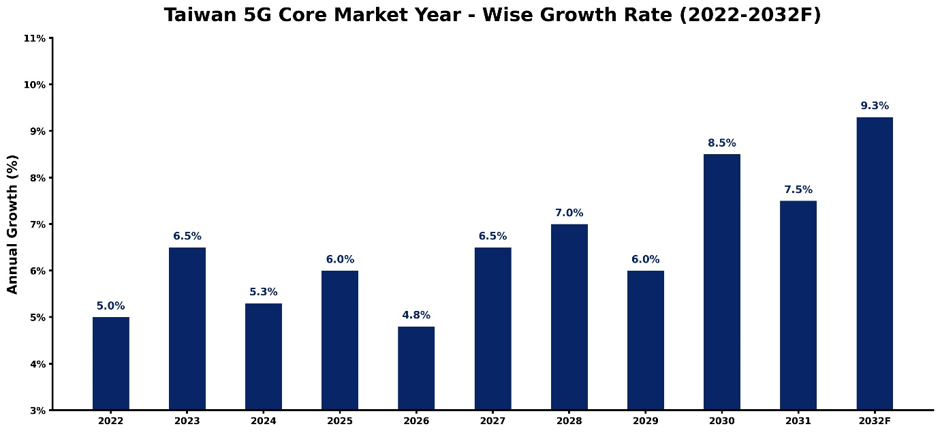
The following table presents the estimated annual growth rates of the market for each year, along with the key factors influencing market performance during the respective period. The values are intended to highlight year-wise drivers rather than provide a direct comparison between individual years.
| Year | Est. Annual Growth (%) | Market Rationale |
| 2022 | 5% | Expansion of Taiwan’s 5G network infrastructure increased demand for advanced core network solutions. |
| 2023 | 6.5% | Growing deployment of 5G standalone (SA) networks supported adoption of next-generation core network platforms. |
| 2024 | 5.3% | Increasing demand for low-latency communication and cloud-based core solutions drove market growth. |
| 2025 | 6% | Accelerated 5G SA adoption and rising requirements for network slicing supported expansion of the 5G core market. |
| 2026 | 4.8% | 5G infrastructure expansion and telecom modernization initiatives are expected to support steady market growth. |
| 2027 | 6.5% | Increasing adoption of private 5G networks across manufacturing sector boosts demand for flexible core network solutions. |
| 2028 | 7% | Growth in AI-driven networks and smart factory deployments creates new opportunities for advanced 5G core platforms. |
| 2029 | 6% | Rising IoT connectivity and enterprise 5G applications strengthen demand for efficient and smart core network infrastructure. |
| 2030 | 8.5% | Expansion of smart cities and high-bandwidth applications accelerates adoption of advanced 5G core technologies. |
| 2031 | 7.5% | Advancements in network automation and AI-enabled network management drive continued market adoption. |
| 2032 | 9.3% | Long-term growth is supported by widespread 5G ecosystem maturity, increasing demand for high-performance core networks. |
Topics Covered in the Taiwan 5G Core Market Report
The Taiwan 5G Core Market report covers the market By Component, Network Function, Deployment Model and End User. It provides an in-depth analysis of technological advancements, competitive landscape, market opportunities, industry trends, and growth drivers, enabling stakeholders to understand current and future market dynamics.
Taiwan 5G Core Market Highlights
| Report Name | Taiwan 5G Core Market |
| Forecast period | 2026-2032 |
| CAGR | 11.7% |
| Growing Sector | Telecommunications |
Taiwan 5G Core Market Synopsis
Taiwan 5G Core Market is projected to grow at a healthy rate during the forecast period owing to the growing 5G network deployments, increasing adoption of standalone 5G architecture, and increasing demand for advanced network management solutions. 5G Core network is essential to providing high speed connectivity, ultra-low latency communication, and efficient data processing for telecom and enterprise applications. Additionally, the strong telecommunications ecosystem of Taiwan and increasing investments in edge computing will continue to support sustained market growth.
Evaluation of Growth Drivers in the Taiwan 5G Core Market (2026–2032)
Below are the major drivers and their influence on the Taiwan 5G Core Market dynamics:
| Drivers | Primary Segment Affected | Why It Matters |
| Expansion of 5G Standalone (SA) Network Deployments | Core Network Infrastructure | Increasing adoption of 5G SA architecture requires advanced core network solutions. |
| Growing Demand for Edge Computing and Cloud Native Networks | cloud-native 5G core solutions | The shift to distributed computing environments increases demand for virtualised 5G core platforms. |
| Increasing Adoption of Private 5G Networks | Enterprise & Industrial Applications | Demand for secure 5G core networks is being driven by smart factory deployments. |
| Growing IoT and Connected Device Deployment | IoT Network Management Solution | The proliferation of connected devices demands scalable core infrastructure to support the massive connectivity of devices. |
| Advancement of Network Virtualization and Automation | Network Function Virtualization (NFV) & Software-Defined Networking (SDN) | Telecom operators are adopting automated and software-driven core networks. |
The Taiwan 5G Core Market is expected to record a CAGR of 11.7% during 2026-2032. The market growth is driven by the growth of 5G standalone networks, increasing demand for high-performance network infrastructure, and the adoption of cloud-native core technologies. Investments in telecom modernisation, private 5G networks, industrial automation, and IoT connectivity are driving the market growth. Market growth will also be accelerated by developments in network virtualisation and Software-Defined Networking (SDN).
Evaluation of Restraints in the Taiwan 5G Core Market
Below are some major restraints and their influence on the Taiwan 5G Core Market dynamics:
| Restraints | Primary Segment Affected | What This Means |
| Limited availability of 5G professional skill gap | telecom operators and network equipment vendors | 5G Core Network Deployment and Optimization Delayed by Shortage of Experienced Engineers. |
| Strict regulations and compliance requirements | Technology vendors and telecom operators | Regulatory approvals slow deployment and increase operating costs. |
| ROI is uncertain | Telecom operators | High upfront investment and slow monetization make operators cautious. |
| Requirement on global semiconductor and equipment supply chains | Network infrastructure providers | Supply chain disruptions can limit the supply of equipment, increasing project timelines and costs. |
| Slow enterprise migration to standalone 5G | Enterprise end users | Delayed adoption of advanced 5G applications reduces immediate demand for 5G core solutions. |
Taiwan 5G Core Market Challenges
The Taiwan 5G Core Market faces challenges including high deployment costs, complex migration from legacy networks, and the need for advanced cloud-based infrastructure. Operators are also challenged by cybersecurity risks, edge computing integration, and a shortage of skilled professionals. Continuous network upgrades are required to manage increasing data traffic and support low-latency applications. Additionally, rising competition and operational expenses may impact profitability and influence the overall pace of market growth.
Taiwan 5G Core Market Trends
Key trends shaping the Taiwan 5G Core Market include:
- Increasing Adoption of Cloud-Native 5G Core Networks: Telecom operators are increasingly shifting to cloud-based and virtualised core architectures to enhance scalability, flexibility, and operational efficiency.
- Growth of Private 5G Networks: The growing rollout of private 5G solutions across manufacturing, semiconductor, logistics, and industrial sectors is driving demand for customised and secure 5G core infrastructure.
- Increasing Adoption of Edge Computing: Increasing adoption of edge computing capabilities with 5G core networks and the increasing demand for real-time data processing and low-latency applications are anticipated to drive the market growth.
Investment Opportunities in the Taiwan 5G Core Market
Key investment opportunities in the Taiwan 5G Core Market include:
- Cloud-Native 5G Core Infrastructure Growth: There are great opportunities for investments in cloud-based, virtualised and software-driven core network platforms as telecom operators modernise their network architecture.
- Private 5G Network Solutions Growth: There is growing demand for semiconductor manufacturing, smart factories, logistics and enterprise applications, all of which are opportunities for providers of customised private 5G core solutions.
- Edge computing-enabled core platforms: Investments in edge-enabled 5G core infrastructure stand to benefit from the growing demand for ultra-low latency applications such as industrial automation, autonomous systems, and real-time analytics.
Top Leading Companies in the Taiwan 5G Core Market
A comprehensive list of major companies involved in the Taiwan 5G Core Market is provided below:
1. Ericsson
| Company Name | Ericsson |
| Established Year | 1876 |
| Headquarters | Stockholm, Sweden |
| Official Website | Click Here |
Ericsson is a leading global provider of 5G core network solutions, offering cloud-native core platforms, network automation, and advanced telecom infrastructure solutions.
2. Nokia
| Company Name | Nokia |
| Established Year | 1865 |
| Headquarters | Espoo, Finland |
| Official Website | Click Here |
Nokia provides advanced 5G core solutions, including cloud-native network functions, private wireless networks, and automation platforms. Its technologies support telecom operators in improving network flexibility.
3. Cisco Systems
| Company Name | Cisco Systems |
| Established Year | 1984 |
| Headquarters | San Jose, California, United States |
| Official Website | Click Here |
Cisco provides networking, security, and cloud solutions that support 5G core infrastructure. Its technologies enable network virtualization, automation and efficient data management for telecom operators and enterprises.
4. NEC Corporation
| Company Name | NEC Corporation |
| Established Year | 1899 |
| Headquarters | Tokyo, Japan |
| Official Website | Click Here |
NEC provides 5G core technologies, private 5G solutions, and network integration services. The company focuses on secure, flexible, and enterprise-oriented 5G infrastructure for industrial and commercial applications.
5. Samsung Electronics
| Company Name | Samsung Electronics |
| Established Year | 1969 |
| Headquarters | Suwon, South Korea |
| Official Website | Click Here |
Samsung offers 5G core network solutions, including cloud-native platforms and virtualized network functions. Its solutions support telecom operators and enterprises in implementing high-performance 5G networks.
Government & Industry Initiatives in the Taiwan 5G Core Market
According to Taiwanese government data, key initiatives include:
- Progress of 5G Network Infrastructure Development: The Taiwanese government continues to enable the development of 5G infrastructure via digital transformation programs.
- 5G Enterprise and Industrial Applications Development: Government programs are promoting the deployment of private 5G networks in manufacturing and other industrial areas to improve automation and operational efficiency.
- Digital Transformation and Smart Industry Programs: National digitalisation strategies promote the integration of 5G, IoT, and cloud technologies to boost Taiwan’s industrial competitiveness and support Industry 4.0 development.
Future Insights of the Taiwan 5G Core Market
The Taiwan 5G Core Market is expected to witness strong growth during the forecast period. Growth will be driven by increasing 5G standalone deployments, cloud-native core adoption, and AI-enabled network solutions. By 2032, enterprise and industrial applications are expected to account for over 35% of market demand, supported by private 5G networks, smart manufacturing, and IoT adoption. Investments in edge computing, network virtualization, and telecom modernization will further accelerate market expansion across Taiwan.
Market Segmentation Analysis
This report presents a detailed analysis of the Taiwan 5G Core Market segments along with their leading categories.
By Component – Solutions Segment Dominated, Services Segment Set to Expand Rapidly
As per Sumit Sagar, Senior Research Analyst, 6Wresearch, the Solutions segment dominated the market, accounting for an estimated 62% market share in 2025, driven by increasing deployment of cloud-native 5G core platforms. The Services segment is projected to witness significant growth during 2026–2032, registering a CAGR of approximately 11.8%, supported by rising demand for network integration.
By Network Function – Mobility Management Function Segment Dominated, Unified Data Management Segment Set to Expand Rapidly
The Mobility Management Function segment held the largest market share of approximately 32% in 2025, owing to the critical role of mobility management in enabling seamless connectivity. The Unified Data Management segment is expected to grow at a CAGR of around 13.5% during the forecast period (2026–2032), owing to the increasing demand for centralised subscriber data management.
By Deployment Model – Cloud Segment Dominated, Cloud-Native Expansion to Drive Growth
The Cloud segment accounted for the largest market share in 2025, with close to 58%, owing to the increasing adoption of cloud-native 5G core architectures. The Cloud deployment segment is expected to grow at a CAGR of around 14.5% during 2026-2032 due to investments in edge computing.
By End User – Telecom Operators Segment Dominated, Enterprises Segment Set to Expand Rapidly
The Telecom Operators segment accounted for the largest market share of approximately 65% in 2025, owing to continuous investments by telecom providers in 5G standalone network deployment. The Enterprises segment is projected to register the fastest growth during 2026–2032, with a CAGR of nearly 14.2%, driven by increasing adoption of private 5G networks across manufacturing.
Note- Market size estimations and growth projections presented in this report are based on 6Wresearch's proprietary forecasting methodology, utilizing the latest available industry data, company disclosures, government publications, and primary research inputs.
Key Attractiveness of the Report
- 10 Years of Market Numbers
- Historical Data Starting from 2022 to 2025
- Base Year: 2025
- Forecast Data until 2032
- Key Performance Indicators Impacting the Market
- Major Upcoming Developments and Projects
Key Highlights of the Report:
- Taiwan 5G Core Market Outlook
- Market Size of Taiwan 5G Core Market, 2025
- Forecast of Taiwan 5G Core Market, 2032
- Historical Data and Forecast of Taiwan 5G Core Revenues & Volume for the Period 2022-2032
- Taiwan 5G Core Market Trend Evolution
- Taiwan 5G Core Market Drivers and Challenges
- Taiwan 5G Core Price Trends
- Taiwan 5G Core Porter`s Five Forces
- Taiwan 5G Core Industry Life Cycle
- Historical Data and Forecast of Taiwan 5G Core Market Revenues & Volume By Component for the Period 2022-2032
- Historical Data and Forecast of Taiwan 5G Core Market Revenues & Volume By Solutions for the Period 2022-2032
- Historical Data and Forecast of Taiwan 5G Core Market Revenues & Volume By Services for the Period 2022-2032
- Historical Data and Forecast of Taiwan 5G Core Market Revenues & Volume By Network Function for the Period 2022-2032
- Historical Data and Forecast of Taiwan 5G Core Market Revenues & Volume By Access for the Period 2022-2032
- Historical Data and Forecast of Taiwan 5G Core Market Revenues & Volume By Mobility Management Function for the Period 2022-2032
- Historical Data and Forecast of Taiwan 5G Core Market Revenues & Volume By Policy Control Function for the Period 2022-2032
- Historical Data and Forecast of Taiwan 5G Core Market Revenues & Volume By Unified Data Management for the Period 2022-2032
- Historical Data and Forecast of Taiwan 5G Core Market Revenues & Volume By Deployment Model for the Period 2022-2032
- Historical Data and Forecast of Taiwan 5G Core Market Revenues & Volume By Cloud for the Period 2022-2032
- Historical Data and Forecast of Taiwan 5G Core Market Revenues & Volume By On-premises for the Period 2022-2032
- Historical Data and Forecast of Taiwan 5G Core Market Revenues & Volume By End User for the Period 2022-2032
- Historical Data and Forecast of Taiwan 5G Core Market Revenues & Volume By Telecom Operators for the Period 2022-2032
- Historical Data and Forecast of Taiwan 5G Core Market Revenues & Volume By Enterprises for the Period 2022-2032
- Taiwan 5G Core Import Export Trade Statistics
- Market Opportunity Assessment By Component
- Market Opportunity Assessment By Network Function
- Market Opportunity Assessment By Deployment Model
- Market Opportunity Assessment By End User
- Taiwan 5G Core Top Companies Market Share
- Taiwan 5G Core Competitive Benchmarking By Technical and Operational Parameters
- Taiwan 5G Core Company Profiles
- Taiwan 5G Core Key Strategic Recommendations






































