Taiwan 5G Satellite Communication Market Growth Rate
According to 6Wresearch internal database and industry insights, the Taiwan 5G Satellite Communication Market is projected to grow at a compound annual growth rate (CAGR) of 8.9% during the forecast period 2026–2032.
Taiwan 5G Satellite Communication Market Year-wise Growth Rate and Key Drivers (2022–2032)
This graph illustrates the annual growth rates of the Taiwan 5G Satellite Communication Market from 2022 to 2032, highlighting a steady upward trajectory driven by rising demand for high-performance printing materials across industrial applications.
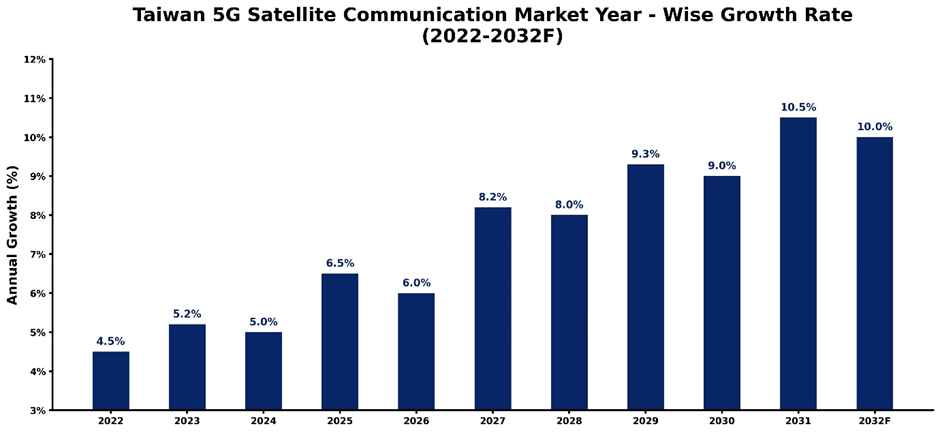
The following table presents the estimated annual growth rates of the Taiwan 5G Satellite Communication Market for each year, along with the key factors influencing market performance during the respective period. The values are intended to highlight year-wise drivers rather than provide a direct comparison between individual years.
| Year | Est. Annual Growth (%) | Market Rationale |
| 2022 | 4.5% | Early adoption of satellite communication solutions supported connectivity expansion. |
| 2023 | 5.2% | Increasing demand for reliable connectivity solutions accelerated satellite communication adoption. |
| 2024 | 5% | Rising investments in next-generation satellite networks supported market development. |
| 2025 | 6.5% | Growing demand for broadband satellite connectivity increased adoption across enterprise applications. |
| 2026 | 6% | Expansion of LEO satellite constellations and integration with 5G networks strengthen satellite communication market growth. |
| 2027 | 8.2% | Increasing adoption of satellite-based IoT connectivity and remote communication solutions drives market expansion. |
| 2028 | 8% | Rising investments in advanced satellite technologies support market growth. |
| 2029 | 9.3% | Rising demand for seamless connectivity in aviation accelerates adoption. |
| 2030 | 9% | Growth of 5G NTN (Non-Terrestrial Networks) integration boosts market opportunities. |
| 2031 | 10.5% | Increasing adoption of satellite-based emergency communication drives market growth. |
| 2032 | 10% | Long-term expansion supported by widespread adoption of integrated satellite-terrestrial networks. |
Topics Covered in the Taiwan 5G Satellite Communication Market Report
The Taiwan 5G Satellite Communication Market report covers the industry By Orbit, Satellite Solutions, Spectrum and End-users. It provides an in-depth analysis of technological advancements, competitive landscape, market opportunities, industry trends, and growth drivers, enabling stakeholders to understand current and future market dynamics.
Taiwan 5G Satellite Communication Market Highlights
| Report Name | Taiwan 5G Satellite Communication Market |
| Forecast period | 2026-2032 |
| CAGR | 8.9% |
| Growing Sector | Telecommunications & Satellite Connectivity |
Taiwan 5G Satellite Communication Market Synopsis
The Taiwan 5G Satellite Communication Market is expected to witness sturdy growth during the forecast period due to rising demand for reliable high-speed connectivity, expansion of satellite-based broadband services, integration of 5G non-terrestrial networks (NTN), and growing requirements for communication coverage in remote and challenging environments. 5G Satellite Communication is a technology that combines 5G wireless networks with satellite communication systems to offer high-speed, low-latency connectivity over large areas, including remote and underserved regions where old cellular towers are inaccessible.
Evaluation of Growth Drivers in the Taiwan 5G Satellite Communication Market (2026–2032)
Below are the major drivers and their influence on the Taiwan 5G Satellite Communication Market dynamics:
| Drivers | Primary Segment Affected | Why It Matters |
| Increasing adoption of 5G Non-Terrestrial Networks (NTN) | Satellite Operators, Telecom Providers, Network Infrastructure | It allows for a smooth integration between satellite and terrestrial 5G networks. |
| Rising demand for connectivity in remote areas | Rural Communication, Government Networks, Emergency Services | Provides robust communications in areas with sparse terrestrial networks. |
| Growth of satellite IoT applications | IoT Devices, Agriculture, Logistics, Maritime | Allows large scale connectivity for distributed devices and sensors. |
| Expansion of LEO satellite constellations | Satellite Broadband, Enterprise Connectivity | Enhanced latency, coverage and broadband availability. |
| Increasing demand for disaster recovery communication | Government Agencies, Defense, Emergency Services | Delivers reliable communication in the event of natural disasters and network outages. |
The Taiwan 5G Satellite Communication Market is expected to grow at a strong CAGR of 8.9% during 2026–2032. The growth is attributed to increasing investments in satellite infrastructure, rising adoption of 5G NTN technologies, demand for reliable connectivity solutions, and expansion of satellite-based IoT and broadband services. With increasing demand for secure and resilient communication networks, satellite communication will play a significant role in supporting Taiwan’s digital transformation, emergency connectivity, smart infrastructure, and next-generation wireless communication ecosystem.
Evaluation of Restraints in the Taiwan 5G Satellite Communication Market
Below are some major restraints and their influence on the Taiwan 5G Satellite Communication Market dynamics:
| Restraints | Primary Segment Affected | What This Means |
| High satellite deployment and maintenance costs | Satellite Operators, Infrastructure Providers | Large capital investments may slow market expansion. |
| Complex regulatory and spectrum management requirements | Satellite Operators, Government Authorities | Licensing and frequency coordination may impact deployment timeframes. |
| Limited satellite communication awareness among enterprises | Enterprise Connectivity Solutions | Slower uptake by smaller firms due to cost and technical complexity. |
| Latency and performance limitations in certain satellite systems | Real-Time Applications, Enterprise Networks | May impact adoption for ultra-low latency applications. |
| Competition from terrestrial 5G networks | Telecom Operators, Broadband Providers | Increased terrestrial coverage may reduce demand in some markets. |
Taiwan 5G Satellite Communication Market Challenges
The Taiwan 5G Satellite Communication Market faces challenges such as high infrastructure costs, spectrum allocation, regulatory compliance, and the complex integration of satellite and terrestrial networks. The construction of satellite infrastructure requires large spending on satellites, ground stations and terminals. However, growth is being driven by the increasing demand for resilient connectivity, disaster recovery, maritime communication and remote IoT. Taiwan has about 72-77% 5G coverage. Global LEO satellite market is expected to surpass US$20 billion by 2030.
Taiwan 5G Satellite Communication Market Trends
Key trends shaping the Taiwan 5G Satellite Communication Market include:
- 5G Non-Terrestrial Networks (NTN) growth: Increasing integration of satellites with 5G networks is helping to offer wider coverage and enhanced connectivity for remote and mobile applications.
- Low Earth Orbit (LEO) Satellite Constellation Expansion: LEO satellite launches are improving communication velocity, reducing latency, and broadening broadband accessibility.
- Satellite IoT Adoption Gains Momentum: Industries increasingly shift to satellite IoT solutions for remote monitoring, logistics tracking, maritime operations and industrial applications.
Investment Opportunities in the Taiwan 5G Satellite Communication Market
Key investment opportunities in the Taiwan 5G Satellite Communication Market include:
- Satellite Broadband Infrastructure Expansion: Investment opportunities in LEO satellites, ground stations, satellite terminals and broadband connectivity solutions are available for satellite broadband infrastructure expansion.
- 5G NTN Technology Development: Investment Opportunities for Companies that can invest in satellite-terrestrial integration technologies, network platforms, and advanced communication systems.
- Satellite-IoT Solutions: Investment Opportunities for Remote monitoring and connected devices are rapidly in demand in agriculture, logistics, maritime and industrial sectors.
Leading Companies in the Taiwan 5G Satellite Communication Market
A comprehensive list of major companies and technology providers involved in the Taiwan 5G Satellite Communication Market is provided below:
1. OneWeb (Eutelsat OneWeb)
| Company Name | OneWeb (Eutelsat OneWeb) |
|---|---|
| Established Year | 2012 |
| Headquarters | London, UK |
| Official Website | Click Here |
OneWeb provides LEO satellite communication services designed for enterprise, government, and connectivity applications.
2. Chunghwa Telecom
| Company Name | Chunghwa Telecom |
|---|---|
| Established Year | 1996 |
| Headquarters | Taipei, Taiwan |
| Official Website | Click Here |
Chunghwa Telecom is Taiwan’s largest telecommunications operator, providing broadband, mobile, cloud, and satellite communication services.
3. Taiwan Mobile
| Company Name | Taiwan Mobile |
|---|---|
| Established Year | 1997 |
| Headquarters | Taipei, Taiwan |
| Official Website | Click Here |
Taiwan Mobile is a major telecommunications operator involved in mobile communication, digital services, and advanced connectivity solutions.
4. Aerkomm
| Company Name | Aerkomm |
|---|---|
| Established Year | 2010 |
| Headquarters | Taiwan |
| Official Website | Click Here |
Aerkomm provides satellite communication solutions focused on broadband connectivity for aviation, maritime, and fixed-location applications.
5. Wistron NeWeb Corporation (WNC)
| Company Name | Wistron NeWeb Corporation (WNC) |
|---|---|
| Established Year | 1996 |
| Headquarters | Hsinchu, Taiwan |
| Official Website | Click Here |
WNC is a Taiwan-based communication technology company providing networking equipment and satellite communication-related products.
Government & Industry Initiatives in the Taiwan 5G Satellite Communication Market
According to Taiwanese government data, key initiatives include:
- Satellite Infrastructure Expansion and Connectivity Improvement Programs: The Taiwanese government encourages the improvement of satellite communication infrastructure, such as satellite ground stations and next-generation satellite networks.
- 5G Non-Terrestrial Networks (NTN) and Satellite Integration: Taiwan is supporting the installation of satellite communication into 5G networks, aiming to offer seamless connectivity beyond traditional terrestrial infrastructure.
- Development of Domestic Satellite Communication Capabilities: Taiwan is investing in the development of local satellite technology including satellite manufacturing, communication payloads, RF components and ground communication equipment.
Future Insights of the Taiwan 5G Satellite Communication Market
The Taiwan 5G Satellite Communication Market is projected to grow at a significant rate owing to the rising demand for reliable connectivity, the growth of Low Earth Orbit (LEO) satellite networks, and the deployment of 5G Non-Terrestrial Network (NTN) technologies. Taiwan plans to spend NT$71 billion through 2031 to boost its space industry and satellite capabilities. The global LEO satellite market is expected to reach US$20.6 billion by 2030, with opportunities in maritime, aviation, IoT, government, and broadband communication segments.
Market Segmentation Analysis
This report presents a detailed analysis of the Taiwan 5G Satellite Communication Market segments along with their leading categories.
By Orbit – Low Earth Orbit (LEO) Segment Dominated, Medium Earth Orbit (MEO) Segment Set to Expand Rapidly
As per Bhawna Singh, Assistant Manager, 6Wresearch, the Low Earth Orbit (LEO) segment dominated the Taiwan 5G Satellite Communication Market, accounting for an estimated 55% market share in 2025, driven by increasing deployment of LEO satellite constellations. The Medium Earth Orbit (MEO) segment is projected to witness significant growth during 2026–2032, registering a CAGR of approximately 10.8%, supported by increasing demand for hybrid satellite-terrestrial communication networks.
By Satellite Solutions – Communication-on-the-Move Segment Dominated, Hybrid Multiplay Segment Set to Expand Rapidly
The Communication-on-the-Move segment accounted for the largest market share, around 38% in 2025, owing to increasing demand for uninterrupted satellite connectivity in aviation. The Hybrid Multiplay segment is projected to grow rapidly during 2026–2032, registering a CAGR of approximately 12.5%, supported by increasing integration of satellite networks with terrestrial 5G infrastructure.
By Spectrum – Ku and Ka Band Segment Dominated, L and S Band Segment Set to Expand
The Ku and Ka Band segment dominated the Taiwan 5G Satellite Communication Market, accounting for an estimated 60% market share in 2025, driven by increasing adoption of high-throughput satellite systems. The L and S Band segment is expected to expand during 2026–2032, registering a CAGR of approximately 9.5%, supported by increasing demand for satellite IoT.
By End-users – Defense and Government Segment Dominated, Aviation and Transportation Segments Set to Expand Rapidly
The Defense and Government segment accounted for the largest share of the Taiwan 5G Satellite Communication Market with about 35% of the market share in 2025, owing to the rising demand for safe communication networks. Strong growth is expected in the Aviation and Transportation & Logistics segments during the 2026-2032 period with CAGRs of around 11.5% respectively, driven by increasing demand for in-flight connectivity.
Note- Market size estimations and growth projections presented in this report are based on 6Wresearch's proprietary forecasting methodology, utilizing the latest available industry data, company disclosures, government publications, and primary research inputs.
Key Attractiveness of the Report
- 10 Years of Market Numbers
- Historical Data Starting from 2022 to 2025
- Base Year: 2025
- Forecast Data until 2032
- Key Performance Indicators Impacting the Market
- Major Upcoming Developments and Projects
Key Highlights of the Report:
- Taiwan 5G Satellite Communication Market Outlook
- Market Size of Taiwan 5G Satellite Communication Market, 2025
- Forecast of Taiwan 5G Satellite Communication Market, 2032
- Historical Data and Forecast of Taiwan 5G Satellite Communication Revenues & Volume for the Period 2022-2032
- Taiwan 5G Satellite Communication Market Trend Evolution
- Taiwan 5G Satellite Communication Market Drivers and Challenges
- Taiwan 5G Satellite Communication Price Trends
- Taiwan 5G Satellite Communication Porter`s Five Forces
- Taiwan 5G Satellite Communication Industry Life Cycle
- Historical Data and Forecast of Taiwan 5G Satellite Communication Market Revenues & Volume By Orbit for the Period 2022-2032
- Historical Data and Forecast of Taiwan 5G Satellite Communication Market Revenues & Volume By Low Earth Orbit (LEO) for the Period 2022-2032
- Historical Data and Forecast of Taiwan 5G Satellite Communication Market Revenues & Volume By Medium Earth Orbit (MEO) for the Period 2022-2032
- Historical Data and Forecast of Taiwan 5G Satellite Communication Market Revenues & Volume By Geosynchronous Earth Orbit (GEO) for the Period 2022-2032
- Historical Data and Forecast of Taiwan 5G Satellite Communication Market Revenues & Volume By Satellite Solutions for the Period 2022-2032
- Historical Data and Forecast of Taiwan 5G Satellite Communication Market Revenues & Volume By Backend and Tower Feed for the Period 2022-2032
- Historical Data and Forecast of Taiwan 5G Satellite Communication Market Revenues & Volume By Trunking and Head-end Feed for the Period 2022-2032
- Historical Data and Forecast of Taiwan 5G Satellite Communication Market Revenues & Volume By Communication-on-the-move for the Period 2022-2032
- Historical Data and Forecast of Taiwan 5G Satellite Communication Market Revenues & Volume By Hybrid Multiplay for the Period 2022-2032
- Historical Data and Forecast of Taiwan 5G Satellite Communication Market Revenues & Volume By Spectrum for the Period 2022-2032
- Historical Data and Forecast of Taiwan 5G Satellite Communication Market Revenues & Volume By L and S band (1-4 GHZ) for the Period 2022-2032
- Historical Data and Forecast of Taiwan 5G Satellite Communication Market Revenues & Volume By C and X band (4-12 GHZ) for the Period 2022-2032
- Historical Data and Forecast of Taiwan 5G Satellite Communication Market Revenues & Volume By Ku and Ka band (12-40 GHZ) for the Period 2022-2032
- Historical Data and Forecast of Taiwan 5G Satellite Communication Market Revenues & Volume By End-users for the Period 2022-2032
- Historical Data and Forecast of Taiwan 5G Satellite Communication Market Revenues & Volume By Defense and Government for the Period 2022-2032
- Historical Data and Forecast of Taiwan 5G Satellite Communication Market Revenues & Volume By Consumer Electronics for the Period 2022-2032
- Historical Data and Forecast of Taiwan 5G Satellite Communication Market Revenues & Volume By Aviation for the Period 2022-2032
- Historical Data and Forecast of Taiwan 5G Satellite Communication Market Revenues & Volume By Energy and Utilities for the Period 2022-2032
- Historical Data and Forecast of Taiwan 5G Satellite Communication Market Revenues & Volume By Transportation and Logistics for the Period 2022-2032
- Historical Data and Forecast of Taiwan 5G Satellite Communication Market Revenues & Volume By Others for the Period 2022-2032
- Taiwan 5G Satellite Communication Import Export Trade Statistics
- Market Opportunity Assessment By Orbit
- Market Opportunity Assessment By Satellite Solutions
- Market Opportunity Assessment By Spectrum
- Market Opportunity Assessment By End-users
- Taiwan 5G Satellite Communication Top Companies Market Share
- Taiwan 5G Satellite Communication Competitive Benchmarking By Technical and Operational Parameters
- Taiwan 5G Satellite Communication Company Profiles
- Taiwan 5G Satellite Communication Key Strategic Recommendations






































