Taiwan Accelerometer Market Growth Rate
According to 6Wresearch internal database and industry insights, the Taiwan Accelerometer Market is projected to grow at a compound annual growth rate (CAGR) of 8.8% during the forecast period 2026–2032.
Taiwan Accelerometer Market Year-wise Growth Rate and Key Drivers (2022–2032)
This graph illustrates the annual growth rates of the Taiwan Accelerometer Market from 2022 to 2032, highlighting a steady upward trajectory driven by rising demand for high-performance printing materials across industrial applications.
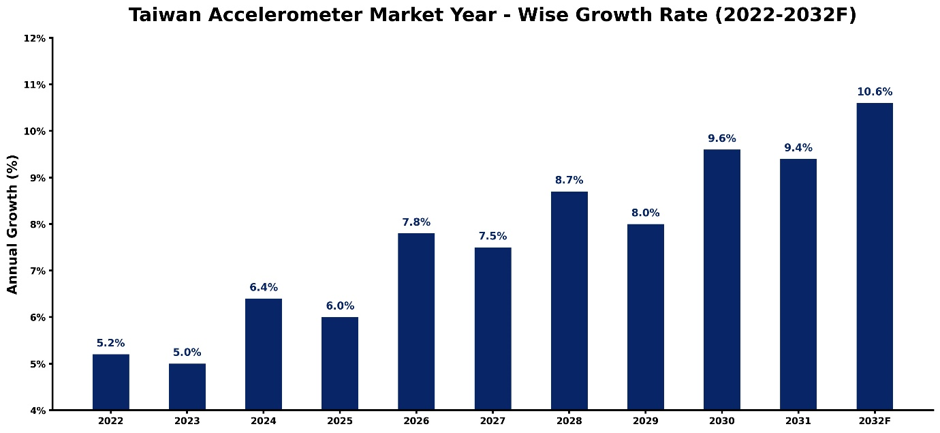
The following table presents the estimated annual growth rates of the Taiwan Accelerometer Market for each year, along with the key factors influencing market performance during the respective period. The values are intended to highlight year-wise drivers rather than provide a direct comparison between individual years.
| Year | Est. Annual Growth (%) | Market Rationale |
| 2022 | 5.2% | Recovery in automotive supported demand for accelerometers across sensing applications. |
| 2023 | 5% | Increasing adoption of MEMS-based sensors in smartphones and industrial equipment supported market development. |
| 2024 | 6.4% | Growth in automotive electronics strengthened demand for compact and accurate accelerometers. |
| 2025 | 6% | Rising adoption of EVs, connected vehicles, and advanced sensing systems supported accelerometer demand. |
| 2026 | 7.8% | Expansion of automotive sensors, smart mobility, and AI-enabled electronics is expected to drive accelerometer adoption. |
| 2027 | 7.5% | Increasing use of accelerometers in ADAS is expected to support market growth. |
| 2028 | 8.7% | Growing demand for MEMS sensors is expected to accelerate market development. |
| 2029 | 8% | Expansion of electric vehicle technologies is expected to increase demand for multi-axis accelerometers. |
| 2030 | 9.6% | Increasing integration of AI is expected to expand accelerometer applications. |
| 2031 | 9.4% | Continued development of industrial automation and connected devices is expected to sustain strong demand for motion sensors. |
| 2032 | 10.6% | Broader adoption of advanced MEMS sensing is expected to support long-term market expansion. |
Topics Covered in the Taiwan Accelerometer Market Report
The Taiwan Accelerometer Market report covers the market By Type, Axis and End-use Industry. It provides an in-depth analysis of motor efficiency technologies, competitive landscape, market opportunities, industrial automation trends, replacement demand, and growth drivers, enabling stakeholders to understand current and future market dynamics.
Taiwan Accelerometer Market Highlights
| Report Name | Taiwan Accelerometer Market |
| Forecast period | 2026-2032 |
| CAGR | 8.8% |
| Growing Sector | Automotive & Consumer Electronics |
Taiwan Accelerometer Market Synopsis
The Taiwan Accelerometer Market is expected to witness steady growth during the forecast period owing to the rising demand for MEMS sensors, automotive electronics, electric vehicles, ADAS, smartphones, wearables, industrial automation, and smart connected devices. Accelerometers are sensors that measure linear acceleration and motion that are used extensively in vehicle safety systems, navigation, consumer electronics, industrial equipment, robotics and other sensing applications. Accelerometer development and integration is well supported by Taiwan’s mature semiconductor, ICT and automotive-electronics ecosystem.
Evaluation of Growth Drivers in the Taiwan Accelerometer Market (2026–2032)
Below are the major drivers and their influence on the Taiwan Accelerometer Market dynamics:
| Drivers | Primary Segment Affected | Why It Matters |
| Growing Demand for MEMS Sensors | Consumer Electronics & Automotive | MEMS technology enables compact, low-power, and cost-effective motion sensing across multiple applications. |
| Rising Adoption of ADAS and Smart Vehicles | ADAS & Autonomous Vehicles | Advanced vehicles require increasingly sophisticated sensing and motion-detection capabilities. |
| Growth of Electric Vehicles | Electric Vehicles | EV development is increasing demand for electronic control, sensing, navigation, and vehicle-monitoring systems. |
| Expansion of Consumer Electronics | Smartphones, Wearables & IoT | Accelerometers are commonly integrated into smartphones, smart watches, fitness devices and connected electronics. |
| Increasing Industrial Automation | Industrial & Robotics | Motion sensing supports equipment monitoring, robotics, machine control, and predictive-maintenance applications. |
The Taiwan Accelerometer Market is expected to grow at a CAGR of about 8.8% during 2026–2032. Taiwan’s automotive-electronics industry is supported by its semiconductor and ICT capabilities, while government and industry programs are increasingly emphasizing AI, new-energy vehicles, smart mobility and in-vehicle sensing technologies. Growth is expected to be driven by increasing adoption of MEMS sensors, automotive electronics, EVs, ADAS, smart devices, industrial automation, and AI-enabled applications.
Evaluation of Restraints in the Taiwan Accelerometer Market
Below are the major restraints and their influence on the Taiwan Accelerometer Market dynamics:
| Restraints | Primary Segment Affected | What This Means |
| Complexity of MEMS Manufacturing | MEMS Accelerometer Manufacturers | Advanced MEMS manufacturing requires specialized equipment and quality-control capabilities. |
| Competition from Alternative Inertial Sensors | Motion-Sensing Applications | Gyroscopes can compete with standalone accelerometers in certain applications. |
| Price Pressure in Consumer Electronics | Smartphones & Wearables | High-volume consumer applications can put pressure on sensor pricing and manufacturer margins. |
| Automotive Qualification Requirements | Automotive Sensors | Automotive applications require very strict reliability, qualification and performance standards before they can be adopted at scale. |
| Cyclical Demand in Electronics Manufacturing | Semiconductor & Electronics Suppliers | Changes in global electronics and automotive production can affect sensor demand and inventory levels. |
Taiwan Accelerometer Market Challenges
Challenges faced by the Taiwan Accelerometer Market include the complexity of MEMS manufacturing, stringent accuracy and reliability requirements, price competition, qualification needs for automotive applications, and changes in electronics need. Manufacturers should continue to improve sensor sensitivity, miniaturization, power efficiency and multi-axis measurement capabilities, all while keeping costs competitive. Another challenge is the growing integration of accelerometers with gyroscopes and other sensors into full inertial measurement units (IMUs). For this purpose, manufacturers need to develop better performance sensing technologies.
Taiwan Accelerometer Market Trends
Key trends shaping the Taiwan Accelerometer Market include:
- Increasing Adoption of MEMS Accelerometers: Increasing need for compact, low-power, and cost-efficient MEMS accelerometers is supporting adoption across consumer electronics, automotive, and industrial applications.
- Rising Automotive Electronics Integration: Increasing electronic content in vehicles is driving the use of accelerometers in safety, stability control, navigation, and vehicle-monitoring systems.
- Growth of ADAS and Autonomous Driving: Advanced driver-guidance and automatic-driving technologies are rising needs for precise motion and acceleration sensing.
Investment Opportunities in the Taiwan Accelerometer Market
Key investment opportunities in the Taiwan Accelerometer Market include:
- MEMS Accelerometer Manufacturing: Developing sophisticated MEMS fabrication, packaging, and testing capabilities can address the rising need for small and high-performance accelerometers.
- Automotive Accelerometer Applications: Increasing integration of vehicle electronics is opening up opportunities for accelerometers used in safety systems, stability control, navigation and vehicle monitoring.
- Electric Vehicle Sensing: The growing EV ecosystem in Taiwan can provide a rise for investment into accelerometer technologies for EV control, battery monitoring, vehicle dynamics and electronic systems.
Leading Companies in the Taiwan Accelerometer Market
A comprehensive list of major companies involved in the Taiwan Accelerometer Market is provided below.
1. Sensortek Technology Corp.
| Company Name | Sensortek Technology Corp. |
| Established Year | 2009 |
| Headquarters | Hsinchu County, Taiwan |
| Official Website | Click Here |
Sensortek Technology Corp. is a Taiwan-based sensor company specializing in MEMS and optical sensing technologies. Its MEMS portfolio includes accelerometer sensors designed for smartphones.
2. Coretronic MEMS Corporation
| Company Name | Coretronic MEMS Corporation |
| Established Year | 2019 |
| Headquarters | Zhunan, Miaoli County, Taiwan |
| Official Website | Click Here |
Coretronic MEMS develops and manufactures MEMS sensing components and module solutions. Its product portfolio includes MEMS accelerometers and related industrial predictive-maintenance solutions.
3. J-MEX Inc.
| Company Name | J-MEX Inc. |
| Established Year | Not publicly confirmed |
| Headquarters | Hsinchu, Taiwan |
| Official Website | Click Here |
J-MEX is a Taiwan-based MEMS technology company involved in the research, development, manufacturing, and sale of accelerometer application modules.
4. STMicroelectronics
| Company Name | STMicroelectronics |
| Established Year | 1987 |
| Headquarters | Geneva, Switzerland |
| Official Website | Click Here |
STMicroelectronics is a major global semiconductor supplier with an extensive MEMS sensor portfolio, including multi-axis accelerometers for consumer, industrial, and automotive applications.
5. Analog Devices, Inc.
| Company Name | Analog Devices, Inc. |
| Established Year | 1965 |
| Headquarters | Wilmington, Massachusetts, USA |
| Official Website | Click Here |
Analog Devices develops precision sensing and semiconductor technologies, including MEMS accelerometers for motion sensing and industrial applications.
Government Initiatives Introduced in the Taiwan Accelerometer Market
According to Taiwanese government data, key initiatives include:
- Advanced Semiconductor R&D and MEMS Sensing Initiative: Taiwan’s Ministry of Economic Affairs is constructing advanced semiconductor R&D infrastructure, including an 8-inch submicron sensing-chip pilot line.
- Five Trusted Industry Sectors Promotion Plan: Taiwan’s Executive Yuan approved the Five Trusted Industry Sectors Promotion Plan in July 2025 to strengthen semiconductor R&D, advanced manufacturing, AI applications and related technology ecosystem.
- Smart Vehicles and Automotive Electronics Development: Through research and industry collaboration, Taiwan’s MOEA is promoting AI-enabled automotive electronics and electric-vehicle technologies.
Future Insights of the Taiwan Accelerometer Market
The Taiwan Accelerometer Market is anticipated to grow steadily during the forecast period due to increasing need from automotive electronics, electric vehicles, ADAS, consumer electronics, wearable devices, industrial automation, robotics, and smart connected devices. Taiwan's mature semiconductor, MEMS, ICT, and electronics manufacturing ecosystem is expected to continue supporting demand for advanced motion-sensing technologies. Increasing adoption of compact, low-power, and high-precision accelerometers is expected to strengthen their use across automotive, consumer, industrial, and IoT applications.
Market Segmentation Analysis
This report presents a detailed analysis of the market segments along with their leading categories.
By Type – DC Response Dominated, AC Response Set to Expand Rapidly
As per Sumit Sagar, Senior Research Analyst, 6Wresearch, The DC Response segment dominated the Market in 2025, accounting for an estimated 61% market share, supported by its broad applicability in measuring both static and dynamic acceleration. The AC Response segment is expected to grow at a CAGR of around 9.4% during 2026–2032, driven by increasing demand for vibration monitoring.
By Axis – 3-Axis Dominated, 2-Axis Set to Expand Rapidly
3-Axis segment held the largest market share in 2025, with an estimated 58% market share due to its ability to measure acceleration in three spatial directions. The 2-Axis segment is expected to grow at a CAGR of around 8.6% during 2026-2032 owing to the rising demand for compact motion-sensing solutions in industrial equipment.
By End-use Industry – Consumer Electronics Dominated, Automotive Set to Expand Rapidly
The Consumer Electronics segment accounted for the largest share of the market in 2025, with an estimated 38% market share, supported by extensive use of accelerometers in smartphones. The Automotive segment is expected to grow at the highest CAGR of around 10.2% during 2026–2032, driven by increasing vehicle electrification.
Note- Market size estimations and growth projections presented in this report are based on 6Wresearch's proprietary forecasting methodology, utilizing the latest available industry data, company disclosures, government publications, and primary research inputs.
Key Attractiveness of the Report
- 10 Years of Market Numbers
- Historical Data Starting from 2022 to 2025
- Base Year: 2025
- Forecast Data until 2032
- Key Performance Indicators Impacting the Market
- Major Upcoming Developments and Projects
Key Highlights of the Report:
- Taiwan Accelerometer Market Outlook
- Market Size of Taiwan Accelerometer Market, 2025
- Forecast of Taiwan Accelerometer Market, 2032
- Historical Data and Forecast of Taiwan Accelerometer Revenues & Volume for the Period 2022-2032
- Taiwan Accelerometer Market Trend Evolution
- Taiwan Accelerometer Market Drivers and Challenges
- Taiwan Accelerometer Price Trends
- Taiwan Accelerometer Porter's Five Forces
- Taiwan Accelerometer Industry Life Cycle
- Historical Data and Forecast of Taiwan Accelerometer Market Revenues & Volume By Type for the Period 2022-2032
- Historical Data and Forecast of Taiwan Accelerometer Market Revenues & Volume By AC Response for the Period 2022-2032
- Historical Data and Forecast of Taiwan Accelerometer Market Revenues & Volume By DC Response for the Period 2022-2032
- Historical Data and Forecast of Taiwan Accelerometer Market Revenues & Volume By Axis for the Period 2022-2032
- Historical Data and Forecast of Taiwan Accelerometer Market Revenues & Volume By 1-Axis for the Period 2022-2032
- Historical Data and Forecast of Taiwan Accelerometer Market Revenues & Volume By 2-Axis for the Period 2022-2032
- Historical Data and Forecast of Taiwan Accelerometer Market Revenues & Volume By 3-Axis for the Period 2022-2032
- Historical Data and Forecast of Taiwan Accelerometer Market Revenues & Volume By End-use Industry for the Period 2022-2032
- Historical Data and Forecast of Taiwan Accelerometer Market Revenues & Volume By Consumer Electronics for the Period 2022-2032
- Historical Data and Forecast of Taiwan Accelerometer Market Revenues & Volume By Automotive for the Period 2022-2032
- Historical Data and Forecast of Taiwan Accelerometer Market Revenues & Volume By Healthcare for the Period 2022-2032
- Historical Data and Forecast of Taiwan Accelerometer Market Revenues & Volume By Aerospace & Defense for the Period 2022-2032
- Historical Data and Forecast of Taiwan Accelerometer Market Revenues & Volume By Industrial for the Period 2022-2032
- Historical Data and Forecast of Taiwan Accelerometer Market Revenues & Volume By Others for the Period 2022-2032
- Taiwan Accelerometer Import Export Trade Statistics
- Market Opportunity Assessment By Type
- Market Opportunity Assessment By Axis
- Market Opportunity Assessment By End-use Industry
- Taiwan Accelerometer Top Companies Market Share
- Taiwan Accelerometer Competitive Benchmarking By Technical and Operational Parameters
- Taiwan Accelerometer Company Profiles
- Taiwan Accelerometer Key Strategic Recommendations
Market Covered
The report provides a comprehensive analysis of the Taiwan Accelerometer Market across the following segments:
By Type
- AC Response
- DC Response
By Axis
- 1-Axis
- 2-Axis
- 3-Axis
By End-use Industry
- Consumer Electronics
- Automotive
- Healthcare
- Aerospace & Defense
- Industrial
- Others






































