Taiwan Acephate Market Growth Rate
According to 6Wresearch internal database and industry insights, the Taiwan Acephate Market is projected to grow at a compound annual growth rate (CAGR) of 4.8% during the forecast period 2026–2032.
Taiwan Acephate Market Year-wise Growth Rate and Key Drivers (2022–2032)
This graph illustrates the annual growth rates of the Taiwan Acephate Market from 2022 to 2032, highlighting a steady upward trajectory driven by rising demand for high-performance printing materials across industrial applications.
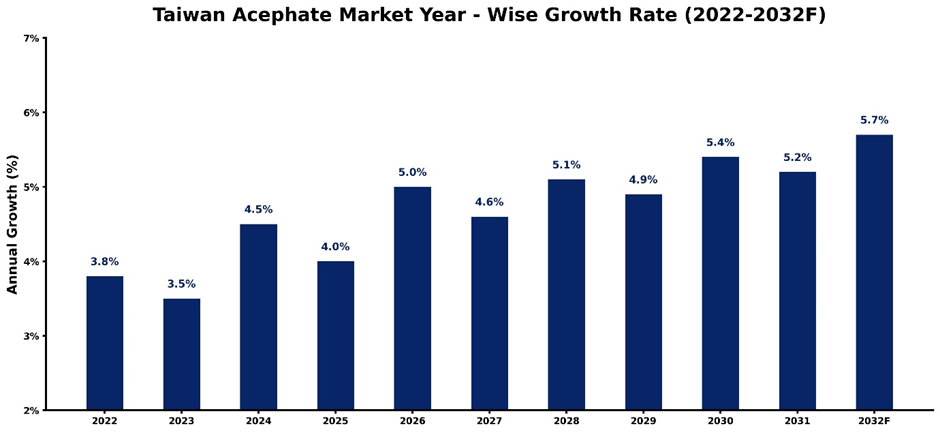
The following table presents the estimated annual growth rates of the Taiwan Acephate Market for each year, along with the key factors influencing market performance during the respective period. The values are intended to highlight year-wise drivers rather than provide a direct comparison between individual years.
| Year | Est. Annual Growth (%) | Market Rationale |
| 2022 | 3.8% | Recovery in agricultural activity supported demand for crop protection products and insecticides. |
| 2023 | 3.5% | Increasing pest-management requirements supported demand for acephate-based insecticides. |
| 2024 | 4.5% | Rising crop protection needs and continued use of insecticides supported market development. |
| 2025 | 4% | Growing emphasis on crop productivity and pest control supported market expansion. |
| 2026 | 5% | Increasing demand for effective insect control in agricultural production is expected to drive market growth. |
| 2027 | 4.6% | Continued adoption of crop protection products is expected to support acephate demand. |
| 2028 | 5.1% | Growing focus on agricultural productivity and integrated pest management is expected to strengthen market development. |
| 2029 | 4.9% | Increasing pest pressure and demand for reliable insect-control solutions are expected to support market expansion. |
| 2030 | 5.4% | Greater adoption of efficient crop protection practices is expected to increase demand for insecticides. |
| 2031 | 5.2% | Continued investment in agricultural productivity and crop protection is expected to sustain market demand. |
| 2032 | 5.7% | Broader adoption of modern pest-management practices is expected to support long-term acephate market expansion. |
Topics Covered in the Taiwan Acephate Market Report
The Taiwan Acephate Market report covers the market By Type, Application and End-User. It provides an in-depth analysis of motor efficiency technologies, competitive landscape, market opportunities, industrial automation trends, replacement demand, and growth drivers, enabling stakeholders to understand current and future market dynamics.
Taiwan Acephate Market Highlights
| Report Name | Taiwan Acephate Market |
| Forecast period | 2026-2032 |
| CAGR | 4.8% |
| Growing Sector | Crop Protection & Agricultural Insecticides |
Taiwan Acephate Market Synopsis
The Taiwan Acephate Market is expected to witness steady growth during the forecast period owing to rising demand for effective crop protection, increasing pest-management requirements, agricultural productivity objectives, and continued use of insecticides in crop cultivation. Acephate is an organophosphate insecticide used to control a range of insect pests affecting agricultural crops and plants. Its systemic and contact insecticidal properties support its application in crop protection programs where effective pest control is required.
Evaluation of Growth Drivers in the Taiwan Acephate Market (2026–2032)
Below are the major drivers and their influence on the Taiwan Acephate Market dynamics:
| Drivers | Primary Segment Affected | Why It Matters |
| Growing Agricultural Pest Pressure | Crop Protection & Insecticides | More pest-management requirements could help drive demand for effective insect control products. |
| Rising Demand for Crop Productivity | Agricultural Crops | Farmers are incentivized to use crop protection solutions to sustain crop production and quality. |
| Increasing Need for Effective Insect Control | Acephate-Based Insecticides | Acephate can provide effective control against various insect pests, supporting its use in crop protection programs. |
| Expansion of Integrated Pest Management | Integrated Crop Protection | Combining chemical and non-chemical pest-control practices can create demand for targeted insecticide applications. |
| Increasing Adoption of Modern Agricultural Practices | Commercial & Professional Farming | Improved farming practices and greater emphasis on crop monitoring can support structured pest-management programs. |
Taiwan Acephate Market is expected to grow at a CAGR of approximately 4.8% during 2026–2032.Taiwan’s developed agricultural sector, continued focus on crop productivity and demand for effective pest-management solutions create a favorable environment for adoption of crop protection products. Increase in pest-management requirements, modernization of agriculture techniques and need for effective insect-control solutions are expected to drive the market growth. Ongoing evolution of integrated pest-management practices is also expected to create opportunities for producers of agricultural insecticides.
Evaluation of Restraints in the Taiwan Acephate Market
Below are the major restraints and their influence on the Taiwan Acephate Market dynamics:
| Restraints | Primary Segment Affected | What This Means |
| Increasing Regulatory Requirements | Agricultural Insecticides | Regulatory requirements governing pesticide registration, application, and residue levels can increase compliance costs. |
| Environmental and Toxicity Concerns | Crop Protection Products | Pesticide exposure and environmental issues can affect the acceptance and use of a product. |
| Availability of Alternative Insecticides | Farmers & Crop Protection | Synthetic and biological alternatives could step up competition and impact demand for acephate-based products. |
| Pesticide Residue Requirements | Food Crops & Agricultural Producers | Tighter residue standards can influence pesticide choice, application practices, and market access. |
| Increasing Adoption of Biological Pest Control | Integrated Pest Management | Greater use of biological and non-chemical pest-control methods can limit reliance on conventional insecticides. |
Taiwan Acephate Market Challenges
The Taiwan Acephate Market is facing a number of challenges including rising regulatory demands, environmental and toxicity concerns, and changes in conventional agricultural methods. Compliance and commercialization costs may increase due to regulatory requirements for pesticide registration, permitted uses, application rates and food-crop residues. The increasing focus on sustainable agriculture and integrated pest management may also lead farmers to decrease their reliance on conventional chemical insecticides. Also changes in agricultural activity, farmer awareness and distribution efficiency can influence market demand.
Taiwan Acephate Market Trends
Key trends shaping the Taiwan Acephate Market include:
- Increasing use of integrated pest management: A greater focus on combining chemical, biological and cultural pest-control methods is impacting how insecticides are applied.
- Increasing Need for Crop Protection Solutions: Increasing focus on protecting crop production and quality is aiding demand for effective insect-control products.
- Growing Focus on Sustainable Agriculture: Farmers and agricultural stakeholders are increasingly focusing on assessing pesticide use according to environmental impact, efficacy of application, and residue management.
Investment Opportunities in the Taiwan Acephate Market
Key investment opportunities in the Taiwan Acephate Market include:
- Acephate Manufacturing and Formulation: Investment in efficient manufacturing and formulation of insecticide can support growing demand for crop protection products.
- Better crop protection products: New formulations and application technologies could provide opportunities to improve the effectiveness of pest control and the efficiency of applications.
- Integrated Pest Management Solutions: The increasing emphasis on sustainable agriculture can be exploited to invest in products and services that combine chemical and non-chemical pest-control approaches.
Leading Companies in the Taiwan Acephate Market
A comprehensive list of major companies involved in the Taiwan Acephate Market is provided below.
Government Initiatives Introduced in the Taiwan Acephate Market
According to Taiwanese government data, key initiatives include:
- Chemical Pesticide Risk Reduction and High Risk Pesticide Phase-Out: Taiwan’s Ministry of Agriculture is implementing measures to reduce chemical pesticide risks, phase out high risk pesticides and enhance risk-based pesticide management.
- Promotion of Integrated Pest Management (IPM): The government is promoting integrated pest management for crops, urging farmers to give priority to safer crop-protection materials, biological controls and economically and appropriately applied pesticides.
- Traceability of pesticide purchases: Taiwan has introduced a real-name system for the purchase of pesticides in an effort to improve the traceability of agricultural pesticides.
Future Insights of the Taiwan Acephate Market
Taiwan Acephate Market is anticipated to grow steadily during the forecast period due to increasing demand for effective crop protection, pest management, agricultural productivity, and insect-control solutions. Taiwan’s continued focus on agricultural efficiency, integrated pest management, crop monitoring, and sustainable farming practices is expected to influence the development and adoption of crop protection products. Increasing emphasis on precision agriculture, pesticide residue management, regulatory compliance, and targeted insecticide applications is expected to shape demand for acephate and alternative pest-control solutions
Market Segmentation Analysis
This report presents a detailed analysis of the market segments along with their leading categories.
By Type – Organo Phosphorus Dominated, Natural Sources Segment Set to Expand Rapidly
As per Sumit Sagar, Senior Research Analyst, 6Wresearch, the Organo Phosphorus segment dominated the Market in 2025, accounting for an estimated 100% market share, as acephate is an organophosphorus insecticide. The Natural Sources segment is expected to expand at a CAGR of around 6.2% during 2026–2032, driven by increasing adoption of biological and lower-chemical-residue pest management alternatives.
By Application – Spray Dominated, Other Applications Segment Set to Expand Rapidly
The Spray segment held the largest market share in 2025, with an estimated 72% share, supported by the widespread use of spray-based application methods for agricultural pest control. Other applications are expected to expand at a CAGR of around 5.3% during 2026–2032, driven by increasing demand for targeted and specialized pest-management practices.
By End-User – Agriculture Dominated, Commercial Segment Set to Expand Rapidly
In 2025, Agriculture segment generated the maximum revenue with the highest share of 76% driven by the sustained demand for insecticides. The Commercial segment is projected to grow at a CAGR of around 5.5% from 2026 to 2032 driven by the growing demand for professional pest-control services.
Note- Market size estimations and growth projections presented in this report are based on 6Wresearch's proprietary forecasting methodology, utilizing the latest available industry data, company disclosures, government publications, and primary research inputs.
Key Attractiveness of the Report
- 10 Years of Market Numbers
- Historical Data Starting from 2022 to 2025
- Base Year: 2025
- Forecast Data until 2032
- Key Performance Indicators Impacting the Market
- Major Upcoming Developments and Projects
Key Highlights of the Report:
- Taiwan Acephate Market Outlook
- Market Size of Taiwan Acephate Market, 2025
- Forecast of Taiwan Acephate Market, 2032
- Historical Data and Forecast of Taiwan Acephate Revenues & Volume for the Period 2022-2032
- Taiwan Acephate Market Trend Evolution
- Taiwan Acephate Market Drivers and Challenges
- Taiwan Acephate Price Trends
- Taiwan Acephate Porter's Five Forces
- Taiwan Acephate Industry Life Cycle
- Historical Data and Forecast of Taiwan Acephate Market Revenues & Volume By Type for the Period 2022-2032
- Historical Data and Forecast of Taiwan Acephate Market Revenues & Volume By Organo Chlorine for the Period 2022-2032
- Historical Data and Forecast of Taiwan Acephate Market Revenues & Volume By Organo Phosphorus for the Period 2022-2032
- Historical Data and Forecast of Taiwan Acephate Market Revenues & Volume By Carbamate for the Period 2022-2032
- Historical Data and Forecast of Taiwan Acephate Market Revenues & Volume By Arsenicals for the Period 2022-2032
- Historical Data and Forecast of Taiwan Acephate Market Revenues & Volume By Natural Sources for the Period 2022-2032
- Historical Data and Forecast of Taiwan Acephate Market Revenues & Volume By Others for the Period 2022-2032
- Historical Data and Forecast of Taiwan Acephate Market Revenues & Volume By Application for the Period 2022-2032
- Historical Data and Forecast of Taiwan Acephate Market Revenues & Volume By Spray for the Period 2022-2032
- Historical Data and Forecast of Taiwan Acephate Market Revenues & Volume By Dipping Vat for the Period 2022-2032
- Historical Data and Forecast of Taiwan Acephate Market Revenues & Volume By Hand Dressing for the Period 2022-2032
- Historical Data and Forecast of Taiwan Acephate Market Revenues & Volume By Others for the Period 2022-2032
- Historical Data and Forecast of Taiwan Acephate Market Revenues & Volume By End-User for the Period 2022-2032
- Historical Data and Forecast of Taiwan Acephate Market Revenues & Volume By Agriculture for the Period 2022-2032
- Historical Data and Forecast of Taiwan Acephate Market Revenues & Volume By Animal Husbandry for the Period 2022-2032
- Historical Data and Forecast of Taiwan Acephate Market Revenues & Volume By Commercial for the Period 2022-2032
- Historical Data and Forecast of Taiwan Acephate Market Revenues & Volume By Others for the Period 2022-2032
- Taiwan Acephate Import Export Trade Statistics
- Market Opportunity Assessment By Type
- Market Opportunity Assessment By Application
- Market Opportunity Assessment By End-User
- Taiwan Acephate Top Companies Market Share
- Taiwan Acephate Competitive Benchmarking By Technical and Operational Parameters
- Taiwan Acephate Company Profiles
- Taiwan Acephate Key Strategic Recommendations
Market Covered
The report provides a comprehensive analysis of the Taiwan Acephate Market across the following segments:
By Type
- Organo Chlorine
- Organo Phosphorus
- Carbamate
- Arsenicals
- Natural Sources
- Others
By Application
- Spray
- Dipping Vat
- Hand Dressing
- Others
By End-User
- Agriculture
- Animal Husbandry
- Commercial
- Others






































