Taiwan Active Geofencing Market Growth Rate
According to 6Wresearch internal database and industry insights, Taiwan Active Geofencing Market is projected to expand at a CAGR of approximately 23.2% during 2026–2032.
Taiwan Active Geofencing Market Year-wise Growth Rate and Key Drivers (2022–2032)
This graph illustrates the annual growth rates of the Taiwan Active Geofencing Market from 2022 to 2032, highlighting a steady upward trajectory and projected market expansion over the forecast period.
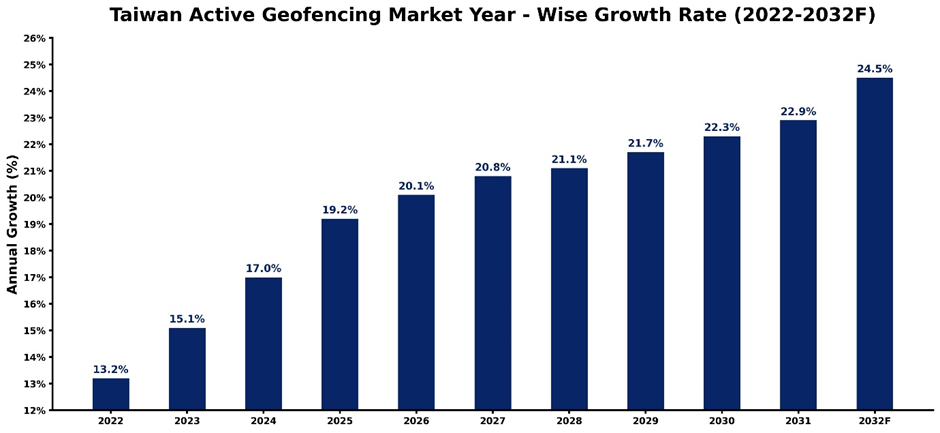
The following table presents the estimated annual growth rates of the market for each year, along with the key factors influencing market performance during the respective period. The values are intended to highlight year-wise drivers rather than provide a direct comparison between individual years.
| Year | Estimated Annual Growth (%) | Market Rationale |
| 2022 | 13.2% | Digital retail, logistics tracking, and location-based engagement increased demand. |
| 2023 | 15.1% | Smart transportation, IoT connectivity, and real-time monitoring supported market expansion. |
| 2024 | 17% | Location intelligence adoption accelerated across retail, transportation, manufacturing, and government. |
| 2025 | 19.2% | Real-time geofencing, smart enforcement, and connected devices strengthened market demand. |
| 2026 | 20.1% | AI-enabled geofencing and smart monitoring applications are expected to accelerate adoption. |
| 2027 | 20.8% | 5G, IoT platforms, cloud services, and software integration support growth. |
| 2028 | 21.1% | Mobile geofencing, location intelligence, and automated alerts broaden market deployment. |
| 2029 | 21.7% | Predictive logistics, asset monitoring, and personalization drive market development. |
| 2030 | 22.3% | Smart-city infrastructure and connected transportation applications create additional opportunities. |
| 2031 | 22.9% | Enterprise location intelligence and automated controls sustain market momentum. |
| 2032 | 24.5% | AI geofencing maturity and connected infrastructure support long-term growth. |
Topics Covered in the Taiwan Active Geofencing Market Report
The Taiwan Active Geofencing Market report provides detailed analysis across Type, Organization Size, and End-use Industry segments. The report provides a detailed analysis of ongoing market trends, opportunities/high-growth areas, and market drivers that will help stakeholders align strategies based on current and future market dynamics.
Taiwan Active Geofencing Market Highlights
| Report Name | Taiwan Active Geofencing Market |
| Forecast period | 2026-2032 |
| CAGR | 23.2% |
| Growing Sector | Location Intelligence |
Taiwan Active Geofencing Market Synopsis
The Taiwan Active Geofencing Market is growing due to companies adopting location-based technologies for real-time monitoring, alerts, tracking and automation. Active geofencing solutions leverage GPS, cellular networks, Wi-Fi, RFID, sensors, and software platforms to create virtual geographic boundaries that trigger pre-defined actions when connected devices, vehicles, assets, or people enter or leave designated areas. Adoption is underpinned by Taiwan advanced technology ecosystem, robust digital connectivity, IoT deployment, smart transportation initiatives and growing demand for fleet management, logistics, retail engagement, industrial monitoring and smart mobility applications.
Evaluation of Drivers in Taiwan Active Geofencing Market (2026–2032)
Below mentioned are some major drivers and their influence on the market dynamics:
| Drivers | Primary Segment Affected | Why It Matters (Evidence) |
| Rising adoption of location-based services | Mobile Geofencing, Retail | Enables proximity alerts, offers, navigation, and customer engagement. |
| Expansion of smart transportation | Fixed Geofencing, Transportation and Logistics | AI, 5G, and big-data systems support location-aware transportation. |
| Increasing demand for real-time asset tracking | Fixed Geofencing, Industrial Manufacturing | Virtual zones monitor assets and trigger alerts across facilities. |
| Growth of retail personalization | Mobile Geofencing, Retail | Location insights help you make offers and interactions with customers targeted. |
| Expansion of IoT and connected devices | Fixed Geofencing, Industrial Manufacturing | Connected devices provide you with real-time location data for automated events. |
The Taiwan Active Geofencing Market growth is projected to reach a CAGR of 23.2% during 2026–2032, growing digitalization, smart transportation development, IoT adoption, location intelligence, real-time monitoring, and rising demand for automated geographic controls. The government has demonstrated AI geofencing applications in environmental enforcement and intelligent transportation initiatives support the deployment of AI, 5G, big data and location-enabled mobility services. These developments strengthen the technology ecosystem for broader adoption of active geofencing solutions across transportation, logistics, industrial, retail and public sector applications.
Evaluation of Restraints in Taiwan Active Geofencing Market
Below mentioned are some major restraints and their influence on market dynamics:
| Market Restraint | Primary Segment Affected | Why It Matters (Evidence) |
| Data privacy and governance requirements | Mobile Geofencing, Retail, BFSI, Healthcare | Location data requires secure collection, processing, use, and governance. |
| High implementation costs | Fixed Geofencing, Industrial Manufacturing | Deployments require devices, connectivity, platforms, integration, and ongoing maintenance. |
| Integration complexity | Fixed Geofencing, Transportation and Logistics | Integrating legacy systems increases deployment complexity and implementation requirements. |
| Location accuracy limitations | Mobile Geofencing, Transportation and Logistics | GPS, networks, devices, and environments can affect location accuracy. |
| Shortage of specialized technical skills | Platform and Services | Geofencing requires expertise across IoT, GIS, cloud, analytics, cybersecurity. |
Challenges in the Taiwan Active Geofencing Market
The Taiwan Active Geofencing Industry is expected to grow, but there are several challenges that could limit adoption. Key barriers include data privacy and governance requirements, challenges of integrating geofencing solutions with existing enterprise and government systems, high implementation costs, location accuracy limitations in complex environments and a shortage of specialized technical skills. Moreover, entities that collect location related personal information are subject to the Personal Data Protection Act of Taiwan which regulates the lawful collection, processing and use of personal data for specific purposes.
Trends in the Taiwan Active Geofencing Market
Below mentioned are some of the trends shaping the Taiwan Active Geofencing Market Growth are:
- Trend toward Real-Time Location Intelligence: Companies are increasingly combining geofencing with real-time location data to monitor vehicles, assets, employees, inventory, and customer movement.
- Rise in AI-enabled Geofencing: Taiwan environmental authorities have demonstrated the use of AI geofencing for illegal-dumping enforcement, integrating vehicle license-plate recognition, real-time monitoring, and AI object recognition.
- Expansion of Mobile Geofencing: Mobile geofencing is increasingly relevant to location-based marketing, customer engagement, field-service management, mobile workforce applications, and proximity-based notifications.
Investment Opportunities in the Taiwan Active Geofencing Market
Some of the investment opportunities in the Taiwan Active Geofencing Market are:
- AI-Powered Geofencing Platforms: Investment in platforms that combine geographic boundaries with AI-driven anomaly detection, predictive analytics, computer vision, and automated alerts can meet the rising demand for intelligent monitoring.
- Smart Transportation and Fleet Solutions: Taiwan ongoing work on intelligent transportation systems can contribute to developing geofencing applications for public transportation, commercial fleets, delivery vehicles, ports and logistics networks.
- Retail Location Intelligence: Retailers can opt to invest in mobile geofencing platforms that link physical locations with digital campaigns, proximity notifications, customer analytics and personalized engagement.
Leading Players in Taiwan Active Geofencing Market
Stated below are some of the leading companies contributing significantly to the Taiwan Active Geofencing Market Share:
1. Google
| Company Name | |
|---|---|
| Established Year | 1998 |
| Headquarters | Mountain View, California, United States |
| Official Website | Click Here |
Google provides mapping, location, cloud, mobile, analytics, and artificial intelligence technologies that can support location-aware applications, geospatial services, real-time analytics, and geofencing-related enterprise use cases.
2. Microsoft Corporation
| Company Name | Microsoft Corporation |
|---|---|
| Established Year | 1975 |
| Headquarters | Redmond, Washington, United States |
| Official Website | Click Here |
Microsoft provides cloud computing, data analytics, artificial intelligence, IoT, and enterprise software capabilities that can support geofencing applications, connected-device management, operational monitoring, and location-based analytics.
3. IBM Corporation
| Company Name | IBM Corporation |
|---|---|
| Established Year | 1911 |
| Headquarters | Armonk, New York, United States |
| Official Website | Click Here |
IBM provides enterprise AI, cloud, data management, automation, and analytics technologies that can support location intelligence, asset monitoring, operational analytics, and enterprise geofencing deployments.
4. Apple Inc.
| Company Name | Apple Inc. |
|---|---|
| Established Year | 1976 |
| Headquarters | Cupertino, California, United States |
| Official Website | Click Here |
Apple provides mobile-device, location, operating-system, and application technologies that enable developers and organizations to build location-aware experiences and geographic trigger applications.
Government Initiatives in the Taiwan Active Geofencing Market
Taiwan government drives digital transformation, smart transportation, AI adoption, and tech-enabled public services, all of which set the stage for active geofencing in transportation, environmental management, and government operations. Intelligent Transportation Systems projects use 5G, AI and big data for tracking and digital mobility services. The government's AI geofencing effort uses license-plate recognition, real-time monitoring and geographic boundaries to identify where illegal dumping may happen. At the same time, Taiwan Personal Data Protection Act establishes the lawful purpose-specific treatment of personal data and raises privacy and governance issues for companies.
Future Insight of the Taiwan Active Geofencing Market
Taiwan Active Geofencing Market is supported by expanding IoT, AI, GPS, and real-time analytics adoption. A key case study is the Environmental Management Administration’s smart geofencing initiative, which combines license-plate recognition, e-Tags, AI, and GPS monitoring. The government proposed NT$2.35 billion over four years for 2,200 monitoring systems. By September 2025, 1,463 cases had been referred for local action. Separately, environmental inspectors’ average enforcement cases increased from 98 to 188 between 2021 and 2023, demonstrating significantly growing technology-enabled enforcement efficiency.
Market Segmentation Analysis
The report offers a comprehensive study of the following market segments and their leading categories in the market:
By Type – Fixed Geofencing Dominated the Market, While Mobile Geofencing is Expected to Witness Strong Growth
According to Sumit Sagar, Senior Research Analyst at 6Wresearch, till 2025, Fixed Geofencing dominated the Taiwan Active Geofencing Market with an estimated 54% market share, supported by its widespread use for defining permanent operational zones around retail outlets and transportation infrastructure. From 2026 to 2032, Mobile Geofencing is projected to register a stronger CAGR of approximately 15.6%, driven by increasing smartphone penetration and growing deployment of dynamic location-based services.
By Organization Size – Large-scale Businesses Dominated the Market, While Small-scale and Medium-scale Businesses are Expected to Witness Strong Growth
Till 2025, Large-scale Businesses dominated the Taiwan Active Geofencing Market with an estimated 67% market share, driven by higher investments in enterprise IoT and location-based operational platforms. From 2026 to 2032, Small-scale and Medium-scale Businesses are projected to witness stronger growth at a CAGR of approximately 16.2%, supported by the increasing availability of cloud-based geofencing platforms and growing adoption of digital tools among SMEs.
By End Use Industry – Transportation and Logistics Dominated the Market, While Healthcare is Expected to Witness Strong Growth
The Transportation and Logistics segment held the highest 55% share in the Taiwan Active Geofencing Market in 2025, trailed by Media and Entertainment, a consequence of the increasing demand for real-time fleet visibility and logistics optimization. Healthcare is expected to grow at a CAGR of around 16.8% between 2026 and 2032 due to growing demand for asset tracking and IoT-enabled healthcare infrastructure.
Note: Market size estimations and growth projections presented in this report are based on 6Wresearch's proprietary forecasting methodology, utilizing the latest available industry data, government publications, and primary research inputs.
Key Attractiveness of the Report
- 10 Years of Market Numbers
- Historical Data Starting from 2022 to 2025
- Base Year: 2025
- Forecast Data until 2032
- Key Performance Indicators Impacting the Market
- Major Upcoming Developments and Projects
Key Highlights of the Report:
- Taiwan Active Geofencing Market Outlook
- Market Size of Taiwan Active Geofencing Market, 2025
- Forecast of Taiwan Active Geofencing Market, 2032
- Historical Data and Forecast of Taiwan Active Geofencing Revenues & Volume for the Period 2022-2032
- Taiwan Active Geofencing Market Trend Evolution
- Taiwan Active Geofencing Market Drivers and Challenges
- Taiwan Active Geofencing Price Trends
- Taiwan Active Geofencing Porter's Five Forces
- Taiwan Active Geofencing Industry Life Cycle
- Historical Data and Forecast of Taiwan Active Geofencing Market Revenues & Volume By Type for the Period 2022-2032
- Historical Data and Forecast of Taiwan Active Geofencing Market Revenues & Volume By Fixed for the Period 2022-2032
- Historical Data and Forecast of Taiwan Active Geofencing Market Revenues & Volume By Mobile for the Period 2022-2032
- Historical Data and Forecast of Taiwan Active Geofencing Market Revenues & Volume By Organization Size for the Period 2022-2032
- Historical Data and Forecast of Taiwan Active Geofencing Market Revenues & Volume By Small-scale and Medium-scale Businesses for the Period 2022-2032
- Historical Data and Forecast of Taiwan Active Geofencing Market Revenues & Volume By Large-scale Businesses for the Period 2022-2032
- Historical Data and Forecast of Taiwan Active Geofencing Market Revenues & Volume By End Use Industry for the Period 2022-2032
- Historical Data and Forecast of Taiwan Active Geofencing Market Revenues & Volume By BFSI for the Period 2022-2032
- Historical Data and Forecast of Taiwan Active Geofencing Market Revenues & Volume By Retail for the Period 2022-2032
- Historical Data and Forecast of Taiwan Active Geofencing Market Revenues & Volume By Defense, Government and Military for the Period 2022-2032
- Historical Data and Forecast of Taiwan Active Geofencing Market Revenues & Volume By Healthcare for the Period 2022-2032
- Historical Data and Forecast of Taiwan Active Geofencing Market Revenues & Volume By Industrial Manufacturing for the Period 2022-2032
- Historical Data and Forecast of Taiwan Active Geofencing Market Revenues & Volume By Transportation and Logistics for the Period 2022-2032
- Taiwan Active Geofencing Import Export Trade Statistics
- Market Opportunity Assessment By Type
- Market Opportunity Assessment By Organization Size
- Market Opportunity Assessment By End Use Industry
- Taiwan Active Geofencing Top Companies Market Share
- Taiwan Active Geofencing Competitive Benchmarking By Technical and Operational Parameters
- Taiwan Active Geofencing Company Profiles
- Taiwan Active Geofencing Key Strategic Recommendations
Market Covered
The report offers an extensive study of the following market segments:
By Type
- Fixed
- Mobile
By Organization Size
- Small-scale and Medium-scale Businesses
- Large-scale Businesses
By End-use Industry
- BFSI
- Retail
- Defense
- Government and Military
- Healthcare
- Industrial Manufacturing
- Transportation and Logistics






































