Taiwan Active Space Debris Removal Market Growth Rate
According to 6Wresearch internal database and industry insights, the Taiwan Active Space Debris Removal Market is projected to expand at a CAGR of approximately 11.3% during 2026–2032.
Taiwan Active Space Debris Removal Market Year-wise Growth Rate and Key Drivers (2022–2032)
This graph illustrates the annual growth rates of the Taiwan Active Space Debris Removal Market from 2022 to 2032, highlighting a steady upward trajectory and projected market expansion over the forecast period.
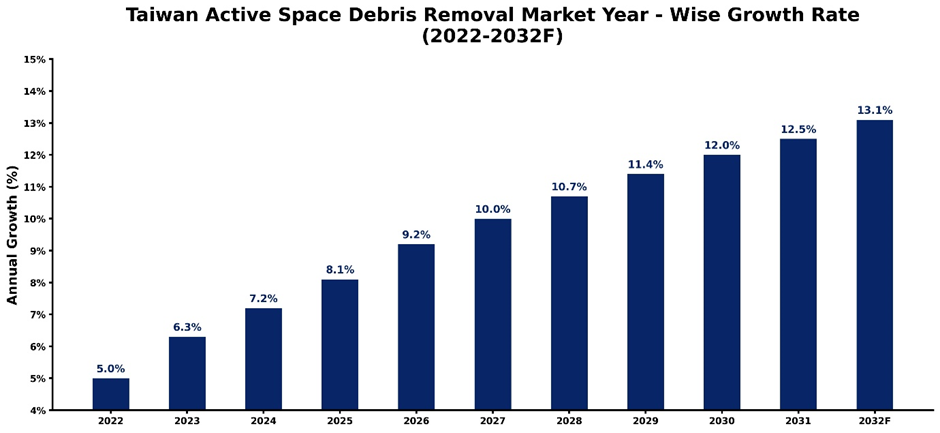
The following table presents the estimated annual growth rates of the market for each year, along with the key factors influencing market performance during the respective period. The values are intended to highlight year-wise drivers rather than provide a direct comparison between individual years.
| Year | Estimated Annual Growth (%) | Market Rationale |
| 2022 | 5% | Establishment of Taiwan Space Agency framework and greater institutional focus on space technology. |
| 2023 | 6.3% | Growth of LEO satellite activities and increasing interest in orbital tracking and servicing technologies. |
| 2024 | 7.2% | Expansion of Taiwan satellite supply chain and growing awareness of orbital debris mitigation. |
| 2025 | 8.1% | Increasing satellite manufacturing, launch-development activity, and demand for sustainable end-of-life operations. |
| 2026 | 9.2% | Commercial satellite applications and de-orbiting technologies strengthen demand for debris-removal capabilities. |
| 2027 | 10% | Increasing deployment of LEO satellites supports demand for inspection, rendezvous, and removal services. |
| 2028 | 10.7% | Growth of satellite constellations increases requirements for active debris management and orbital servicing. |
| 2029 | 11.4% | Expansion of autonomous rendezvous and proximity-operation technologies supports debris-removal missions. |
| 2030 | 12% | Greater adoption of satellite servicing and end-of-life disposal services supports market expansion. |
| 2031 | 12.5% | Commercialization of debris-removal services and stronger orbital sustainability requirements accelerate adoption. |
| 2032 | 13.1% | Mature satellite servicing ecosystem, government missions, and commercial debris-removal demand sustain market growth. |
Topics Covered in the Taiwan Active Space Debris Removal Market Report
The Taiwan Active Space Debris Removal Market report provides detailed analysis across Debris Size and End-user segments. The report provides a detailed analysis of ongoing market trends, opportunities/high-growth areas, and market drivers that will help stakeholders align strategies based on current and future market dynamics.
Taiwan Active Space Debris Removal Market Highlights
| Report Name | Taiwan Active Space Debris Removal Market |
| Forecast period | 2026-2032 |
| CAGR | 11.3% |
| Growing Sector | Space Technology & Satellite Services |
Taiwan Active Space Debris Removal Market Synopsis
Taiwan Active Space Debris Removal Market is expanding due to increasing satellite deployment, orbital sustainability requirements, and growing demand for managing inactive spacecraft and debris in Low Earth Orbit. Active debris removal solutions enable spacecraft to identify, approach, capture, relocate, and de-orbit orbital objects using autonomous navigation, rendezvous technologies, robotic capture, and electric propulsion. Taiwan developing space ecosystem, supported by government programs, satellite manufacturing, launch-vehicle development, research institutions, and private-sector participation, is creating opportunities for advanced orbital servicing technologies.
Evaluation of Drivers in Taiwan Active Space Debris Removal Market (2026–2032)
Below mentioned are some major drivers and their influence on the market dynamics:
| Drivers | Primary Segment Affected | Why It Matters (Evidence) |
| Increasing deployment of LEO satellites | Commercial | More satellites increase demand for disposal, monitoring, collision-risk management. |
| Development of Taiwan domestic space industry | Commercial, Defense | Growing space capabilities create demand for orbital servicing technologies. |
| Increasing focus on space sustainability | All segments | Taiwan promotes sustainable space development and environmental protection through legislation. |
| Growth of satellite constellations | Commercial | Larger fleets increase demand for scalable inspection and disposal services. |
| Development of autonomous rendezvous and proximity operations | Debris Removal Services | Autonomous navigation enables approaches to non-cooperative orbital objects safely. |
The Taiwan Active Space Debris Removal Market growth is projected to reach at a CAGR of 11.3% strongly during 2026–2032, satellite deployment, space sustainability requirements, government-backed space technology development, autonomous rendezvous technologies, and increasing interest in end-of-life satellite disposal are driving market development. Taiwan long-term space program has also encouraged participation from domestic companies, universities, and research institutions, strengthening the technical ecosystem required for satellite servicing and orbital sustainability.
Evaluation of Restraints in Taiwan Active Space Debris Removal Market
Below mentioned are some major restraints and their influence on market dynamics:
| Market Restraint | Primary Segment Affected | Why It Matters (Evidence) |
| High mission development and launch costs | Commercial, Defense | Specialized spacecraft require costly propulsion, navigation, capture, communications, and launch. |
| Complex rendezvous and capture operations | Debris Removal Services | Tumbling, uncooperative debris increases capture complexity and mission execution risks. |
| Limited domestic ADR flight heritage | Commercial | Taiwan space ecosystem is developing, while dedicated ADR remains emerging. |
| Regulatory and liability requirements | Commercial, Defense | Registration, launch authorization, insurance, and liability requirements increase compliance burdens. |
| Shortage of specialized space-servicing expertise | Commercial, Defense | ADR requires expertise spanning robotics, propulsion, autonomy, navigation, and orbital operations. |
Taiwan Active Space Debris Removal Market Challenges
The Taiwan Active Space Debris Removal Industry encounters various challenges that could affect its overall expansion. High spacecraft-development and launch costs, limited domestic experience with dedicated debris-removal missions, complex rendezvous and proximity operations, and the technical difficulty of capturing non-cooperative or tumbling objects remain key concerns. Moreover, debris-removal missions require highly reliable propulsion, guidance, navigation, communication, sensors, and capture mechanisms. Organizations may also need to increase investment in space-domain awareness, autonomous navigation, robotics, cybersecurity, testing infrastructure, and specialized workforce development.
Trends in the Taiwan Active Space Debris Removal Market
Below mentioned are some of the trends shaping the Taiwan Active Space Debris Removal Market Growth are:
- Trend toward Autonomous Debris Inspection and Removal: Companies and research institutions are increasingly developing autonomous rendezvous, navigation, and proximity-operation technologies that can allow servicing spacecraft to approach objects without continuous manual control.
- Growing use of De-orbit-as-a-Service: Satellite operators are increasingly exploring service-based approaches in which specialized spacecraft undertake end-of-life disposal rather than requiring every satellite to carry extensive disposal hardware.
- Increasing Integration of Satellite Servicing and Debris Removal: Active debris removal is increasingly being developed alongside inspection, life extension, relocation, refueling, and repair capabilities.
Investment Opportunities in the Taiwan Active Space Debris Removal Market
Some of the investments opportunities in the Taiwan Active Space Debris Removal Market are:
- Autonomous Debris-Removal Spacecraft: Investments in autonomous servicing spacecraft equipped with advanced navigation, computer vision, electric propulsion, and robotic capture systems can support Taiwan developing space ecosystem and create opportunities for international technology partnerships.
- Satellite Inspection and Space Situational Awareness: Development of ground and orbital systems capable of identifying, tracking, characterizing, and monitoring debris can provide an important technology layer before actual removal operations.
- De-orbiting and End-of-Life Services: Commercial opportunities may emerge around dedicated spacecraft capable of safely relocating or de-orbiting inactive satellites. TASA's launch-vehicle development already incorporates de-orbiting capability, creating an institutional technology pathway around debris mitigation.
Government Initiatives in the Taiwan Active Space Debris Removal Market
Taiwan is establishing a stronger space ecosystem through the Space Development Act, Taiwan Space Agency, national space programs, launch vehicles, satellite programs and commercial applications. The Space Development Act establishes a regulatory framework, which includes space policy, registration, launches, international cooperation and sustainable development. TASA supports technology transfer and industry collaboration and space technology research. National programs are supporting the development of satellite manufacturing and workforce, and launch vehicles are being equipped with de-orbiting capabilities.
Future Insight of the Taiwan Active Space Debris Removal Market
Taiwan ADR outlook is supported by expanding satellite capabilities and domestic supply chains. FORMOSAT-8 comprises six 1-meter-resolution satellites plus two sub-meter satellites, while FORMOSAT-8A launched in November 2025 with 84% of key components domestically developed. TASA’s planned launch vehicle targets 200-kg LEO payloads and incorporates de-orbiting capability. Taiwan semiconductor strength, including TSMC’s 69.9% global foundry share in 2025, can support advanced ADR electronics and autonomy.
Market Segmentation Analysis
The report offers a focused study of the following market segments and their leading categories in the market:
By Debris Size – Market Dominated by More than 10 cm Debris, Expected to Maintain Leadership Through 2032
According to Shubham Padhi, Research Analyst at 6Wresearch, till 2025, debris larger than 10 cm dominated the Taiwan Active Space Debris Removal Market with an estimated 58% market share, supported by the higher collision risk and stronger priority assigned to large objects capable of causing significant damage to operational satellites. From 2026 to 2032, the more than 10 cm segment is projected to grow at a CAGR of 9.6%, driven by increasing demand for targeted removal of high-risk objects and growing emphasis on sustainable LEO operations.
By End User – Market Dominated by Defense, Expected to Maintain Leadership Through 2032
The Taiwan Active Space Debris Removal Market was dominated by the defense segment in 2025 and accounted for 61% of the market share. The strategic importance of protecting national-security satellite assets and enhancing resilience against orbital hazards was the key driver for the segment. From 2026 to 2032, the Defense segment is projected to grow at a CAGR of 10.2%, supported by rising investment in space-domain awareness and government-led development of indigenous space capabilities.
Note: Market size estimations and growth projections presented in this report are based on 6Wresearch's proprietary forecasting methodology, utilizing the latest available industry data, government publications, and primary research inputs.
Key Attractiveness of the Report
- 10 Years of Market Numbers
- Historical Data Starting from 2022 to 2025
- Base Year: 2025
- Forecast Data until 2032
- Key Performance Indicators Impacting the Market
- Major Upcoming Developments and Projects
Key Highlights of the Report:
- Taiwan Active Space Debris Removal Market Outlook
- Market Size of Taiwan Active Space Debris Removal Market, 2025
- Forecast of Taiwan Active Space Debris Removal Market, 2032
- Historical Data and Forecast of Taiwan Active Space Debris Removal Revenues & Volume for the Period 2022-2032
- Taiwan Active Space Debris Removal Market Trend Evolution
- Taiwan Active Space Debris Removal Market Drivers and Challenges
- Taiwan Active Space Debris Removal Price Trends
- Taiwan Active Space Debris Removal Porter`s Five Forces
- Taiwan Active Space Debris Removal Industry Life Cycle
- Historical Data and Forecast of Taiwan Active Space Debris Removal Market Revenues & Volume By Debris Size for the Period 2022-2032
- Historical Data and Forecast of Taiwan Active Space Debris Removal Market Revenues & Volume By Between 1 mm and 1 cm for the Period 2022-2032
- Historical Data and Forecast of Taiwan Active Space Debris Removal Market Revenues & Volume By Between 1 cm to 10 cm for the Period 2022-2032
- Historical Data and Forecast of Taiwan Active Space Debris Removal Market Revenues & Volume By More than 10 cm for the Period 2022-2032
- Historical Data and Forecast of Taiwan Active Space Debris Removal Market Revenues & Volume By End-users for the Period 2022-2032
- Historical Data and Forecast of Taiwan Active Space Debris Removal Market Revenues & Volume By Commercial for the Period 2022-2032
- Historical Data and Forecast of Taiwan Active Space Debris Removal Market Revenues & Volume By Defense for the Period 2022-2032
- Taiwan Active Space Debris Removal Import Export Trade Statistics
- Market Opportunity Assessment By Debris Size
- Market Opportunity Assessment By End-users
- Taiwan Active Space Debris Removal Top Companies Market Share
- Taiwan Active Space Debris Removal Competitive Benchmarking By Technical and Operational Parameters
- Taiwan Active Space Debris Removal Company Profiles
- Taiwan Active Space Debris Removal Key Strategic Recommendations
Market Covered
The report offers an extensive study of the following market segments:
By Debris Size
- Between 1 mm and 1 cm
- Between 1 cm to 10 cm
- More than 10 cm
By End-users
- Commercial
- Defense






































