Taiwan Electric 3-Wheeler Market Growth Rate
According to 6Wresearch internal database and industry insights, the Taiwan Electric 3-Wheeler Market is projected to grow at a compound annual growth rate (CAGR) of 12.5% during the forecast period (2026–2032).
Taiwan Electric 3-Wheeler Market Year-wise Growth Rate and Key Drivers
This graph highlights how the Taiwan Electric 3-Wheeler Market has steadily grown over the past five years, supported by major growth factors.
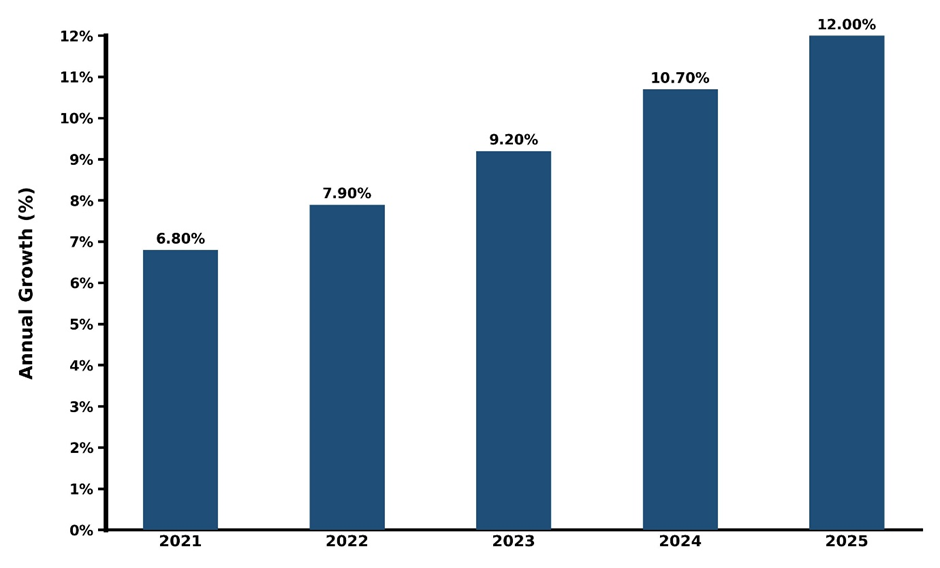
Below is an evaluation of year-wise growth rate along with growth drivers:
| Year | Est. Annual Growth (%) | Growth Drivers |
| 2021 | 6.8% | Early adoption by delivery services seeking cost-efficient and eco-friendly vehicles. |
| 2022 | 7.9% | Government incentives for EV adoption and expansion of charging infrastructure. |
| 2023 | 9.2% | Surge in fuel prices push migration from gasoline to electric 3-wheelers for SMEs and individual riders. |
| 2024 | 10.7% | Consumer confidence increased by better battery technology and longer driving ranges. |
| 2025 | 12% | Collaboration between EV manufacturers and logistics companies boosts commercial fleet adoption. |
Topics Covered in the Taiwan Electric 3-Wheeler Market Report
The Taiwan Electric 3-Wheeler Industry report includes the market segmented b end-use, motor power, battery capacity, range, battery type, payload capacity. The report provides an unbiased and critical analysis of ongoing market trends, opportunities, and challenges, helping stakeholders plan and implement strategies according to current and future market dynamics.
Taiwan Electric 3-Wheeler Industry Highlights
| Report Name | Taiwan Electric 3-Wheeler Market |
| Forecast period | 2026-2032 |
| CAGR | 12.5% |
| Growing Sector | Commercial Fleet & Last-Mile Delivery Electric 3-Wheelers |
Taiwan Electric 3-Wheeler Industry Synopsis
The Taiwan Electric 3-Wheeler Market is an emerging segment in the EV industry as it offers compact and urban-friendly electric vehicles. The vital users include small businesses, logistics and delivery services, and individual urban commuters. Government subsidies, upgraded battery technology, and extending charging stations encourage transformation. The Taiwan Electric 3-Wheeler Market growth is driven by stricter environmental regulations, surging fuel prices, and need for cost-effective last-mile delivery solutions making electric 3-wheelers an effective solution for commercial and personal urban transport in Taiwan.
Evaluation of Growth Drivers in the Taiwan Electric 3-Wheeler Market (2026–2032)
Below are some major drivers and their influence on the market dynamics:
| Drivers | Primary Segment Affected | Growth Drivers |
| Government Incentives | SMEs & Individual Consumers | Tax reductions, purchase subsidies, and EV-friendly policies inspire to shift to electric 3-wheelers. |
| Rising Fuel Prices | Delivery Services & SMEs | Surging gasoline prices push fleet operators and SMEs to electric alternatives. |
| Upgraded Battery Technology | Individual Consumers & Commercial Fleets | Long driving ranges and fast charging improve vehicle usability and reduce range fear. |
| Environmental Regulations | Logistics Companies & Public Transport | Policies restrict emissions and elevate fleet operators to exchange to electric 3-wheelers. |
| Fleet Modernization & Operational Efficiency | Delivery & Logistics Companies | EV 3-wheelers reduce operational costs by lowering fuel and maintenance costs, thus improves profitability. |
The Taiwan Electric 3-Wheeler Market Share is expected to proliferate at a robust rate, exhibiting a CAGR of 12.5% during the forecast period (2026–2032). Progress is carried by migration of businesses and individuals from conventional gasoline-powered 3-wheelers to electric alternatives. This trend is backed by manufacturers and logistics operators who are investing in advanced battery technologies, charging infrastructure, and vehicle management solutions. Thus, this all leads to sharply increase the acceptance and revenue generation in the Taiwan’s electric 3-wheeler market.
Evaluation of Restraints in the Taiwan Electric 3-Wheeler Market
Below are some major restraints and their influence on the market dynamics:
| Restraints | Primary Segment Affected | Evidence |
| Escalated Initial Cost | Individual consumers and small businesses (e.g., delivery services) | Price sensitivity remains a major hurdle for expansion among private buyers especially for small delivery operators. |
| Limited Charging Infrastructure | Commercial fleet operators and daily commuters | Fleet operators report route planning difficulties due to insufficient charging points as Government initiatives are slow and coverage remains limited, thus slowing adoption. |
| Battery Life & Replacement Costs | Logistics and delivery companies relying on frequent daily use | Replacement costs almost one third of original price urging companies to look for battery concerns as a key factor in fleet upgrade decisions. |
| Rules & Safety Standards | Startups and smaller EV manufacturers | Regulation obstructs migration and delays transformation discouraging new entrants especially for small manufacturers. |
| Consumer Awareness & Trust | Individual urban riders | Lack of firsthand experience discourages adaption. Marketing and education efforts helped but awareness still remains shallow. |
Taiwan Electric 3-Wheeler Market Challenges
In spite of various growth factors, The Taiwan Electric 3-Wheeler Market faces several challenges such as rigorous data sovereignty and privacy regulations which needs nearby data centres, high connectivity costs pressurise SMEs thus limiting adaptation to advance cloud solutions, shortage of skilled professionals including certified engineers and DevOps experts which disrupts the management and latency-sensitive applications suffer from insufficient edge infrastructure. By tackling to all these problems, Taiwan Electric 3-Wheeler Market revenue will increase.
Taiwan Electric 3-Wheeler Market Trends
The following are key trends that influence for the Taiwan Electric 3-Wheeler Market:
- AI-Enabled Cloud Services: Requirements for platforms that offer real-time data interpretation and upgraded automation are increasing due to integration of AI.
- Hybrid and Multi-Cloud Installations: Businesses are accelerating the use of hybrid and multi-cloud environments to maintain cost and security.
- Expansion of Edge Computing: Installation of edge infrastructure is increasing due to low-latency tools in manufacturing, healthcare and logistics.
- Cybersecurity & Compliance Core: Secure, compliant cloud solutions are prioritized by enterprises due to stern data privacy regulation.
Investment Opportunities in Taiwan Electric 3-Wheeler Market
Certain possible investment opportunities available in the Taiwan Electric 3-Wheeler Market are listed below:
- AI inclusion in Cloud Solutions: Growing sectors will be exposed by AI-integrated platforms for data interpretation and taking decisions
- Cloud Security & Compliance Solutions: Equipping with specialized cybersecurity and compliance solutions have enormous potential for generating revenue.
- Multi-Cloud Inclusion in Services: Seamless transition and interoperability between clouds provided by companies to meet demand of enterprises.
- Deployment of Edge Infrastructure: The market coverage and lag-sensitive applications will expand after funding local edge computing centres.
Top 5 Leading Players in Taiwan Electric 3-Wheeler Industry
Below is a list of prominent companies dominating the Taiwan Electric 3-Wheeler Market:
1. ADATA Technology
| Company Name | ADATA Technology |
|---|---|
| Established Year | 2001 |
| Headquarters | Taipei, Taiwan |
| Official Website | Click Here |
A major Taiwanese innovator known for commercial electric tricycles (e.g., USD-01) designed for heavy-duty logistics. Their vehicles feature cloud-connected fleet management for enhanced operational efficiency.
2. Terra Motors
| Company Name | Terra Motors |
|---|---|
| Established Year | 2010 |
| Headquarters | Tokyo, Japan |
| Official Website | Click Here |
A prominent Japanese manufacturer with strong traction across the Asia-Pacific region. Offers passenger and cargo 3-wheelers, emphasizing electric mobility solutions.
3. Gogoro
| Company Name | Gogoro |
|---|---|
| Established Year | 2011 |
| Headquarters | Taipei, Taiwan |
| Official Website | Click Here |
Traditionally a two-wheeler giant, Gogoro’s advanced battery-swapping network powers commercial electric mobility solutions and three-wheeler fleet trials in Taiwan and the region.
4. Kymco (Kwang Yang Motor Co.)
| Company Name | Kymco (Kwang Yang Motor Co.) |
|---|---|
| Established Year | 1963 |
| Headquarters | Kaohsiung, Taiwan |
| Official Website | Click Here |
A leading Taiwanese mobility manufacturer integrating electric powertrains into utility and commercial last-mile delivery vehicles, focusing on durability and efficiency.
5. China Motor Corporation (CMC)
| Company Name | China Motor Corporation (CMC) |
|---|---|
| Established Year | 1969 |
| Headquarters | Taipei, Taiwan |
| Official Website | Click Here |
A major Taiwanese automaker manufacturing and distributing commercial electric vehicles, expanding its footprint in green logistics and sustainable transport solutions.
Government Initiatives Supporting Taiwan Electric 3-Wheeler Market
According to Taiwanese Government data, several initiatives have been taken to encourage the adoption of electric 3-wheelers. The Ministry of Economic Affairs (MOEA) subsidies commercial and private buyers which drops the initial cost. Also, the Ministry of Finance gives tax incentives and minimized the registration for commercial fleets and logistics operators. Thus, helps to increase the Taiwan Electric 3-Wheeler Market Revenue. The Bureau of Energy backs the growth of EV charging infrastructure in urban and suburban areas.
Future Insights of the Taiwan Electric 3-Wheeler Market
The Taiwan Electric 3-Wheeler Market is composed for drastic growth, as demand for sustainable urban mobility and last-mile delivery solutions increases. Technological upgradation in battery efficiency, charging infrastructure, and fleet management systems will amplify vehicle performance and operational reliability. Factors such as government incentives, strict environmental regulations, and corporate endorsement of green logistics will further enhance Taiwan Electric 3-Wheeler Market Size. Inclusion of above-mentioned factors IoT and cloud-based fleet will be perfect for route planning and energy use.
Market Segmentation Analysis
This report offers a comprehensive study of the following market segments and their leading categories:
By End-Use
According to Surbhi, Senior Research Analyst, 6Wresearch, By End-Use, the market was dominated by 62% market share in 2025 by the Load Carriers and in 2026-2032, it continued to grow with a CAGR of 12.8% due to urban e-mobility adoption.
By Motor Power
By Motor Power, 1,000-1,500 W led with 55% of the market share in 2025 and due to its adoption in urban delivery and commercial applications, it will continue to dominate the market in 2026-2032 with a CAGR of 12.5%.
By Range
By Range, up to 50 Miles was acquiring the 65% of market share in 2025 while during the forecast period of 2026-2032, the Above 50 Miles is expected to grow with 12.4% CAGR and as densely populated cities demand rise.
Note: Market size estimations and growth projections presented in this report are based on 6Wresearch’s advanced forecasting approach, validated with industry datasets as of June 2026.
Key Attractiveness of the Report:
- 10 Years of Market Numbers
- Historical Data Starting from 2022-2025
- Base Year: 2025
- Forecast Data until 2032
- Key Performance Indicators Impacting the Market
- Major Upcoming Developments and Projects
Key Highlights of the Report:
- Taiwan Electric 3-Wheeler Market Outlook
- Market Size of Taiwan Electric 3-Wheeler Market, 2025
- Forecast of Taiwan Electric 3-Wheeler Market, 2032
- Historical Data and Forecast of Taiwan Electric 3-Wheeler Revenues & Volume for the Period 2022-2032
- Taiwan Electric 3-Wheeler Market Trend Evolution
- Taiwan Electric 3-Wheeler Market Drivers and Challenges
- Taiwan Electric 3-Wheeler Price Trends
- Taiwan Electric 3-Wheeler Porter`s Five Forces
- Taiwan Electric 3-Wheeler Industry Life Cycle
- Historical Data and Forecast of Taiwan Electric 3-Wheeler Market Revenues & Volume By End-Use for the Period 2022-2032
- Historical Data and Forecast of Taiwan Electric 3-Wheeler Market Revenues & Volume By Passenger Carrier for the Period 2022-2032
- Historical Data and Forecast of Taiwan Electric 3-Wheeler Market Revenues & Volume By Load Carrier for the Period 2022-2032
- Historical Data and Forecast of Taiwan Electric 3-Wheeler Market Revenues & Volume By Motor Power for the Period 2022-2032
- Historical Data and Forecast of Taiwan Electric 3-Wheeler Market Revenues & Volume By Below 1,000 W for the Period 2022-2032
- Historical Data and Forecast of Taiwan Electric 3-Wheeler Market Revenues & Volume By 1,000-1,500 W for the Period 2022-2032
- Historical Data and Forecast of Taiwan Electric 3-Wheeler Market Revenues & Volume By Above 1,500 W for the Period 2022-2032
- Historical Data and Forecast of Taiwan Electric 3-Wheeler Market Revenues & Volume By Battery Capacity for the Period 2022-2032
- Historical Data and Forecast of Taiwan Electric 3-Wheeler Market Revenues & Volume By Below 3 kWh for the Period 2022-2032
- Historical Data and Forecast of Taiwan Electric 3-Wheeler Market Revenues & Volume By 3-6 kWh for the Period 2022-2032
- Historical Data and Forecast of Taiwan Electric 3-Wheeler Market Revenues & Volume By Above 6 kWh for the Period 2022-2032
- Historical Data and Forecast of Taiwan Electric 3-Wheeler Market Revenues & Volume By Range for the Period 2022-2032
- Historical Data and Forecast of Taiwan Electric 3-Wheeler Market Revenues & Volume By Up to 50 Miles for the Period 2022-2032
- Historical Data and Forecast of Taiwan Electric 3-Wheeler Market Revenues & Volume By Above 50 Miles for the Period 2022-2032
- Historical Data and Forecast of Taiwan Electric 3-Wheeler Market Revenues & Volume By Battery Type for the Period 2022-2032
- Historical Data and Forecast of Taiwan Electric 3-Wheeler Market Revenues & Volume By Lead-acid Battery for the Period 2022-2032
- Historical Data and Forecast of Taiwan Electric 3-Wheeler Market Revenues & Volume By Lithium-ion Battery for the Period 2022-2032
- Historical Data and Forecast of Taiwan Electric 3-Wheeler Market Revenues & Volume By Other for the Period 2022-2032
- Historical Data and Forecast of Taiwan Electric 3-Wheeler Market Revenues & Volume By Payload Capacity for the Period 2022-2032
- Historical Data and Forecast of Taiwan Electric 3-Wheeler Market Revenues & Volume By Up to 300 kg for the Period 2022-2032
- Historical Data and Forecast of Taiwan Electric 3-Wheeler Market Revenues & Volume By 300-500 kg for the Period 2022-2032
- Historical Data and Forecast of Taiwan Electric 3-Wheeler Market Revenues & Volume By Above 500 kg for the Period 2022-2032
- Taiwan Electric 3-Wheeler Import Export Trade Statistics
- Market Opportunity Assessment By End-Use
- Market Opportunity Assessment By Motor Power
- Market Opportunity Assessment By Battery Capacity
- Market Opportunity Assessment By Range
- Market Opportunity Assessment By Battery Type
- Market Opportunity Assessment By Payload Capacity
- Taiwan Electric 3-Wheeler Top Companies Market Share
- Taiwan Electric 3-Wheeler Competitive Benchmarking By Technical and Operational Parameters
- Taiwan Electric 3-Wheeler Company Profiles
- Taiwan Electric 3-Wheeler Key Strategic Recommendations
Market Covered
The report offers an extensive study of the following market segments:
By End-Use
- Passenger Carrier
- Load Carrier
By Motor Power
- Below 1,000 W
- 1,000–1,500 W
- Above 1,500 W
By Battery Capacity
- Below 3 kWh
- 3–6 kWh
- Above 6 kWh
By Range
- Up to 50 Miles
- Above 50 Miles
- By Battery Type
- Lead-acid Battery
- Lithium-ion Battery
- Other
By Payload Capacity
- Up to 300 kg
- 300–500 kg
- Above 500 kg






































