Taiwan Meat Market Growth Rate
According to 6Wresearch internal databases and industry insights, the Taiwan Meat Market is projected to grow at a steady compound annual growth rate (CAGR) of 3.2% during the forecast period 2026–2032.
Taiwan Meat Market Year-wise Growth Rate and Key Drivers
This graph illustrates the annual growth rates of the Taiwan Meat Market from 2021 to 2032, highlighting a steady upward trajectory and projected market expansion over the forecast period.
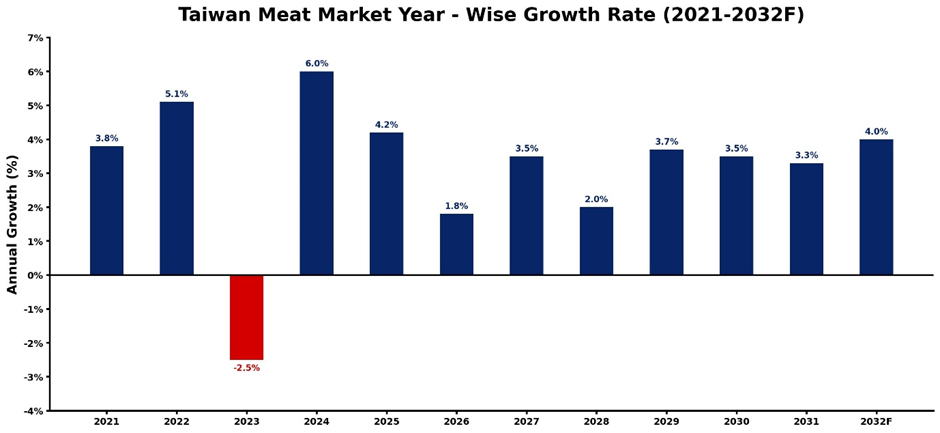
The following table summarizes the historical and forecasted growth rates of the Meat Market, along with the rationale behind each year’s performance.
| Year | Estimated Growth (%) | Rationale |
| 2021 | 3.8% | Recovery from COVID-19 disruptions; meat consumption rebounds in restaurants and households. |
| 2022 | 5.1% | Increased domestic demand and rising pork prices; government supports local producers. |
| 2023 | -2.5% | ASF (African Swine Fever) concerns and supply chain disruptions reduced pork availability. |
| 2024 | 6% | Expansion of meat processing facilities and export opportunities; consumer confidence enhanced. |
| 2025 | 4.2% | Upgraded cold-chain logistics assisting the growth still urban demand remains stagnant. |
| 2026 | 1.8% | Mature markets in urban areas due to surging costs and less consumption. |
| 2027 | 3.5% | Policies encouraging safe and traceable meat lead to increase in alternative protein requirement. |
| 2028 | 2% | Growth is restricted due to cost volatility and fluctuations in feed prices. |
| 2029 | 3.7% | Average growth in rural markets and protein-rich diets' need will increase due to aging population. |
| 2030 | 3.5% | Slight growth as meat alternatives stabilize; premium meat segments expand. |
| 2031 | 3.3% | Demand is driven by adaption of processed and ready-to-cook meat products. |
| 2032 | 4% | Stable growth driven by population trends, improved food safety, and innovative meat products. |
Topics Covered in the Taiwan Meat Market Report
The Taiwan Meat Industry report covers the market by end users and distribution channel. The report provides a detailed analysis of ongoing market trends, high-growth opportunities, and key market drivers that will help stakeholders align strategies based on current and future market dynamics.
Taiwan Meat Market Highlights
| Report Name | Taiwan Meat Market |
| Forecast period | 2026-2032 |
| CAGR | 3.2% |
| Growing Sector | Food Processing |
Taiwan Meat Market Synopsis
The Taiwan Meat Industry is poised for steady growth during the forecast period and the growth is backed by increasing domestic demand, growth in premium and processed meat segments, and rising adoption of ready-to-cook products. The rising need protein-rich diets, rising awareness of food safety, and expansion of cold-chain logistics are vital factors. Furthermore, changing consumer preferences, technological advancements, and
government initiatives that support cold-chain infrastructure will boost the market expansion.
Evaluation of Growth Drivers in Taiwan Meat Market (2026–2032)
Below are some major drivers and their influence on the market dynamics:
| Drivers | Primary Segment Affected | Why It Matters (Evidence) |
| Rising Protein Demand | Pork, Beef, Poultry | Increasing consumer awareness of high-protein diets drives meat consumption, especially among aging and health-conscious populations. |
| Expansion of Premium & Processed Meat | Retail & Foodservice | Adoption of ready-to-cook and packaged meat products increases convenience and boosts market value. |
| Cold-Chain Logistics Improvements | Meat Distributors & Retailers | Market reach can be widened by less spoilage and increase shelf-life, better storage and transport facilities. |
| Government Support & Food Safety Regulations | Producers & Consumers | Export possibilities enhanced due to seamless supply that led to increased consumer confidence. |
| Urbanization & Convenience-Oriented Lifestyle | Urban Consumers & Supermarkets | Changing eating habits and fast-paced lifestyles lead to increased consumption of processed and packaged meat. |
The Taiwan Meat Market Share is anticipated to rise with a CAGR of 3.2% during 2026–2032. The shift from traditional fresh meat markets to packaged, processed, and ready-to-cook products is increasing due to urban and health-conscious consumer segments, rising need for high-quality protein, technological upgradations in meat processing, and widespread cold-chain infrastructure. Furthermore, government initiatives and rigorous food safety regulations are creating new paths for market extension, this will also assist producers and distributors to penetrate the market.
Evaluation of Restraints in Taiwan Meat Market
Below are some major restraints and their influence on the market dynamics:
| Restraints | Primary Segment Affected | What This Means (Evidence) |
| Price Volatility of Raw Materials | Producers & Retailers | Rising feed and input costs may reduce profit margins and limit price competitiveness. |
| Supply Chain Disruptions | Distributors & Retailers | Product shortages and spoilage can happen due to delay in logistics and transport. |
| Market Maturity in Urban Areas | Urban Retail & Foodservice | Mature urban markets can restrict the incremental growth possibilities. |
| Health & Dietary Concerns | Consumers | Stagnant growth in few segments due to dilemma in processed and red meat consumption. |
| Economic Fluctuations | Consumers & Producers | Inflation, unstable currency, or reduced disposable income can lower consumption and affect prices. |
Taiwan Meat Market Challenges
The market tackles with several challenges such as fluctuations in raw material price, supply chain disruptions, and saturation in urban areas, which can restrict growth opportunities. Also, health and dietary concerns pushed for alternative proteins options, at the same time, economic volatility may affect consumer spending and production costs. Thus, to maintain the Taiwan Meat Market growth, stakeholders must invest on upgradations and invention in meat processing and effective cold-chain logistics.
Taiwan Meat Market Trends
Major trends responsible for Taiwan Meat Market growth include:
- Premium & Processed Meat Segments : Rising consumer demand for quality, ready-to-cook, and convenience-focused meat products lead to extension of frozen products.
- Cold-Chain Logistics Expansion : Upgraded refrigeration and better transport systems enabled less spoilage and wider distribution to distant markets including rural area.
- Health & Protein-Focus Diets : Lean meats such as chicken and premium pork are in more demand due to increasing consumer awareness in high-protein diets.
- Government & Regulatory Support : Consumer trust can be built by rigorous monitoring of meat quality, hygiene standards, and traceability systems.
Investment Opportunities in Taiwan Meat Market
Below are the investment opportunities available in the Taiwan Meat Market:
- Premium & Ready-to-Cook Meat Products: Urban consumer needs can be met by creating processed and convenient meat options and providing opportunities to value-added packaging.
- Cold-Chain Infrastructure: Cold-chain opportunities can be increased by investment in storage and logistics, thus reducing loss and, opening new markets.
- Sustainable & Organic Meat Production: To attract the premium market, organic and locally sourced meat must be targeted as awareness of sustainability diets are increasing.
- Retail & E-Commerce Expansion: Increase in online grocery shopping, home delivery services and collaborations with supermarkets and delivery services to boost market expansion.
Top 5 Leading Players in Taiwan Meat Industry
Below are some of the leading companies in the Taiwan Meat Market:
1. Dachan Greatwall Group
| Company Name | Dachan Greatwall Group |
|---|---|
| Established Year | 1954 |
| Headquarters | Taiwan |
| Official Website | Click Here |
Dachan Greatwall Group is Taiwan's largest agricultural, livestock, food conglomerate, and has a comprehensive supply chain.
2. Taiwan Farms Industry Co., Ltd.
| Company Name | Taiwan Farms Industry Co., Ltd. |
|---|---|
| Established Year | 1947 |
| Headquarters | Taiwan |
| Official Website | Click Here |
TAFCO is a leading domestic company specializing in pork and processed meats, including bacon, sausages, and hams.
3. Puhui Foods Enterprise Co., Ltd.
| Company Name | Puhui Foods Enterprise Co., Ltd. |
|---|---|
| Established Year | 1985 |
| Headquarters | Taiwan |
| Official Website | Click Here |
PUHUI Foods is a major meat importer and distributor serving restaurant chains, wholesalers, and food processing plants.
4. Thomas Meat
| Company Name | Thomas Meat |
|---|---|
| Established Year | 1990 |
| Headquarters | Taiwan |
| Official Website | Click Here |
Thomas Meat is a premium meat distributor with modern processing facilities. They handle hundreds of imported and domestic meat varieties.
5. Mayfull Fine Foods
| Company Name | Mayfull Fine Foods |
|---|---|
| Established Year | 1989 |
| Headquarters | Taiwan |
| Official Website | Click Here |
Mayfull Fine Foods is a major supplier of top-grade beef and specialty meats, known for both wholesale and premium retail operations.
Government Initiatives being implemented in the Taiwan Meat Market
According to The Taiwanese government data, the meat industry is backed through funding in sustainable livestock practices and policies that encourages food safety, traceability, and domestic production. Initiatives such as the “Certified Traceable Meat Program”, which checks origin tracking from farm to table, and subsidies for modernizing slaughterhouses and cold-chain logistics. By these measures, the Taiwan Meat Market size will increase with better product quality, enhanced consumer confidence, and increased export competitiveness.
Future Insights of the Taiwan Meat Market
The market is set to grow steadily due to rising consumer need for high-quality, protein-rich diets and convenience-focused products. Widespread cold-chain logistics, modern processing facilities, and high-quality and ready-to-cook meat segments will boost the Taiwan Meat market revenue. Sustainable and traceable meat production which is backed by government initiatives will build better consumer confidence. Urbanization, changing lifestyles, and increasing health awareness will shape consumption patterns, while investment in e-commerce and retail channels will expand market reach.
Market Segmentation Analysis
The report offers a comprehensive study of the following market segments and their leading categories
By End Users - Market Dominated by Food Service Providers, Household/Retail Set for Rapid Expansion
According to Surbhi, Senior Research Analyst, 6Wresearch, By End Users, in 2025, the Food Service Providers segment was dominating the market by holding 42% of the market share due to high demand from restaurants, hotels, and catering chains. The Household/Retail segment will lead the market with a CAGR of 3.5%, during 2026-2032, driven by growing urbanization and increasing preference for ready-to-cook meat products.
By Distribution Channel - Market Dominated by Hypermarkets/Supermarkets, Online Retailing Set for Rapid Expansion
By Distribution Channel, in 2025, the Hypermarkets/Supermarkets channel dominated the Taiwan meat market by capturing 38% of the market share, driven by wide product variety. Online Retailing will lead the market with a CAGR of 4%, due to digital adoption and home delivery services during the forecast period 2026-2032.
Note:Market size estimations and growth projections presented in this report are based on 6Wresearch’s advanced forecasting approach, validated with industry datasets as of June 2026.
Key Attractiveness of the Report:
- 10 Years of Market Numbers
- Historical Data Starting from 2022 to 2025
- Base Year: 2025
- Forecast Data until 2032
- Key Performance Indicators Impacting the Market
- Major Upcoming Developments and Projects
Key Highlights of the Report:
- Taiwan Meat Market Outlook
- Market Size of Taiwan Meat Market, 2025
- Forecast of Taiwan Meat Market, 2032
- Historical Data and Forecast of Taiwan Meat Revenues & Volume for the Period 2022-2032
- Taiwan Meat Market Trend Evolution
- Taiwan Meat Market Drivers and Challenges
- Taiwan Meat Price Trends
- Taiwan Meat Porter`s Five Forces
- Taiwan Meat Industry Life Cycle
- Historical Data and Forecast of Taiwan Meat Market Revenues & Volume By End Users for the Period 2022-2032
- Historical Data and Forecast of Taiwan Meat Market Revenues & Volume By Food Processing Industry for the Period 2022-2032
- Historical Data and Forecast of Taiwan Meat Market Revenues & Volume By Food Service Providers for the Period 2022-2032
- Historical Data and Forecast of Taiwan Meat Market Revenues & Volume By Household/ Retail for the Period 2022-2032
- Historical Data and Forecast of Taiwan Meat Market Revenues & Volume By Distribution Channel for the Period 2022-2032
- Historical Data and Forecast of Taiwan Meat Market Revenues & Volume By B2B Direct for the Period 2022-2032
- Historical Data and Forecast of Taiwan Meat Market Revenues & Volume By Hypermarkets/ Supermarkets for the Period 2022-2032
- Historical Data and Forecast of Taiwan Meat Market Revenues & Volume By Convenience Stores for the Period 2022-2032
- Historical Data and Forecast of Taiwan Meat Market Revenues & Volume By Specialty Stores for the Period 2022-2032
- Historical Data and Forecast of Taiwan Meat Market Revenues & Volume By Butcher Shop/ Wets for the Period 2022-2032
- Historical Data and Forecast of Taiwan Meat Market Revenues & Volume By Online Retailing for the Period 2022-2032
- Taiwan Meat Import Export Trade Statistics
- Market Opportunity Assessment By End Users
- Market Opportunity Assessment By Distribution Channel
- Taiwan Meat Top Companies Market Share
- Taiwan Meat Competitive Benchmarking By Technical and Operational Parameters
- Taiwan Meat Company Profiles
- Taiwan Meat Key Strategic Recommendations
Market Covered
The report offers an extensive study of the following market segments:
By End Users
- Food Processing Industry
- Food Service Providers
- Household/Retail
By Distribution Channel
- B2B Direct
- Hypermarkets/Supermarkets
- Convenience Stores
- Specialty Stores
- Butcher Shop/Wets
- Online Retailing






































