Tajikistan 5G Core Market Size, Share & Growth Rate
The Tajikistan 5G Core Market was estimated at USD 355 Million in 2025 and is projected to reach USD 470 Million by 2032, growing at a CAGR of 4.1% from 2026 to 2032. This growth is significantly driven by the increasing demand for high-speed, low-latency connectivity, essential for the evolving digital landscape of the region. Furthermore, telecom operators are heavily investing in upgrading their infrastructure, laying the groundwork for a robust 5G ecosystem that will foster economic advancements across various sectors.
Tajikistan 5G Core Market Year-wise Growth Rate and Key Drivers
This graph highlights how the Tajikistan 5G Core Market has steadily grown over the years, supported by major growth factors.
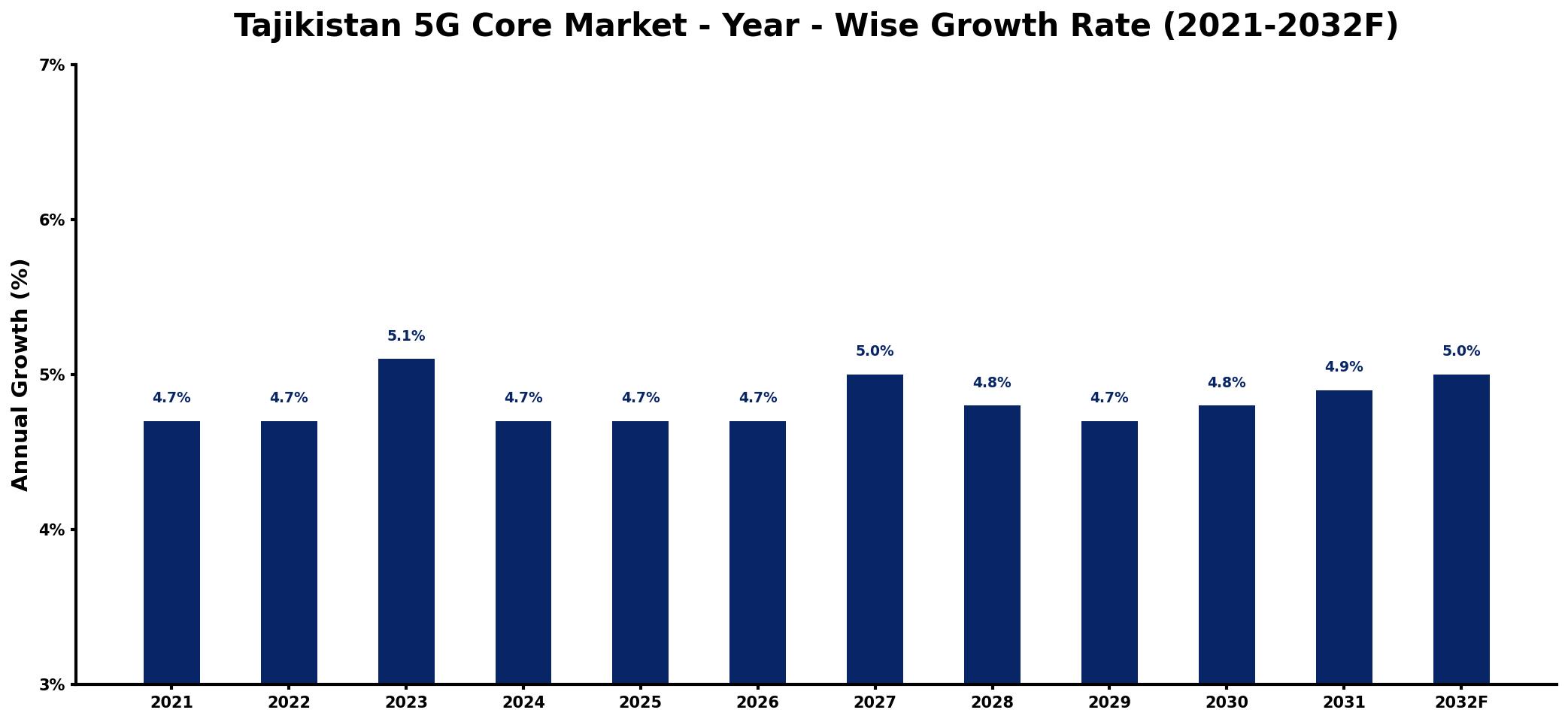
The table below presents the year‑wise growth rates along with the key drivers influencing the market
| Year | Growth Rate | Major Drivers |
| 2021 | 4.7% | Increased investments in telecommunications infrastructure |
| 2022 | 4.7% | Growing demand for high-speed internet |
| 2023 | 5.1% | rising end-use demand growth |
| 2024 | 4.7% | enhanced product quality standards |
| 2025 | 4.7% | Enhanced network capabilities for businesses |
| 2026 | 4.7% | Improved mobile app development opportunities |
| 2027 | 5.0% | Expansion of digital payment systems |
| 2028 | 4.8% | Increased government support for technology |
| 2029 | 4.7% | Growth in remote work solutions |
| 2030 | 4.8% | Surge in e-commerce platform usage |
| 2031 | 4.9% | Development of smart city projects |
| 2032 | 5.0% | Increased focus on cybersecurity measures |
Note: Market size estimations and growth projections presented in this report are based on 6Wresearch's proprietary forecasting methodology, utilizing the latest available industry data, government publications, and primary research inputs.
Tajikistan 5G Core Market Synopsis
The primary force shaping the Tajikistan 5G Core Market is the urgent demand for enhanced connectivity solutions. Telecom operators are recognizing that the shift towards 5G is not merely an upgrade; it is a transformational opportunity that will impact industries such as healthcare, manufacturing, and transportation, fundamentally changing how businesses operate.
As the country embarks on a digital transformation journey, the rollout of 5G technology becomes increasingly critical. This shift promises not only improved connectivity but also the potential for innovative applications driven by emerging technologies, which will accelerate the pace of economic growth and societal benefits in Tajikistan.
Tajikistan 5G Core Market Key Takeaways
- The market is currently valued at USD 355 Million and projected to grow to USD 470 Million by 2032.
- Investment in infrastructure upgrades by telecom operators is central to market growth.
- Advanced technologies like IoT, AI, and edge computing are pushing the demand for 5G core services.
- Security and network slicing capabilities are crucial areas of focus for service providers.
- The government is actively promoting policies to support the development and deployment of 5G technology.
Evaluation of Restraints in Tajikistan 5G Core Market
Despite its potential, the Tajikistan 5G Core market faces significant restraints. One major limitation is the country's rugged mountainous terrain, which presents logistical challenges for establishing a seamless 5G infrastructure. This geographical barrier risks creating coverage gaps, particularly in remote areas. Additionally, the high costs associated with the initial rollout of 5G technology, including the necessary upgrades to hardware and software, can deter investment from telecom operators. The regulatory environment also plays a role, with complex frameworks complicating spectrum allocation and network deployment. Overcoming these challenges will be essential for harnessing the full potential of 5G in Tajikistan.
Tajikistan 5G Core Market Trends
Several key trends are shaping the Tajikistan 5G Core Market. A significant focus is on the development and deployment of virtualized and cloud-native 5G core networks that promise enhanced data speeds and reduced latency. Telecom service providers are prioritizing infrastructure improvements to facilitate the integration of emerging technologies such as the Internet of Things (IoT) and artificial intelligence (AI). Additionally, there is a growing emphasis on security features and network slicing capabilities, which are necessary for providing tailored connectivity solutions across diverse applications and industries. This focus on innovation is pivotal for driving market evolution.
Tajikistan 5G Core Market Opportunities
The landscape for investment opportunities within the Tajikistan 5G Core Market is promising. Companies that are keen on entering this space should consider providing advanced networking solutions, including equipment and software tailored for 5G deployment. Collaborations with local telecom operators to enhance their service capabilities will also be beneficial. Furthermore, there is significant potential for investment in research and development aimed at pioneering new 5G technologies. Such strategic initiatives can position companies advantageously as the market continues to expand and evolve.
Government Initiatives in the Tajikistan 5G Core Market
The Tajikistan government has demonstrated a commitment to fostering the development of 5G technology. Policies aimed at stimulating investment in digital infrastructure have been instituted, alongside efforts to promote innovation and research within the telecommunications sector. Additionally, the government is actively working on spectrum allocation strategies that are essential for the efficient rollout of 5G networks. These initiatives are critical for enhancing connectivity and positioning Tajikistan as a competitive player in the global 5G landscape.
Future Insights of the Tajikistan 5G Core Market
Looking ahead, the Tajikistan 5G Core Market is expected to undergo significant transformation between 2026 and 2032. The continued demand for high-speed connectivity and the transition towards a more digital-centric economy will likely propel the adoption of 5G technology. Telecom operators will increasingly seek to improve their network capacity and reliability to support a variety of applications, particularly in the realms of IoT, AI, and cloud services. With favorable government policies and growing private sector interest, the market is well-positioned for robust growth in the coming years.
Tajikistan 5G Core Market Latest Developments (2025 - 2026)
Recent developments within the Tajikistan 5G Core Market indicate a strong momentum towards the rollout of 5G networks. Telecom operators are actively pursuing partnerships with technology providers to accelerate deployment and enhance service offerings. There has also been a marked increase in pilot projects aimed at testing 5G capabilities in urban centers, showcasing the potential applications of this technology across various sectors. Additionally, discussions surrounding regulatory frameworks continue to evolve, aiming to create a more conducive environment for investment and growth in the market.
Tajikistan 5G Core Market - Key Attractiveness of the Report
- 10 Years of Market Numbers
- Historical Data Starting from 2022 to 2025
- Base Year: 2025
- Forecast Data until 2032
- Key Performance Indicators Impacting the Market
- Major Upcoming Developments and Projects
Key Highlights of the Report:
- Tajikistan 5G Core Market Outlook
- Market Size of Tajikistan 5G Core Market, 2025
- Forecast of Tajikistan 5G Core Market, 2032
- Historical Data and Forecast of Tajikistan 5G Core Revenues & Volume for the Period 2022-2032F
- Tajikistan 5G Core Market Trend Evolution
- Tajikistan 5G Core Market Drivers and Challenges
- Tajikistan 5G Core Price Trends
- Tajikistan 5G Core Porter's Five Forces
- Tajikistan 5G Core Industry Life Cycle
- Historical Data and Forecast of Tajikistan 5G Core Market Revenues & Volume By Component for the Period 2022-2032F
- Historical Data and Forecast of Tajikistan 5G Core Market Revenues & Volume By Solutions for the Period 2022-2032F
- Historical Data and Forecast of Tajikistan 5G Core Market Revenues & Volume By Services for the Period 2022-2032F
- Historical Data and Forecast of Tajikistan 5G Core Market Revenues & Volume By Network Function for the Period 2022-2032F
- Historical Data and Forecast of Tajikistan 5G Core Market Revenues & Volume By Access for the Period 2022-2032F
- Historical Data and Forecast of Tajikistan 5G Core Market Revenues & Volume By Mobility Management Function for the Period 2022-2032F
- Historical Data and Forecast of Tajikistan 5G Core Market Revenues & Volume By Policy Control Function for the Period 2022-2032F
- Historical Data and Forecast of Tajikistan 5G Core Market Revenues & Volume By Unified Data Management for the Period 2022-2032F
- Historical Data and Forecast of Tajikistan 5G Core Market Revenues & Volume By Deployment Model for the Period 2022-2032F
- Historical Data and Forecast of Tajikistan 5G Core Market Revenues & Volume By Cloud for the Period 2022-2032F
- Historical Data and Forecast of Tajikistan 5G Core Market Revenues & Volume By On-premises for the Period 2022-2032F
- Historical Data and Forecast of Tajikistan 5G Core Market Revenues & Volume By End User for the Period 2022-2032F
- Historical Data and Forecast of Tajikistan 5G Core Market Revenues & Volume By Telecom Operators for the Period 2022-2032F
- Historical Data and Forecast of Tajikistan 5G Core Market Revenues & Volume By Enterprises for the Period 2022-2032F
- Tajikistan 5G Core Import Export Trade Statistics
- Market Opportunity Assessment By Component
- Market Opportunity Assessment By Network Function
- Market Opportunity Assessment By Deployment Model
- Market Opportunity Assessment By End User
- Tajikistan 5G Core Top Companies Market Share
- Tajikistan 5G Core Competitive Benchmarking By Technical and Operational Parameters
- Tajikistan 5G Core Company Profiles
- Tajikistan 5G Core Key Strategic Recommendations






































